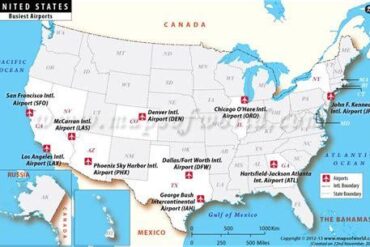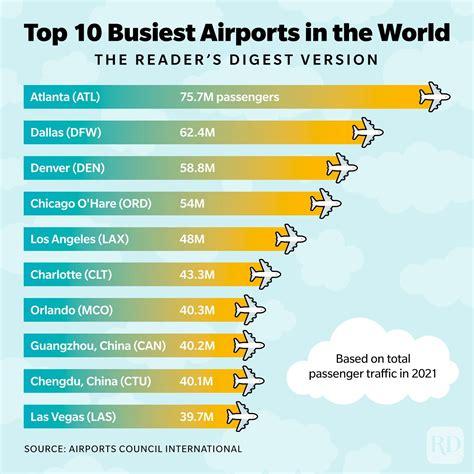
With nearly one billion passenger enplanements annually across the United States, the competition among the busiest airports in the US is fierce, multi-dimensional, and full of surprises. From passenger volume to daily flights, aircraft movements, and number of airlines served, the data reveals a layered picture of how American airports operate at capacity — and beyond.
At the heart of this aviation surge stands Atlanta Hartsfield-Jackson International Airport (ATL). As of 2025, ATL reigns supreme in passenger numbers, aircraft movements, and seasonal travel intensity. But does its dominance extend to other metrics like total square footage or the number of daily flights? Not entirely. To uncover the full spectrum of what defines the busiest US airports, we dive into authoritative figures and expert observations.
Atlanta Hartsfield-Jackson: A Passenger Volume Powerhouse
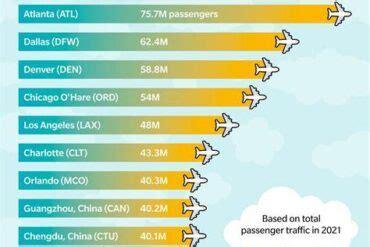
In 2023, 104.7 million travelers passed through ATL, accounting for a staggering 11.1% of all US passenger traffic, according to the FAA. That figure wasn’t just impressive—it was unmatched worldwide, outpacing even Dubai International Airport, which clocked in at 92.3 million.
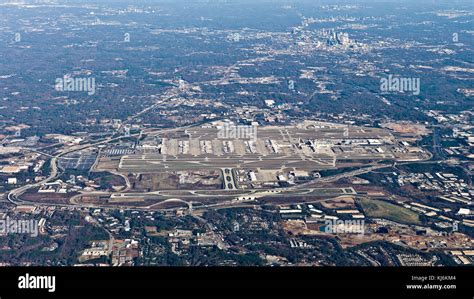
Beyond its global standing, ATL’s 2024-2025 holiday season saw 3.7 million passengers during a two-week period—a feat that highlights both logistical prowess and overwhelming demand. The airport’s response? A sophisticated public relations campaign, including the launch of a dedicated podcast, Under the Canopy, celebrating stories from the world’s busiest airport.
Mayor Andre Dickens encapsulated the airport’s civic pride, stating, “Hartsfield-Jackson is not only a critical asset for our city but also for the global aviation community.” And yet, despite such traffic, ATL is far from being the largest airport geographically, occupying just 7.34 square miles.
Daily Flight Volume: O’Hare Takes the Crown
If we shift the focus to daily flights, Chicago O’Hare International Airport (ORD) becomes the dominant player. In January 2025, ORD averaged 815 daily departures, topping ATL’s 786. With nearly 200 domestic destinations and 278 total destinations, O’Hare’s tight scheduling and expansive reach make it the go-to choice for time-conscious travelers.
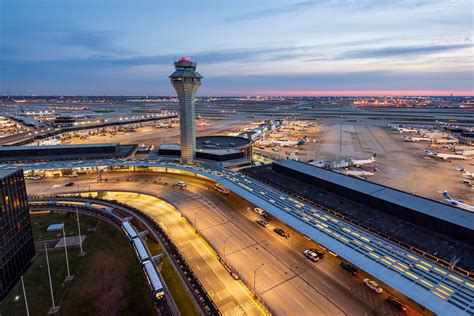
ATL, while second in daily flights, faces stiff competition from Dallas Fort Worth (DFW) and Denver International (DEN), which also surpass 700 flights per day. Interestingly, Charlotte Douglas International Airport (CLT), often underrated, enters the top five with 671 flights daily, reinforcing the role of regional hubs in national air travel.
Aircraft Movements: Another ATL Victory
In terms of aircraft movements—a key operational metric encompassing takeoffs and landings—ATL again leads the pack with 775,818 annual movements in 2023. It’s a crucial indicator of logistical density and operational stamina.
Following closely are:
- Chicago O’Hare – 720,582 movements
- Dallas Fort Worth – 689,569 movements
- Denver International – 657,218 movements
- Harry Reid International (Las Vegas) – 611,806 movements
The volume of aircraft movements tells us not just about passenger throughput but also about cargo traffic, regional connections, and international linkages. These figures prove ATL’s resilience not just as a Delta hub, but as a national logistical centerpiece.
The Most Connected: JFK and the Airline Spread
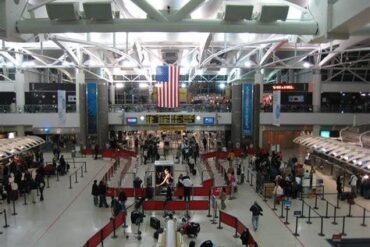
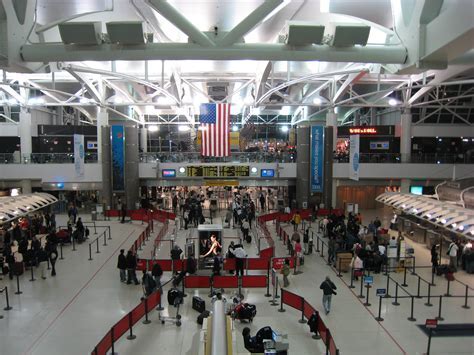
For global connectivity and airline diversity, no airport matches New York’s John F. Kennedy International Airport (JFK). Hosting over 90 airlines, JFK serves as a primary bridge between the United States and global capitals.
Other notable contenders include:
- Miami International (MIA) – 80+ airlines
- Chicago O’Hare (ORD) – 48 airlines
- Los Angeles International (LAX) – 40+ airlines
In stark contrast, ATL, despite its passenger dominance, hosts just 31 airlines, showing that volume and variety are not necessarily correlated. JFK’s status as a transatlantic and transpacific gateway gives it unmatched strategic value, especially for international travelers and multi-leg itineraries.
Biggest by Land? Denver Claims the Space
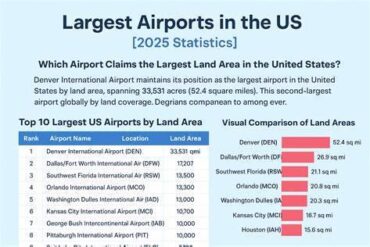
Size often misleads in aviation metrics. The biggest airport in the US by area is not ATL, but Denver International Airport (DEN), which spans an eye-watering 52.4 square miles — nearly seven times the size of ATL.
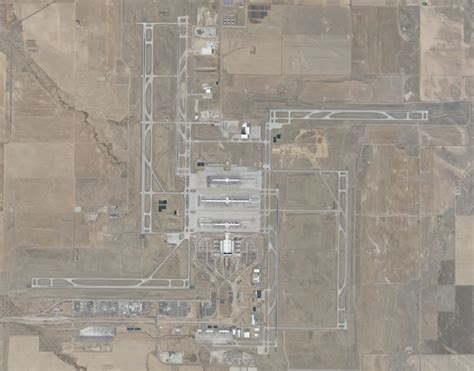
DEN’s terminal size is modest—just 2.6 million square feet—especially when compared to LAX’s 9 terminals and DFW’s 5 terminals, but its footprint allows for future scalability, robust weather handling, and logistical maneuverability that few others can match. It’s the second-largest airport in the world and stands as a testament to American infrastructural ambition.
Other spatial giants include:
- Dallas Fort Worth – 26.9 sq mi
- Orlando International – 20.8 sq mi
- Washington Dulles – 20 sq mi
- Houston Bush Intercontinental – 15.6 sq mi
Yet, as the data shows, size doesn’t equate to crowding. Denver may be vast, but in terms of passenger volume, it ranks third behind ATL and DFW.
Are Bigger and Busier the Same Thing? Not Quite
Our analysis across passenger volume, daily flight count, aircraft movements, number of airlines, and airport size reveals nuanced insights. While ATL stands out as the definitive leader in throughput, it is not the biggest in size nor the most diverse in airline partnerships.
Meanwhile, ORD leads daily flights, JFK rules airline diversity, and DEN commands the most space. These airports define “busyness” in different dimensions:
- ATL = Most passengers + most aircraft movements
- ORD = Most daily flights
- JFK = Most airlines
- DEN = Largest in size
Each metric provides a unique window into how American aviation hubs operate, adapt, and evolve.

The takeaway? There is no single definition of “busiest.” For travelers, this means that choosing an airport involves more than just counting passengers. It’s about connections, efficiency, layout, crowd handling, and international accessibility.
Conclusion: Navigating the Giants of US Aviation
The data from 2025 makes it abundantly clear: Hartsfield-Jackson Atlanta International Airport remains the beating heart of US air travel, but it coexists within a network of regional titans each excelling in their own right. From Chicago’s intricate flight web to JFK’s global connectivity and Denver’s sprawling infrastructure, the American airport ecosystem is both competitive and complementary.
For travelers and industry professionals alike, understanding these dynamics is essential for better planning, smoother transits, and recognizing the marvel that is modern air travel in the United States.