Satellite imagery circulating since early September 2026 shows a roughly 656-foot vessel with a 98-foot beam taking shape inside a 1,115-foot-class dry dock in China, and naval analysts in the West are increasingly convinced the hull is no ordinary auxiliary ship. Its defining features — a large internal hangar forward of a well deck, multi-layer deck structures with ramps reminiscent of car carriers, and pole-like fittings arrayed along the upper hull — point to a purpose-built XLUUV mothership designed to launch, recover, and maintain extra-large uncrewed underwater vehicles far from home waters. If that reading is correct, China would be fielding the undersea equivalent of its airborne drone mothership, a mobile forward base capable of sustaining robotic submarines on patrol near an adversary’s coastline rather than tethered to a distant port.
What Satellite Imagery Reveals About Beijing’s XLUUV Carrier
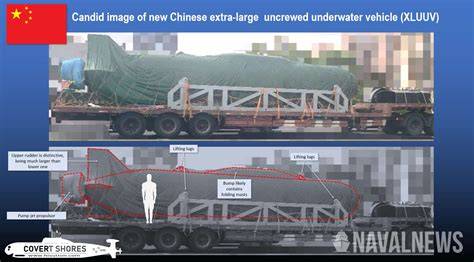
Because China does not publish technical dossiers on its military programs, outside experts have reconstructed the vessel’s purpose from overhead photographs alone, measuring deck geometry, hatch placement, and hull proportions against known Chinese designs. The most striking clue is the cavernous hangar capable of sheltering as many as four XLUUVs, a capacity that would let a single hull rotate multiple drones through surveillance, minelaying, or strike missions while keeping the others submerged. The ship’s overall silhouette echoes a deep-sea research submersible China unveiled in 2025 — visually kin to the ill-fated OceanGate Titan — but at vastly greater scale, and with an enclosed internal hangar replacing an open-deck cradle for the submersible.
How a Floating Hangar Sustains Drone Submarines at Sea
The strategic logic of the design rests on recovery, not just launch. A mothership that can steam to a contested region, release its XLUUVs for days or weeks of work, then hoist them back aboard for repair, recharging, and reloading compresses the logistics chain that currently cripples long-range uncrewed operations. Rather than returning drones to a distant base, the vessel itself becomes the base — a forward-deployed node able to keep underwater assets in operation for extended periods along an enemy’s shoreline. That endurance transforms UUVs from expendable adjuncts into persistent sensors and weapons platforms, and it is precisely the capability Western navies have struggled to field at scale.
China’s XLUUV Fleet Is Already at Sea
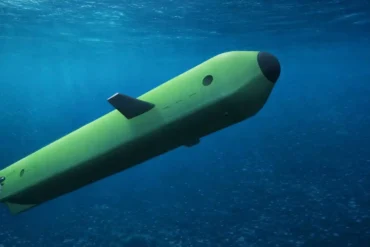
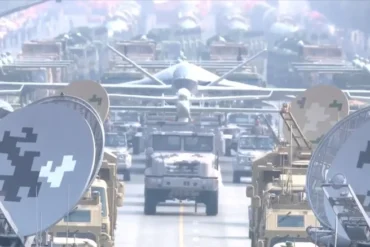
The mothership is not arriving into a vacuum. At the 2025 Victory Parade, China publicly displayed two operational XLUUVs measuring between 59 and 66 feet long, and reporting suggests Beijing has been testing prototypes roughly twice that length. XLUUVs are generally defined as spanning 20 to 82 feet, and China’s parade hulls sit comfortably in the upper range. What little the West knows about these boats suggests China leads the world in XLUUV development — and may now be extending that lead into the mothership category itself.
Why Undersea Drone Motherships Could Trigger a Naval Arms Race
Militarized drones have flown, walked, driven, and floated for decades, and the Russo-Ukrainian War demonstrated how rapidly unmanned systems can reshape a battlefield. Submersible drones are the newest frontier, and a functioning mothership would mark a genuine rupture in undersea warfare: naval planners who assumed UUVs were short-legged curiosities must now contend with robotic wolf packs staging from a mobile hangar. The likely consequence is an underwater drone arms race as rival navies scramble to build comparable hosts and countermeasures, racing to match a capability China appears to be fielding first.