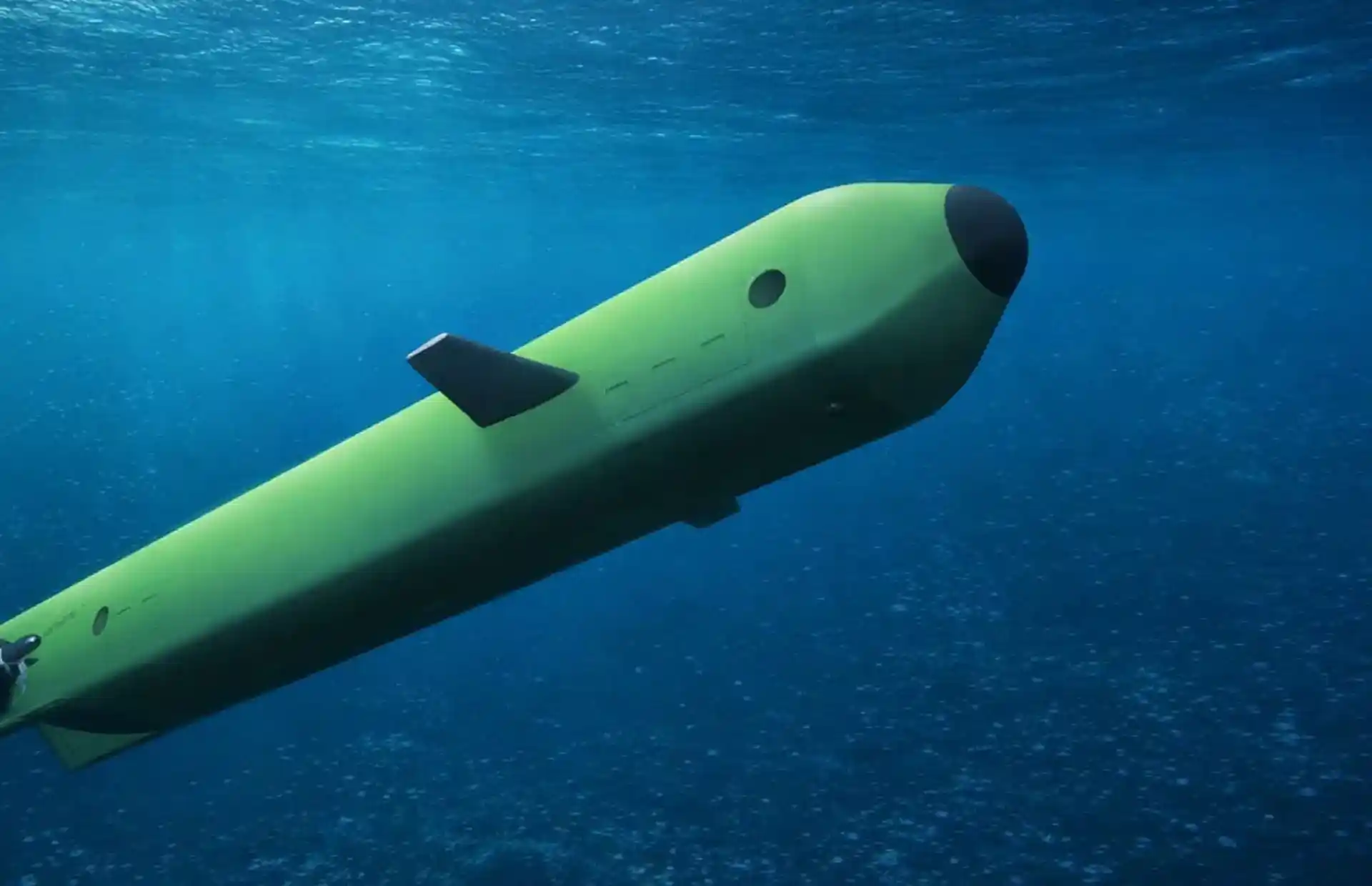
Lockheed Martin has formally introduced the Lamprey Multi-Mission Autonomous Undersea Vehicle (MMAUV), a modular combat drone engineered to deploy torpedoes, acoustic decoys, and unmanned aerial vehicles from beneath the surface. Announced on February 9, 2026, the platform represents a deliberate move toward scalable, forward-positioned undersea combat power that reduces operational strain on crewed submarines while expanding maritime reach in contested waters.
The Lamprey is not positioned as a traditional survey-oriented autonomous underwater vehicle. Instead, it is designed as a weapons-capable, plug-and-play undersea system optimized for assured access and sea denial. Its architecture centers on flexibility, allowing operators to configure payloads based on mission requirements. By combining strike capability, deception systems, and cross-domain drone launch functionality in a single hull, the platform shifts the perception of unmanned underwater vehicles from passive observers to active combat participants.
The strategic logic behind Lamprey’s unveiling is clear. Submarines remain among the most potent assets in naval warfare, yet they are finite, expensive, and politically sensitive. Forward-deployed unmanned systems offer persistence without equivalent risk. Lamprey fits into this calculus as a distributed maritime operations enabler, extending sensor and strike envelopes while preserving crewed assets for decisive engagements.
Hitchhike Deployment Concept Redefines UUV Endurance
The defining engineering innovation of the Lamprey lies in its “hitchhike” deployment model. Unlike many autonomous underwater vehicles that require dedicated launch infrastructure, Lamprey can attach to a host surface ship or submarine without structural modifications. It rides into theater as a passive payload, arriving with fully charged batteries and ready for independent operation.
To overcome the long-standing trade-off between endurance and payload capacity, Lockheed Martin incorporated onboard hydrogenator technology to recharge batteries while attached to the host vessel. Complementing this is a hydrogenerator concept designed to harvest energy during transit. Together, these systems extend operational endurance beyond what is typical for mid-sized unmanned underwater vehicles.
This approach effectively transforms Lamprey into a forward-deployed undersea magazine. Rather than expending submarine time and reactor hours on persistent patrol, naval commanders can detach Lamprey units at strategic points, allowing them to operate autonomously for surveillance, disruption, or strike missions. The result is operational mass without proportional increases in fleet size.
Modular Payload Architecture with 24 Cubic Feet of Combat Space
Lamprey’s internal design emphasizes payload flexibility. The vehicle features a 24 cubic foot open-architecture mission bay, providing significant internal volume for effectors rather than limiting the platform to sensors alone. This design choice signals a doctrinal shift toward autonomous systems as active force multipliers.
Lockheed frames Lamprey’s mission set around three primary functions: deploy, deny, and disrupt. Deployment refers to host integration and in-transit recharging. Denial includes torpedo launch capability and UAV deployment. Disruption centers on acoustic deception and sensor confusion.
This modularity allows rapid reconfiguration. A Lamprey unit could be outfitted for ambush strike missions in one deployment and reconfigured as a deception-focused platform in another. The open architecture also positions the system for integration with emerging effectors, ensuring adaptability as naval technologies evolve.
Torpedo Integration Elevates Autonomous Lethality
The inclusion of lightweight anti-submarine torpedoes distinguishes Lamprey from most existing autonomous underwater platforms. Integrating kinetic weapons within the hull requires structural reinforcement, internal ejection mechanisms, and fire control synchronization capable of autonomous or remotely authorized engagement.
Public renderings indicate internal torpedo storage rather than externally mounted ordnance, preserving hydrodynamic efficiency and acoustic discretion. This configuration suggests Lamprey is intended not merely as a decoy or scout but as a genuine combat shooter.
Such capability introduces a new layer of tactical complexity. An adversary tracking a manned submarine may instead encounter an autonomous platform capable of returning fire. In contested littoral environments, this ambiguity complicates targeting decisions and increases the cognitive load on opposing anti-submarine warfare units.
Submerged Launch of UAVs Enables Cross-Domain Operations
Beyond torpedoes, Lamprey incorporates retractable twin-tube launchers capable of deploying small unmanned aerial systems. Concept imagery depicts configurations supporting up to three twin-tube arrays, implying a notional capacity of six drones.
The ability to launch UAVs from a submerged platform creates cross-domain operational effects. Once airborne, these drones can conduct intelligence, surveillance, and reconnaissance missions, relay targeting data, or potentially deliver precision strike payloads. This fusion of underwater stealth with aerial reach blurs traditional domain boundaries.
In practical terms, a Lamprey unit operating near contested coastlines could surface briefly, deploy drones to map enemy positions or identify high-value targets, then submerge while transmitting collected data to allied ships or submarines. The synergy between submerged autonomy and aerial ISR extends fleet awareness without exposing crewed platforms.
Acoustic Decoys and Battlespace Shaping
Equally consequential is Lamprey’s capacity to deploy mobile acoustic decoys. These expendable devices can replicate submarine signatures, generate broadband noise, simulate active sonar returns, and produce echo patterns that mimic real vessels.
In operational environments saturated with sensors, deception becomes as critical as firepower. By dispersing convincing acoustic impostors, Lamprey can stretch an adversary’s search geometry, induce premature torpedo launches, and dilute anti-submarine warfare resources. This function transforms the undersea battlespace into a dynamic environment of ambiguity and misdirection.
Decoys also serve defensive roles. A Lamprey tasked with escorting a high-value unit could deploy acoustic diversions to shield friendly assets during transit. In chokepoints or contested straits, the cumulative effect of multiple decoys can create uncertainty disproportionate to their cost.
Networked Integration and Distributed Maritime Operations
Operational concepts indicate Lamprey can function in dual modes. In assured access missions, it inserts covertly, conducts persistent surveillance, and maintains the option to engage once authorized. In sea denial roles, emphasis shifts to deception, electronic disruption, and targeted strike.
A communications mast near the surface enables secure data transfer, while potential integration with seabed nodes supports persistent networking. This aligns with the distributed maritime operations doctrine, which emphasizes dispersal, redundancy, and cross-platform connectivity.
Under this framework, Lamprey operates as part of a wider mesh of sensors and shooters. Data gathered by its onboard systems or deployed UAVs can feed directly into fleet combat networks. Conversely, it can receive tasking updates in near real time, enhancing responsiveness without sacrificing stealth.
Strategic Context: Addressing Submarine Scarcity
The introduction of Lamprey reflects broader structural pressures in naval force planning. Submarines are highly capable but limited in number. Construction timelines stretch across years, and maintenance cycles constrain availability. Meanwhile, adversaries are investing heavily in seabed sensors, anti-access networks, and maritime surveillance grids.
Lamprey offers a way to generate undersea presence without expanding submarine fleets at equivalent cost. For the U.S. Navy and allied forces, it complements platforms such as the Virginia-class by extending operational reach and providing expendable forward presence. For smaller navies, it presents a comparatively affordable pathway to credible coastal sea denial and chokepoint control.
The platform also fits within a global shift toward autonomous warfare systems. From aerial drones to unmanned surface vessels, militaries are embracing distributed, attritable assets capable of absorbing risk. Lamprey extends this philosophy beneath the surface.
Positioning Within the Unmanned Undersea Ecosystem
Compared to Boeing’s Orca XLUUV, a 51-foot extra-large unmanned submarine optimized for endurance and heavy payload missions, Lamprey occupies a more tactical niche. Orca emphasizes strategic-scale operations such as seabed mining or long-duration patrols. Lamprey prioritizes fleet integration, modularity, and rapid deployment.
On the smaller end, platforms like Anduril’s Dive-LD or Saab’s Sabertooth focus largely on sensing and infrastructure tasks. Lamprey diverges by centering on weaponized autonomy, combining torpedoes, decoys, and UAV launch capability within a single system.
This positioning underscores its intended role as a combat enabler rather than a specialized survey tool. The fusion of ISR, deception, and kinetic strike in one modular vehicle suggests a deliberate move toward integrated undersea lethality.
Implications for Future Seabed Warfare
As great power competition intensifies in maritime theaters, undersea domains are becoming increasingly contested. Seabed infrastructure, submarine cables, and forward operating areas are all vulnerable to disruption. Autonomous systems capable of persistent presence and rapid reconfiguration will likely define this evolving environment.
Lamprey represents a calculated evolution in undersea warfare doctrine. By combining stealth, modular firepower, and cross-domain integration, it expands the options available to naval planners. If operationalized at scale, it could reshape deterrence dynamics by introducing ambiguity and distributed lethality beneath the waves.
In an era where control of the maritime domain increasingly hinges on sensors, networks, and autonomy, the Lamprey MMAUV signals that the undersea battlespace is no longer reserved solely for crewed submarines. It is becoming a layered, interconnected arena where unmanned systems operate as both scouts and shooters, shaping outcomes long before the first visible confrontation occurs.