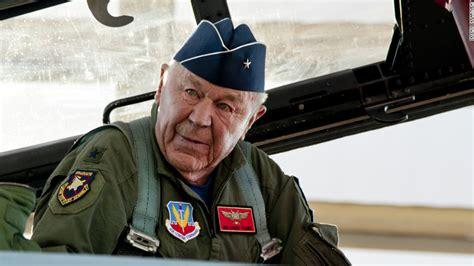
Brigadier General Charles Elwood “Chuck” Yeager was not merely a man of his era—he was a man ahead of it. Born on February 13, 1923, in the humble town of Myra, West Virginia, and raised in nearby Hamlin, Yeager’s trajectory would become one of the most influential and defining paths in the history of aviation. Rising from mechanic to global legend, Yeager’s name is etched not just in military history but in the very boundaries of what was once thought possible.
From his fearless exploits as a World War II fighter ace to his legendary supersonic flight and decades of service across multiple theaters of conflict and aerospace advancement, Yeager symbolizes the relentless pursuit of excellence in aviation. His journey is not just a personal story but a chronicle of American ambition, courage, and innovation.
From Ground Crew to Ace in the Sky: Yeager in World War II
Chuck Yeager’s aviation career began on the ground, quite literally. Enlisting in the U.S. Army Air Forces in 1941, he initially served as an aircraft mechanic, a role that grounded him in the intricacies of the machines he would soon master in the skies. With the rapid expansion of the wartime pilot training program, Yeager seized the opportunity, earning his pilot wings in March 1943.
Assigned to the 363rd Fighter Squadron, Yeager flew the iconic P-51 Mustang, quickly distinguishing himself as a natural flyer with deadly precision. His keen instincts and lightning-fast reactions led to 11½ confirmed aerial victories, with one of the most astonishing feats occurring on October 12, 1944. That day, Yeager shot down five German Me 109s in a single mission, a feat that earned him the coveted status of “ace in a day.” Two of those kills were achieved without firing a single round—he forced the enemy pilots into fatal errors with daring maneuvering.
The Sound Barrier Falls: Bell X-1 and Supersonic Glory
Following the end of World War II, Yeager joined the elite ranks of test pilots at Muroc Army Air Field (later Edwards Air Force Base). At a time when jet propulsion and high-speed flight were rewriting the laws of aerodynamics, Yeager stood at the forefront.
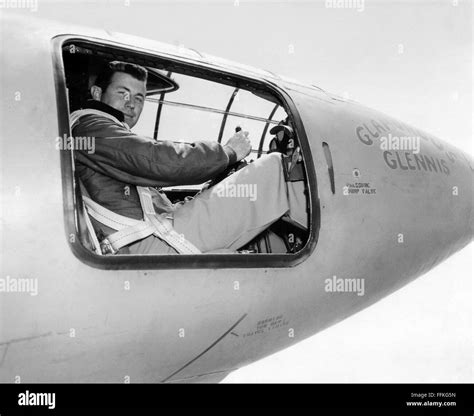
On October 14, 1947, piloting the rocket-powered Bell X-1, affectionately named “Glamorous Glennis” after his wife, Yeager soared to an altitude of 45,000 feet and accelerated to Mach 1.05, becoming the first human to break the sound barrier in level flight. This moment—fueled by courage, innovation, and extraordinary skill—ushered in the jet age, forever altering the scope of aviation and aerospace.

The recognition was swift and profound. Yeager received the Collier Trophy and Mackay Trophy in 1948, both of which honored exceptional feats in aviation. Yet he was far from done. In subsequent years, he flew the Bell X-1A to Mach 2.44, enduring and surviving a harrowing inertial coupling incident that could have easily claimed his life. Instead, it solidified his place as a titan of test flight.
Leadership Beyond the Cockpit: Training America’s Best
As the space race began to gather momentum, Yeager’s expertise was redirected toward shaping the next generation of elite pilots. In 1962, he became the first commandant of the USAF Aerospace Research Pilot School. This institution was not just a proving ground for military test pilots—it was also instrumental in preparing future NASA astronauts.
Under Yeager’s leadership, the school gained prestige and a reputation for rigorous excellence. Though Yeager himself was not selected for the astronaut program due to his lack of a college degree, his contributions were pivotal in building the framework that helped propel America’s space exploration ambitions.
Combat Missions and Cold War Duties
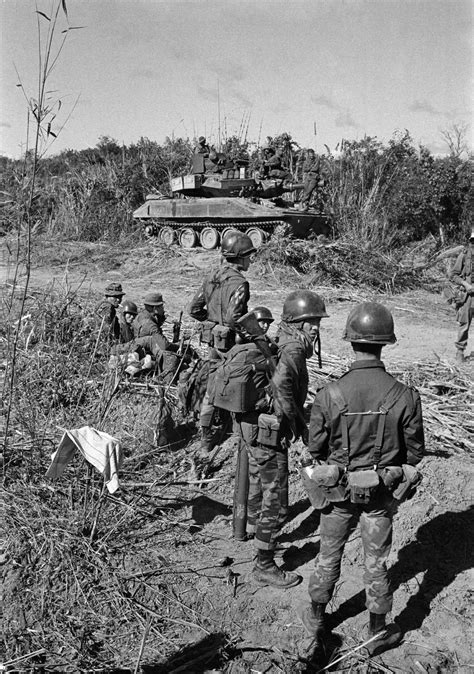
Despite his fame as a test pilot, Yeager’s role as a combat leader was equally formidable. During the Vietnam War, he commanded fighter squadrons and wings, logging an impressive 127 combat missions. Whether flying over Europe during the Cold War or leading missions in Southeast Asia, Yeager remained at the forefront of aerial tactics and command strategy.
In 1969, he was promoted to Brigadier General, cementing his status not only as a legendary pilot but also as a high-ranking officer. Among his diplomatic and strategic roles, he served as Vice-Commander of the Seventeenth Air Force and later became the U.S. Air Attaché in Pakistan during the tense period of the 1971 Indo-Pakistani War. His insights and advisory presence during this conflict demonstrated the multifaceted importance of military aviators in broader geopolitical contexts.
A Legacy in Flight: Post-Retirement Contributions
Chuck Yeager officially retired from active duty on March 1, 1975, closing out a career that spanned over three decades. Yet, retirement did not mark an end to his influence. Over his lifetime, he flew more than 360 different aircraft types, a testament to his extraordinary adaptability and aeronautical mastery.
In the years that followed, Yeager remained a beloved and visible figure in the aviation community. He consulted on flight simulator technologies, appeared in documentaries and films (including a cameo in The Right Stuff), and commemorated his historic supersonic flights with anniversary reenactments well into his later years.
His contribution to the Air Force and to aviation as a whole remained so vital that he continued as a consultant to the USAF, shaping policies and mentoring pilots even after his active service concluded.
Honors, Recognition, and Enduring Impact
Yeager’s accolades were as vast as the sky he once ruled. In 1973, he was inducted into the National Aviation Hall of Fame, solidifying his place among the greatest to ever take flight. His medal rack included the Air Force Distinguished Service Medal, Silver Star, Distinguished Flying Cross, and the Congressional Silver Medal, each a testament to specific acts of heroism, innovation, and excellence.
His influence extended beyond medals. Yeager became a symbol of the American spirit—undaunted, visionary, and pioneering. His name graces schools, museums, and airfields, and his story is told not just in military history, but in the broader chronicles of 20th-century achievement.
The Man Behind the Legend
Though known for his fearlessness and tactical brilliance, Yeager was also a devoted family man. He married Glennis Dickhouse in 1945, and together they raised four children. Her name adorned not only his aircraft but also many of his personal reflections and dedications. Following her passing in 1990, Yeager found companionship again, marrying Victoria Scott D’Angelo in 2003.
In his later years, Yeager settled in Grass Valley, California, where he remained until his passing on December 7, 2020, at the age of 97. Even in death, his memory soared, celebrated by presidents, pilots, and citizens alike as the man who quite literally broke the sky open for all who would follow.
Conclusion: A Life That Redefined the Possible
Chuck Yeager’s life was one of uncompromising daring and visionary excellence. From his early days as a mechanic to his historic flight into the sound barrier, from training future astronauts to commanding missions in wartime skies, Yeager embodied the apex of aerial achievement. His career reflects not only personal valor but also the evolution of flight itself—from piston-powered fighters to supersonic jets, and into the space age.
As we look to the future of aerospace and beyond, the legacy of Chuck Yeager serves as a guiding star—a reminder that boundaries exist only to be challenged and that with skill, courage, and vision, the sky is never the limit.