Coded Departure Route (CDR)
In the United States and Canada, Coded Departure Routes, or CDRs, are preplanned alternative routes between specific city pairs. These routes can be activated quickly during traffic constraints like thunderstorms, turbulence, or high demand periods. CDRs are precoded in the Air Traffic Control (ATC) system and can be easily issued as revised clearances to flight crews of CDR-capable aircraft. This allows departures from their origin point with minimal delays via alternate routes.
Background
Traffic congestion or local weather events, such as severe thunderstorms or turbulence, can temporarily make certain airspace segments unsuitable for use. This situation can negatively impact departure traffic if flights are routed through the affected areas. To address this issue, the first CDRs were developed in the late 1990s. The CDR program includes preplanned alternative departure routes, coding, dissemination of information, and a re-clearance process to avoid any sector facing temporary restrictions. Initially, only commercial air carriers that signed a memorandum of understanding (MOU) could use these routes, but the program has expanded to include general aviation (GA) traffic.
CDR Identification
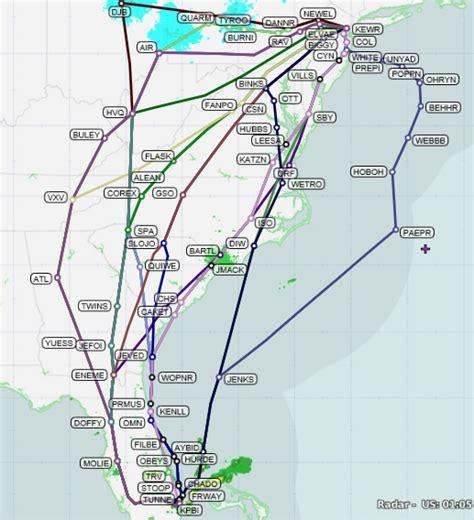
Each CDR has a unique eight-character alphanumeric code. The first three characters identify the departure airport, the next three indicate the arrival airport, and the last two differentiate various route options between the cities. For instance, all CDRs between Newark Liberty International Airport, NJ (KEWR), and Palm Beach International Airport, FL (KPBI) will be coded EWRPBIxx, where “xx” specifies a particular route from a group of CDRs. At the time of writing, the CDR identifier EWRPBI64 corresponded to the route KEWR NEWEL J60 DANNR RAV J64 BURNI TYROO QUARM AIR HVQ BULEY J91 ATL YUESS Q79 MOLIE WLACE4 KPBI. While a coded route can be filed as the proposed flight route, the eight-character code itself cannot be used for this purpose; the full route must be included in the flight plan.
Scope
The scope of the CDR program is extensive. Most city pair combinations between major airports in the United States and Canada have preplanned CDRs. Typically, there are multiple CDR options for each city pair to allow rapid adjustments when a specific ATC sector is closed or saturated. For example, at the time of writing, there were six CDRs between Newark and Toronto/Lester B. Pearson International Airport, 20 between Newark and Palm Beach, and 53 different coded routes between Newark and Los Angeles International Airport. Across the United States and Canada, there are more than 36,000 preplanned CDRs, all subject to review and amendment in the normal 56-day chart amendment cycle for instrument flight rules operations.
Benefits
The main advantage of using CDRs is to provide users with optional, preplanned alternative departure routes and associated procedures. This helps quickly reduce the impact of adverse conditions and minimize departure delays. Specifically, CDRs offer:
-
Alternative departure routes during periods of constraint or restriction. If a standard instrument departure (SID) or filed route becomes unavailable, pilots can obtain new departure instructions.
-
More routes to decrease departure delays when normal structures are unusable due to weather, ATC equipment outages, or other constraints.
-
An abbreviated ATC clearance format to reduce radio communication congestion and speed up the clearance delivery process.
Use of Coded Departure Routes
Communicating readiness to accept a coded route is straightforward for dispatchers and flight crews. When a potential delay or reroute arises at the departure airport due to thunderstorms, outages, or volume issues, the pilot-in-command can add “CDR CAPABLE” in the flight plan remarks. This indicates to ATC that they:
-
Are familiar with the CDR program.
-
Have an updated list of available CDRs on board.
-
Can accept changes to the filed route.
-
Have the necessary navigation equipment for the new route.
-
Have enough fuel for the new route.
To access a list of all CDRs connecting a city pair, visit the FAA Air Traffic Control System Command Center Route Management Tool website. Input the origin and destination airports and click “Submit Search Terms” to generate a list of CDRs, including both the alphanumeric code and full route details, along with navigation capability requirements. Commercial flight planning services often include a selectable “CDR” option, automatically generating the “CDR CAPABLE” notation and appending all CDR route information, including fuel calculations for each potential route.
ATC Clearance
The content and format of the ATC clearance depend on how it is transmitted to the flight crew, when it is sent, and the tactical situation as departure time approaches. Usually, the initial clearance, received via datalink or voice, is standard via the filed route. However, an aircraft operator indicating “CDR Capable” may receive a CDR routing as part of its initial clearance. The CDR program is designed to support abbreviated clearances. An ATC initial clearance via a CDR might say, “N265C, cleared to West Palm Beach via EWRPBI64, depart RW 22R, NEWARK 3 departure, squawk 4673.” An amended clearance could be communicated as, “N265C, cleared to West Palm Beach via EWRPBI64, remainder of the route unchanged.” In either case, the flight crew will read back using the same abbreviated format. The controller can always opt to issue a full route clearance instead of using the CDR identifier. If there’s any uncertainty about the routing, the pilot should clarify and request a full route clearance if needed.