Destructive and Non-Destructive Testing (DT and NDT) are vital techniques used to evaluate the integrity, performance, and safety of materials, components, and structures. While both methods aim to ensure the reliability of products across various industries, their approaches, advantages, and limitations differ significantly. In this article, we will explore the core principles of both testing methodologies, common techniques, applications, and the respective pros and cons associated with each method.
What is Destructive Testing?
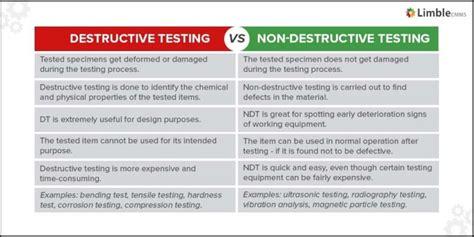
Destructive testing (DT) refers to a range of tests where materials or components are subjected to extreme conditions until they fail or are permanently altered. The purpose is to measure the material’s behavior under stress and determine key properties like tensile strength, impact resistance, and more. These tests provide definitive data about the material’s limits and performance.
Destructive testing is often employed in scenarios where the failure of a sample is not only acceptable but necessary to gain a complete understanding of its behavior under stress. Common types of destructive testing include:
- Corrosion Testing: Materials are exposed to corrosive environments like saltwater or acid to understand their resistance to deterioration over time.
- Fatigue Testing: This process involves cyclic loading, simulating the effects of repeated stress on a material to predict its life expectancy under operational conditions.
- Impact Testing: Materials are subjected to sudden, high-force impacts to determine their toughness and resistance to shock loading. Tests like the Charpy and Izod impact tests are typical methods used.
- Tensile Testing: This test applies controlled tension to a material until it breaks, providing data on its yield strength, elongation, and other critical properties.
- Compression Testing: Used to evaluate the material’s response to compressive forces, helping engineers determine its behavior under crushing conditions.
- Hardness Testing: This measures a material’s resistance to indentation, providing insights into its durability and wear resistance.
- Torsion Testing: A test in which a twisting force is applied to a material to evaluate its shear strength.
- Residual Stress Testing: This involves measuring the stress that remains in a material after it has been subjected to various forces or processes.
What is Non-Destructive Testing?
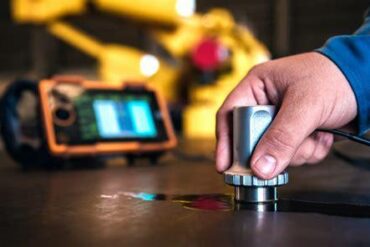
Unlike destructive testing, non-destructive testing (NDT) allows for the examination and evaluation of materials, components, and structures without causing damage or altering their properties. NDT is crucial in applications where testing must not compromise the integrity of the tested objects. It allows repeated inspections and ensures that products remain functional post-inspection.
Common types of non-destructive testing include:
- Ultrasonic Testing: High-frequency sound waves are sent through a material, and the reflections are analyzed to detect internal flaws like cracks or voids.
- Magnetic Particle Testing (MPT): Used for detecting surface and near-surface flaws in ferromagnetic materials. A magnetic field is applied to the material, and particles are attracted to defects, making them visible.
- Eddy Current Testing: This technique uses electromagnetic induction to detect surface cracks and measure coating thickness. It’s particularly effective for inspecting conductive materials like metals.
- Acoustic Emission Testing: This method listens for stress waves generated by materials under pressure, load, or heat, which helps identify structural weaknesses.
- Visual Inspection: Simple yet effective, this method involves direct observation of a material’s surface using the naked eye or magnification tools.
- Dye Penetrant Testing: A liquid penetrant is applied to the surface, and after cleaning, any flaws are highlighted by the presence of dye in the cracks.
The Pros and Cons of Destructive and Non-Destructive Testing
Both DT and NDT have distinct advantages and limitations. Choosing the appropriate testing method often depends on the specific application, the material being tested, and the goals of the inspection.
Pros of Destructive Testing:
- Provides Definitive Results: Since DT involves pushing materials to their breaking point, it offers highly accurate data about a material’s true performance limits.
- Comprehensive Insight into Material Properties: DT can assess parameters such as tensile strength, fracture toughness, and fatigue resistance, which are crucial for material selection and design.
Cons of Destructive Testing:
- Destructive Nature: The main downside of DT is that it permanently damages or destroys the test object, which can be impractical when dealing with expensive or irreplaceable components.
- Time and Cost Intensive: Performing destructive tests can be both time-consuming and costly, particularly when testing large quantities of materials or components.
Pros of Non-Destructive Testing:
- No Damage to Test Objects: The most significant advantage of NDT is that it doesn’t harm the tested materials, allowing for continuous use after testing.
- Cost-Effective: Because NDT methods do not destroy the material, they are more cost-efficient, especially in industries with high-value components.
- Versatility: NDT can be applied across a wide range of materials, including metals, composites, concrete, and more.
Cons of Non-Destructive Testing:
- Limited Detection of Internal Flaws: While NDT can detect surface and near-surface flaws, identifying deep internal issues can be challenging, particularly in complex materials.
- Requires Expertise: Effective interpretation of NDT results requires skilled technicians and the proper equipment, which can be a limitation in some settings.
Applications of Destructive and Non-Destructive Testing
Both destructive and non-destructive testing are widely used across various industries, from aerospace to automotive, construction, and beyond. The choice of method depends on the specific needs of the industry and the criticality of the components being tested.
In the aerospace sector, DT is typically used to assess the structural integrity of key components like wings, fuselage, and engine parts. The rigorous safety standards in aviation necessitate testing components under extreme conditions to ensure they can withstand the demands of flight. On the other hand, NDT plays a crucial role in inspecting components like turbine blades, welds, and fuselage joints for any hidden defects that could compromise safety.
In the automotive industry, destructive tests like crash simulations are used to evaluate vehicle safety. NDT techniques such as ultrasonic testing and radiographic inspection are used to assess engine parts, welds, and chassis components for internal defects that could jeopardize performance or safety.
The construction industry heavily relies on NDT methods to inspect concrete structures, steel reinforcements, and welded joints. Concrete testing for voids, cracks, or material degradation ensures the long-term stability of buildings and infrastructure.
In the oil and gas sector, non-destructive testing is essential for inspecting pipelines, storage tanks, and pressure vessels for corrosion, cracks, or leaks. These inspections help maintain the safety and efficiency of operations, ensuring that critical infrastructure remains reliable and functional.
Conclusion
Destructive and non-destructive testing are both indispensable in ensuring the quality, safety, and performance of materials and components in various industries. While destructive testing offers definitive data about material behavior and performance limits, non-destructive testing allows for the continuous use of tested objects without compromising their integrity. By understanding the strengths and limitations of both methods, industries can make informed decisions and implement the most appropriate testing strategies to meet their safety and quality requirements.