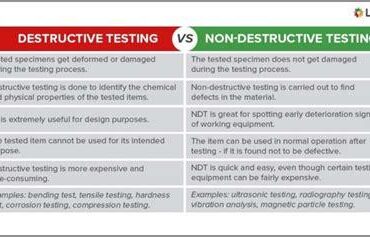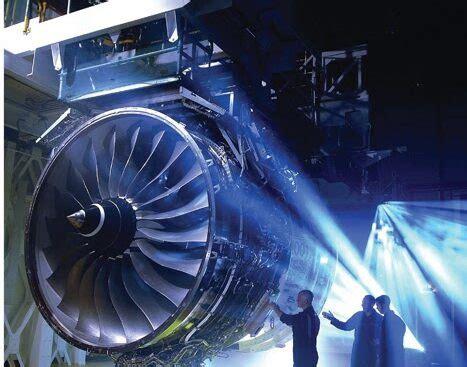
The aerospace industry demands an exceptional degree of precision, safety, and reliability. Every aircraft part, from fuselage panels to turbine blades, must perform flawlessly under extreme stress, pressure, and atmospheric variations. Non-Destructive Testing (NDT) plays a pivotal role in ensuring that components meet rigorous standards without compromising their structural integrity during inspection. As a cornerstone of aerospace maintenance, quality control, and manufacturing, NDT provides a silent yet powerful guarantee of safety.
We explore the essential role of NDT in aerospace, its critical methods, applications, and evolving technologies that are reshaping how aircraft stay airworthy.
Understanding the Importance of NDT in Aerospace
In aerospace, the margin for error is virtually non-existent. A microfracture in a turbine blade or a delaminated composite panel can lead to catastrophic failure. Non-Destructive Testing offers the ability to detect internal and surface-level defects without altering or damaging the material. This not only prevents potential failure but also extends the life cycle of high-value components.
From commercial airliners to military jets and space-bound modules, NDT assures structural soundness across every stage of the aircraft’s life: design validation, manufacturing quality assurance, operational inspection, and post-service evaluation. The application of NDT supports compliance with international standards such as NADCAP, AS9100, and FAA regulations, reinforcing industry-wide trust in aerospace safety.
Visual Testing (VT): The First Line of Inspection
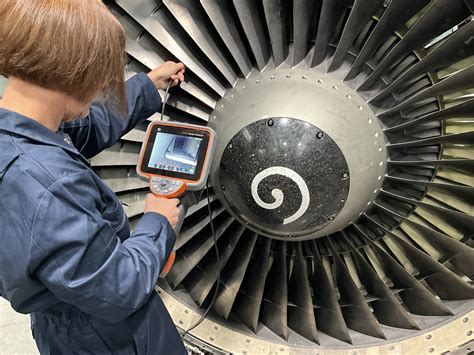
The Visual Testing (VT) process remains the foundation of all NDT protocols. Often regarded as the preliminary stage, it involves highly trained inspectors conducting visual evaluations to identify surface anomalies such as:
- Cracks
- Dents
- Surface corrosion
- Discoloration
- Misalignment
Technicians utilize tools such as borescopes, mirrors, magnifiers, and video-enhanced devices to penetrate areas that are visually inaccessible. For aerospace assemblies, especially in tight fuselage areas or within engine compartments, VT acts as a rapid, cost-effective first step before deploying more complex methods.
VT’s efficiency lies in its simplicity—but its accuracy relies entirely on inspector proficiency. Given that surface defects can often indicate deeper underlying issues, visual testing often dictates which parts proceed to advanced NDT.
Ultrasonic Testing (UT): Penetrating Beneath the Surface
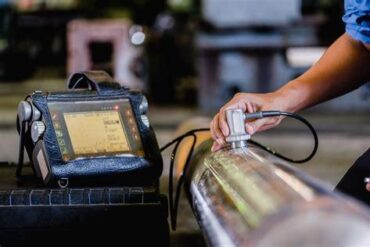
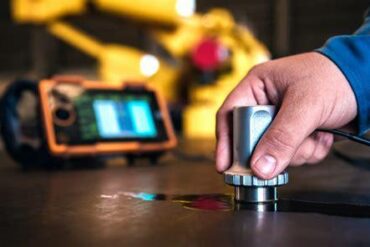
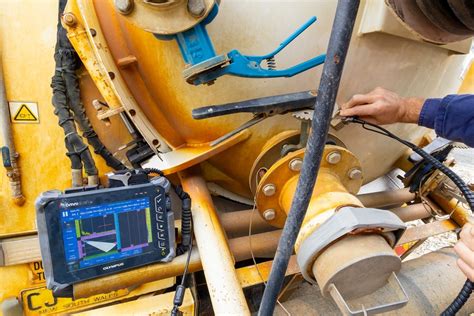
Ultrasonic Testing is one of the most commonly used advanced NDT techniques in aerospace. It relies on high-frequency sound waves introduced into the material. Variations in the signal’s reflection patterns can reveal subsurface discontinuities such as voids, inclusions, laminations, and fatigue cracks.
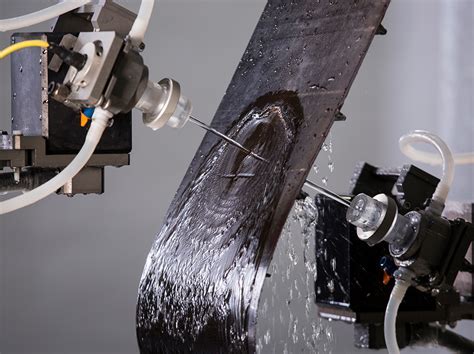
In aerospace structures—especially those using composite materials like carbon fiber reinforced polymers (CFRPs)—UT is vital. Traditional visual or dye penetrant methods cannot detect embedded delaminations or internal porosity. Ultrasonic phased array systems enable technicians to inspect large surfaces with high resolution, allowing real-time image generation and 3D defect mapping.
Applications of UT in aerospace include:
- Engine blades and rotors
- Wing spars and ribs
- Landing gear components
- Rocket and spacecraft fuel tanks
Radiographic Testing (RT): Imaging the Invisible
Radiographic Testing leverages either X-rays or gamma rays to penetrate aerospace materials and produce images that reveal internal structures. RT is particularly effective for detecting volumetric defects such as:
- Gas porosity in welds
- Shrinkage cavities
- Foreign inclusions
Digital radiography (DR) and computed tomography (CT) have revolutionized aerospace RT by providing enhanced resolution, faster processing times, and reduced radiation exposure. CT scans, in particular, allow full 3D reconstructions of parts, which is invaluable for complex geometries.
This method is widely used in evaluating:
- Cast titanium and aluminum components
- Missile and spacecraft fuel lines
- Welded joints in airframe assemblies
RT is especially critical in certifying aerospace parts made using additive manufacturing (3D printing), where internal defects are difficult to detect via traditional means.
Magnetic Particle Testing (MT): Revealing Surface and Near-Surface Cracks
Magnetic Particle Testing is utilized for detecting surface and slightly subsurface discontinuities in ferromagnetic materials. It works by inducing a magnetic field into the material and applying magnetic particles, which accumulate at areas of leakage fields—indicative of cracks or flaws.
MT is extensively used for inspection of:
- Steel landing gear struts
- Rotor shafts
- Brake discs
- Engine mounts
This method is quick, highly sensitive to fine cracks, and effective for complex geometries with varying cross-sections. It is often used during routine aircraft maintenance inspections where frequent, reliable checks are necessary.
Penetrant Testing (PT): Fluorescent Clarity for Surface Anomalies
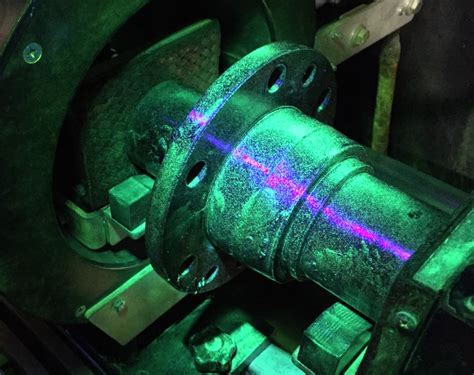
Penetrant Testing, also known as Dye Penetrant Testing, is ideal for detecting surface-breaking flaws in non-porous materials. The part is coated with a liquid dye that seeps into surface discontinuities, and after the excess is removed, a developer draws the penetrant back to the surface to form visible indications.
In aerospace, this method is widely applied to:
- Weld seams
- Turbine blades
- Aluminum and titanium panels
PT is especially valuable during manufacturing and maintenance phases. The fluorescent dye version under UV light offers enhanced visibility, even for microcracks invisible to the naked eye.
Eddy Current Testing (ET): Electromagnetic Precision for Conductive Materials
Eddy Current Testing uses electromagnetic induction to detect flaws in conductive materials without contact. It’s particularly effective for inspecting thin materials and layered structures, making it invaluable for detecting:
- Surface cracks
- Corrosion pitting
- Conductivity variations (indicative of heat damage or material mismatch)
ET is frequently used for assessing:
- Aircraft skin panels
- Fastener holes
- Heat-damaged composite repairs
This method allows technicians to perform high-speed scans with minimal preparation, making it ideal for both in-service inspections and manufacturing QA.
Emerging Technologies in Aerospace NDT
The future of aerospace NDT is driven by automation, digitalization, and data integration. Several emerging technologies are reshaping inspection workflows:
- Automated Robotics and Drones: These systems can perform VT, UT, and ET across large aircraft surfaces with precision and consistency, minimizing human error.
- Augmented Reality (AR) Interfaces: Real-time NDT overlays on smart goggles assist inspectors in navigating complex assemblies.
- Artificial Intelligence (AI) and Machine Learning: Predictive analytics using AI can analyze inspection data for defect classification and maintenance forecasting.
- Digital Twin Integration: NDT data feeds directly into digital twin models of aircraft for lifecycle tracking and predictive maintenance modeling.
These innovations not only improve inspection reliability but also align with the aerospace industry’s shift toward predictive maintenance and Industry 4.0 practices.
Conclusion: NDT as the Guardian of Aerospace Integrity
Non-Destructive Testing in aerospace is far more than a quality control tool—it is a sentinel of safety. By enabling comprehensive evaluations without damaging critical components, NDT ensures that aircraft continue to meet exacting safety, performance, and compliance standards.
As aircraft designs evolve with lighter composite materials, additive manufacturing, and integrated avionics, so too must the techniques we use to validate their integrity. The fusion of traditional NDT with digital intelligence and robotics signals a future where inspections are faster, smarter, and more reliable than ever before.
The sky may be the limit—but with NDT in aerospace, we make sure that every flight is a calculated assurance, not a gamble.