In the quiet hours before dawn on July 5, 2025, a routine Ryanair Boeing 737 departure at Palma de Mallorca Airport (PMI) transformed into a scene of intense alarm and swift action when a fire warning light illuminated in the cockpit at precisely 12:35 a.m. The warning, which proved to be false, nonetheless triggered an immediate emergency response from the flight crew, who followed protocol to the letter. Within seconds, the aircraft’s cabin filled with tension as 180 passengers braced for an ordeal they neither expected nor understood, while ground crews raced into position outside the gate.
From the moment the warning light flashed, communications between cockpit and tower crackled with urgency. The captain’s terse alert to air traffic control set in motion a chain of events that would test both human resolve and institutional readiness. Emergency services—already stationed on standby during overnight operations—sprang into action, mobilizing firefighters, paramedics, and airport police in a race against time. Yet, before hoses could be aimed or sirens silenced, the most critical response came from the passengers themselves, whose instinctive rush for safety would leave 18 individuals nursing sprains and bruises by night’s end.
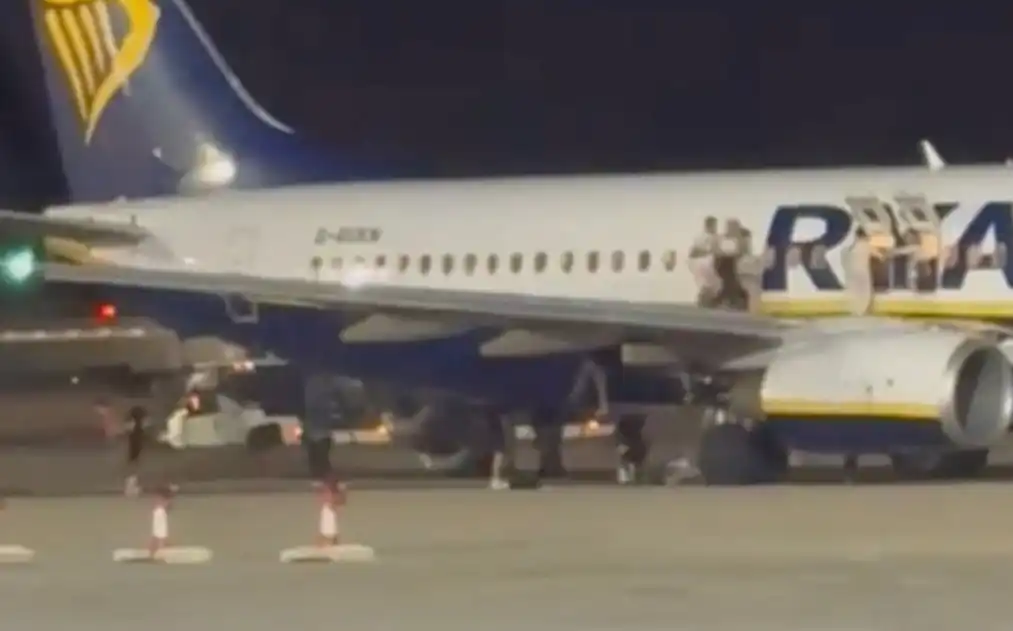
Eyewitness footage captured by fellow travelers and airport staff paints a stark picture of the chaos that unfolded on the tarmac. In an unusually unorthodox evacuation, passengers jettisoned their carry‑ons, hurdled emergency slides onto the wing, and leapt onto the runway below. The sight of frantic figures sprinting across concrete under the glow of floodlights, guided only by shouted instructions and emergency placards, underscored the visceral fear that gripped everyone on board. Despite the tumult, no flames were visible; yet the mere possibility of a spreading fire was enough to spark mass panic and immediate action.
Incident Overview at Palma de Mallorca Airport
At 12:35 a.m., the Boeing 737 stood parked at Gate A21, engines silent and boarding complete. The aircraft had undergone routine safety checks following a standard maintenance inspection earlier that day. As the crew completed final preparations, a red indicator light in the cockpit panel signaled a potential fire in the forward cargo hold. Although the origin of the signal remains under investigation, it activated the aircraft’s automated emergency alert system, prompting both flight attendants and ground responders to prepare for an immediate evacuation.
In accordance with Ryanair’s safety guidelines, the captain issued a concise command over the intercom: “Evacuate, evacuate, evacuate.” Within moments, cabin crew directed passengers toward the nearest exits. However, the tight confines of the cabin, the unexpected nature of the alert, and the dense late‑night crowding of travelers created a bottleneck that fractured discipline. Rather than await assistance with the slides, many passengers opted to climb directly onto the wing or deploy emergency windows, leading to a cascade of hurried departures.
Emergency Evacuation and On‑Scene Response
Ground crews arrived within ninety seconds of the distress call. Firefighters, clad in high‑visibility gear, sprinted toward the aircraft with hoses and extinguishers in hand, while airport police cordoned off the adjacent taxiways to prevent additional traffic. Medical teams approached from multiple directions, carrying stretchers and first‑aid kits. Yet by the time they reached the wing, most passengers had already disembarked, some hopping two meters to the ground, others crawling through emergency exits facing the runway surface.
Amid the confusion, crew members demonstrated remarkable composure. One flight attendant remained on the wing, guiding disoriented travelers to move away from the aircraft’s heat sources and locate the nearest medical point. Another used a handheld radio to coordinate with emergency dispatchers, reporting passenger counts and injury statuses even as they scurried across the tarmac. Their professionalism under duress ensured that the evacuation, though chaotic, concluded without life‑threatening injuries.
Ryanair’s Safety Protocols and the False Alarm
In the aftermath, Ryanair issued a statement confirming that cockpit diagnostics had detected a potential fire through a faulty sensor. Although no active flames were observed in the cabin or cargo compartments, the airline emphasized that crew members adhered strictly to established emergency procedures. A subsequent systems check revealed that a short circuit in the fire‑detection wiring had triggered the warning light, an anomaly slated for detailed technical review by maintenance engineers.
Despite the absence of an actual fire, the incident laid bare the razor‑thin margin between precaution and pandemonium. Ryanair’s training programs, which include quarterly emergency drills and monthly safety briefings, undoubtedly equipped the crew to manage the crisis. Yet, the rapid escalation of passenger panic suggests an opportunity to revisit customer communication strategies, ensuring that travelers understand the importance of following cabin crew instructions even under stressful conditions.
Medical and Emergency Services Deployment
Local emergency response units received the call at 12:36 a.m., just one minute after the captain’s alert. Control towers dispatched four ambulances to Gate A21 in under three minutes:
- Two Basic Life Support (BLS) units equipped for trauma stabilization
- Two Advanced Life Support (ALS) units capable of advanced airway management and cardiac monitoring
Upon arrival, paramedics established a triage area on the tarmac perimeter, assessing 18 passengers for injuries ranging from ankle sprains and minor lacerations to shock. Six individuals exhibiting moderate trauma were transported to nearby hospitals—Clinica Rotger and Palmaplanas—where they received further evaluation and treatment. The remaining dozen were treated on-site and cleared within two hours, highlighting the efficiency of the coordinated medical response.
Investigation and Technical Analysis
Within hours of the evacuation, airport safety inspectors and local fire marshals began a detailed examination of the Boeing 737’s fire‑detection systems. Investigators collected flight-data recorder outputs, maintenance logs, and cockpit voice recordings to reconstruct the sequence leading to the false alarm. Early findings point to a degraded insulation sleeve on the cargo‑hold wiring harness as the culprit, causing intermittent contact and an errant signal to the cockpit panel.
A parallel internal audit by Ryanair’s engineering division has been launched to review wiring assemblies across the airline’s 737 fleet. Maintenance crews have been instructed to apply additional dielectric inspection protocols to similar circuits, while quality‑control teams are evaluating the scope of potential sensor replacements. Aviation authorities, including Spain’s Agencia Estatal de Seguridad Aérea (AESA), will scrutinize the airline’s corrective actions before clearing the aircraft to rejoin service.
Operational Recovery and Flight Continuity
Determined to minimize passenger disruption, Ryanair mobilized its operations control center at Barcelona–El Prat Airport. A ready‑reserve 737 was dispatched to Palma de Mallorca, arriving on the apron at 5:30 a.m. After a rapid safety inspection and crew briefing, the replacement aircraft was prepared for departure. At exactly 7:05 a.m., the new flight took off with the original passengers, many of whom expressed relief that their journey could resume within hours of the crisis.
Meanwhile, PMI ground operations conducted a comprehensive sweep of taxiways and service areas to confirm runway integrity and clear debris from the emergency evacuation. By 8:00 a.m., normal traffic resumed, with no significant delays reported across the airport’s morning schedule. Airport management praised the collaboration between Ryanair personnel and local authorities, noting that the swift resolution preserved both safety and operational reliability.
Implications for Aviation Safety and Passenger Preparedness
This episode at Palma de Mallorca Airport reinforces the essential nature of rigorous safety protocols and passenger compliance. While technology remains the sentinel for early hazard detection, human factors—both crew training and passenger behavior—ultimately determine outcomes in emergencies. Airlines worldwide may take this incident as a case study in balancing automated alerts with clear, authoritative communication to passengers.
Moreover, the event underscores the value of backstage coordination among multiple agencies. From air traffic control to firefighting units, every participant executed a preordained role within seconds of the alarm. Regular joint exercises, streamlined radio procedures, and mutual familiarity with airport layouts proved decisive in preventing a minor system glitch from becoming a catastrophe.
Conclusion and Future Measures
The false fire alarm aboard Ryanair Flight 8xxx at Palma de Mallorca Airport on July 5, 2025, ended without fatalities but delivered a powerful reminder of aviation’s high stakes. Eighteen passengers sustained non‑life‑threatening injuries, testament to both the dangers of panic and the life‑saving potential of well‑rehearsed emergency plans. Ryanair’s commitment to cooperate fully with ongoing investigations and to implement technical enhancements reflects a broader industry imperative: continuous vigilance in the face of unpredictable challenges.
As aviation professionals pore over maintenance records and sensor schematics, the wider community of travelers can draw confidence from the rapid, coordinated response that safeguarded hundreds of lives. In an era when even a false alarm can spark chaos, the dual pillars of robust technology and human expertise stand united as aviation’s greatest guardians against the unexpected.”