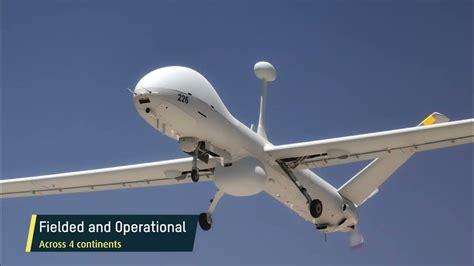
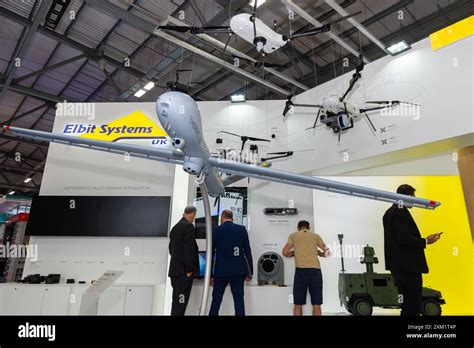
The Elbit Hermes 900, also known as the Kochav (“Star”), stands as one of the most versatile and capable unmanned aerial vehicles (UAVs) developed by Elbit Systems of Israel. Building on the legacy of the Hermes 450, the Hermes 900 offers a significant upgrade in terms of endurance, payload capacity, and operational flexibility. Its introduction has reshaped the tactical landscape for medium-altitude, long-endurance (MALE) drones, making it a critical asset for numerous air forces worldwide.
Design and Capabilities
The Hermes 900 was first flown on December 9, 2009, and officially introduced into service in May 2010. It is a medium-sized UAV designed for long-endurance missions with a wingspan of 15 meters (49 ft), a length of 8.3 meters (27 ft 3 in), and a maximum gross weight of 1,100 kg (2,425 lb). Its powerful Rotax 916 engine, generating 160 kW (210 hp), supports a maximum speed of 220 km/h (140 mph) and a cruise speed of 112 km/h (70 mph), with an operational endurance of 36 hours and a service ceiling of 9,100 meters (30,000 ft).
Payload is a critical aspect of the Hermes 900’s versatility. It boasts a payload capacity of 450 kg (990 lb), allowing it to carry a wide array of sensors and systems, including:
- Electro-optical/infrared (EO/IR) sensors for real-time imaging.
- Synthetic-aperture radar (SAR) for ground mapping and moving target indication (GMTI).
- Communications and electronic intelligence (COMINT/ELINT) for signals gathering and jamming.
- Electronic warfare (EW) systems for disrupting enemy communications.
- Hyperspectral sensors for detailed spectral analysis of the battlefield.
Operational History and Global Deployments
Israel
Israel was the first operator of the Hermes 900, deploying it during Operation Protective Edge in July 2014. This conflict marked the UAV’s first combat use, performing critical surveillance and communications relay roles over Gaza. Despite being fast-tracked into service, it quickly proved its value. However, the Hermes 900 has also faced significant threats, including being shot down by Hezbollah forces in southern Lebanon on April 6, 2024, and again on June 1, 2024, during heightened regional tensions.
Azerbaijan
Azerbaijan became one of the early international operators of the Hermes 900, with media reports first mentioning the procurement of up to 15 units in August 2017. This was later confirmed by the Azerbaijani government in May 2018, with public images showing President Ilham Aliyev inspecting one of the drones. During the 2020 Armenian-Azerbaijani skirmishes, Armenian forces claimed to have shot down an Azerbaijani Hermes 900, a claim that Azerbaijan has consistently denied.
Brazil
The Brazilian Air Force utilized the Hermes 900 during the 2024 Rio Grande do Sul floods, where the UAV helped locate and coordinate the rescue of 36 flood victims over May 5-6, 2024. Despite its effectiveness, one unit was lost due to a technical malfunction, prompting a replacement order in September 2024.
India
India operates a localized variant known as the Adani Drishti-10 Starliner, co-manufactured with Adani Defence & Aerospace. The Indian Navy received two units on January 10, 2024, and December 4, 2024, respectively, while the Army took delivery of its first unit on June 18, 2024. However, one Navy unit crashed during trials on January 14, 2025, potentially due to SATCOM issues, highlighting some of the technical challenges faced during integration.

Current Operators and Global Reach
The Hermes 900 has found a diverse range of operators beyond its initial deployment in Israel, reflecting its adaptability to different mission profiles and environments. Current operators include:
- Azerbaijan – Active use in border surveillance and conflict zones.
- Brazil – Disaster response and national security roles.
- Canada – Transport Canada for environmental monitoring and Arctic patrols.
- Chile – Air and naval surveillance for maritime patrol.
- Colombia – Mixed fleet with Hermes 450 for counter-insurgency and drug interdiction.
- European Maritime Safety Agency (EMSA) – Maritime surveillance and pollution control.
- India – Army and Navy surveillance along sensitive borders.
- Iceland – Exclusive economic zone monitoring.
- Israel – Frontline tactical missions with advanced payloads.
- Mexico – Federal Police surveillance and anti-crime operations.
- Philippines – Intelligence and border control.
- Switzerland – Custom HFE variant for alpine operations and defense.
Technical Specifications
| Specification | Details |
|---|---|
| Ground Crew | 2 (ground operators) |
| Payload Capacity | 450 kg (990 lb) |
| Length | 8.3 m (27 ft 3 in) |
| Wingspan | 15 m (49 ft 3 in) |
| Gross Weight | 1,100 kg (2,425 lb) |
| Powerplant | 1×Rotax 916 (160 kW / 210 hp) |
| Maximum Speed | 220 km/h (140 mph) |
| Cruise Speed | 112 km/h (70 mph) |
| Endurance | 36 hours |
| Service Ceiling | 9,100 m (30,000 ft) |
| Armament | Spike missile |
Conclusion
The Hermes 900 has become a cornerstone of modern military UAV fleets, offering exceptional versatility, endurance, and technological sophistication. With its proven track record in diverse operational theaters, the Hermes 900 stands as a critical asset for both military and civilian applications, ensuring comprehensive situational awareness and strategic advantage on the battlefield.