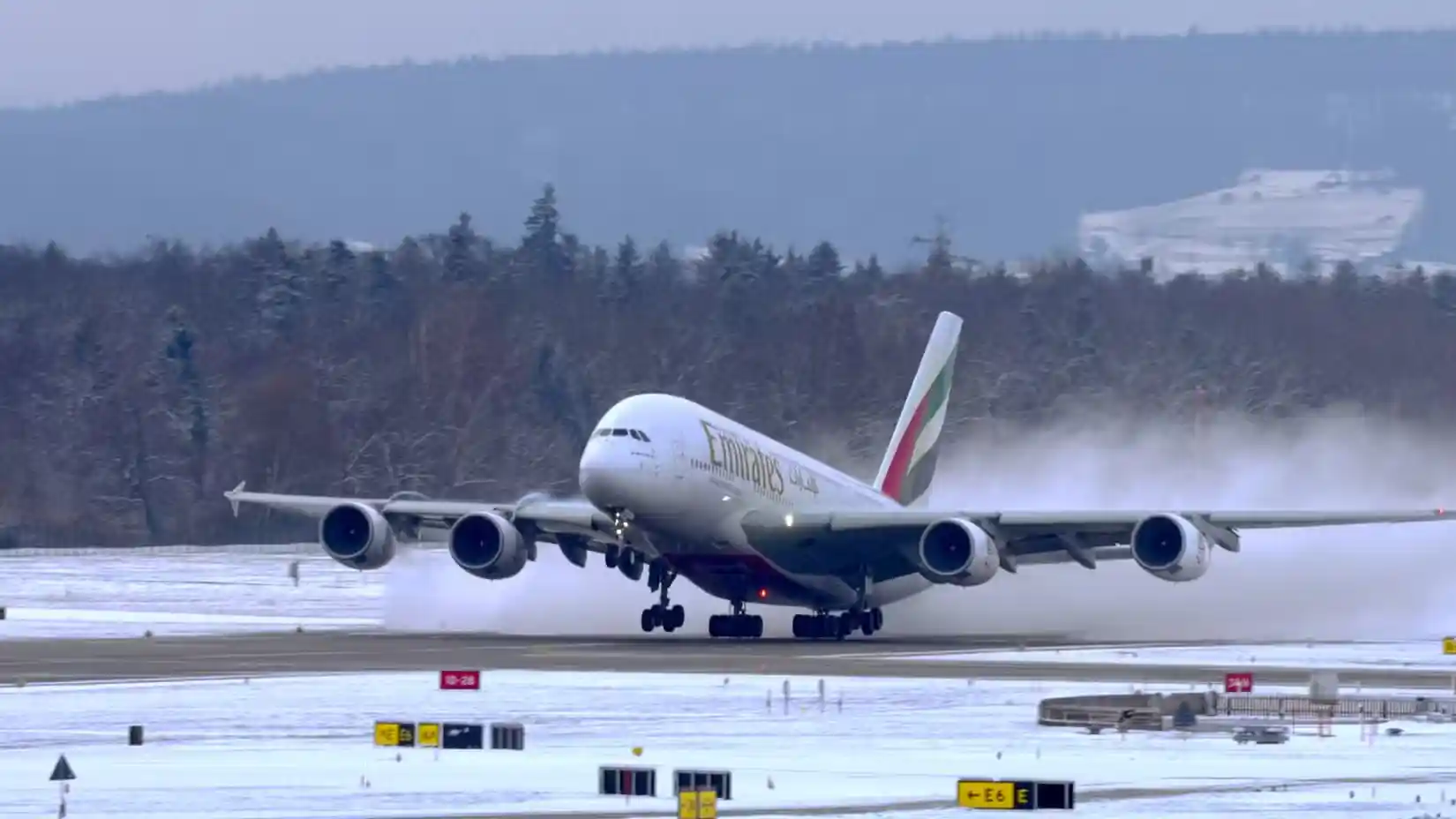
Toronto Pearson International Airport witnessed an unusual and frustrating scene when an Emirates Airbus A380 landed safely after a long-haul flight from Dubai, only for passengers to remain onboard for more than three additional hours due to heavy snowfall and gate congestion. The world’s largest passenger aircraft touched down nearly on schedule, but severe winter conditions quickly turned a routine arrival into an extended ordeal on the ground.
The Emirates-operated flight, traveling from Dubai International Airport to Toronto, completed its intercontinental journey of nearly fourteen hours with minimal disruption in the air. However, conditions on the ground told a different story. Overnight snowfall exceeding 12 centimeters blanketed the airport, forcing authorities to activate traffic management initiatives designed to prioritize safety over speed.
Toronto Pearson is no stranger to harsh winter weather, yet the arrival of a double-decker aircraft like the A380 introduces added complexity. Only two gates at the airport are fully equipped to accommodate the massive aircraft, with a third reserved strictly for emergencies. As snow-clearing crews worked to reopen taxiways and gates, the lack of immediate availability left the Emirates jet parked on the apron, engines shut down, while hundreds of passengers waited.
By the time the aircraft finally reached a suitable gate, three hours and eighteen minutes had passed since landing. For travelers who had already endured an overnight flight across continents and the polar route, the extended confinement tested patience and highlighted the fragile balance between airport infrastructure and extreme weather events.
Heavy Snowfall Paralyzes Gate Availability at Toronto Pearson
The morning of the arrival saw airport operations stretched to their limits. Snowplows, de-icing teams, and ground staff operated continuously to restore normal movement across runways and terminals. Despite these efforts, the combination of snowfall intensity and limited widebody gate capacity created a bottleneck that disproportionately affected large aircraft.
Airport authorities issued advisories warning of potential delays for both arrivals and departures, urging passengers to remain in close contact with their airlines. While safety procedures were executed as intended, the incident underscored how weather-related constraints can cascade into hours-long delays even after a successful landing.
Flight EK241’s Long Journey Ends in Prolonged Ground Delay
According to flight tracking data, the aircraft operated as EK241, departing Dubai slightly behind schedule before cruising north along a polar route. The A380 descended into Canadian airspace without issue and landed at 8:57 a.m. local time, only minutes later than planned. Expectations among passengers were for a swift disembarkation, especially given the on-time arrival.
Instead, the aircraft remained stationary until 12:15 p.m., when a compatible gate finally became available. During this period, passengers stayed seated while crews awaited clearance, illustrating how arrival punctuality offers little comfort when post-landing logistics fail to align.
Snow Disruptions Ripple Across Multiple International Flights
The Emirates delay was not an isolated incident. Other long-haul arrivals faced similar challenges as airport capacity struggled to recover. Reports from passengers indicated that an Air Canada Airbus A330-300 arriving from Frankfurt also remained grounded for nearly three hours before reaching its gate. Departures suffered as well, with some outbound flights delayed by more than five hours.
Such disruptions reveal how winter storms can overwhelm even well-prepared airports, particularly when multiple widebody aircraft converge during peak arrival windows. De-icing requirements, reduced taxiway availability, and crew scheduling constraints compound the impact, creating delays that extend far beyond snowfall itself.
Inside the Emirates Airbus A380 That Waited on the Tarmac
The aircraft involved, registered A6-EEQ, is a 12-year-old Airbus A380 delivered to Emirates in 2014. Powered by four Engine Alliance GP7270 turbofan engines, the jet is configured to carry 489 passengers across First, Business, and Economy Class cabins. Designed for long-haul comfort and high-capacity operations, the A380 is nevertheless dependent on specialized airport infrastructure.
Following the delayed arrival, the return service EK242 also departed Toronto several hours late, ultimately heading back to Dubai under revised scheduling. While the aircraft continued its journey without further incident, the Toronto delay serves as a clear reminder that even the most advanced aircraft remain vulnerable to the realities of winter operations and constrained airport capacity.