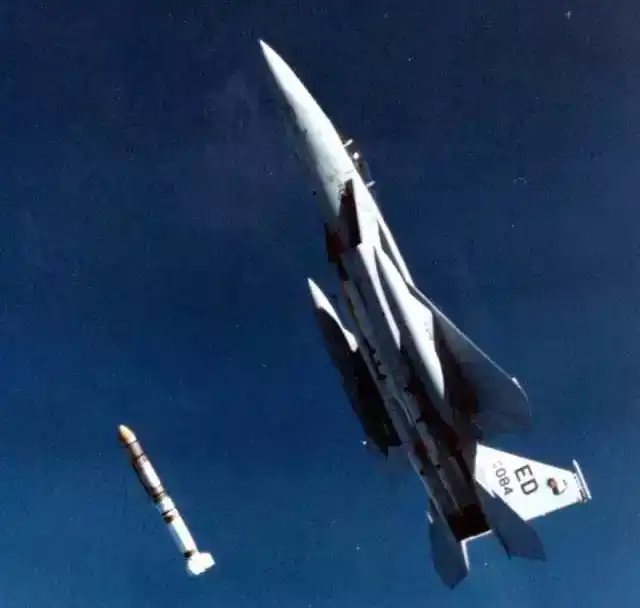
In the mid-1980s, a ground-breaking test in military aerospace technology took place, forever changing the future of satellite defense. The event in question saw an F-15 fighter jet successfully shoot down a satellite using the ASM-135 anti-satellite missile—a moment that would go down in history as one of the most significant demonstrations of airborne space defense capabilities. This achievement was not only a milestone in military innovation but also marked a new chapter in the realm of strategic defense and international security.
The implications of this event went beyond the technical prowess of the missile system; it was a statement about the United States’ commitment to ensuring its dominance in space, even in the face of growing global competition. This article explores the technological innovations, the mission’s historical context, and the ramifications of this landmark event.
Historical Background and Mission Objective
In the 1970s, the Soviet Union‘s rapid advancements in anti-satellite (ASAT) technology sparked significant concerns within the U.S. military. The Cold War competition saw the Soviets developing sophisticated means to neutralize the United States’ space-based assets, such as reconnaissance satellites and communication systems, which were crucial for national security. To counter this emerging threat, the U.S. launched a covert program aimed at developing its own anti-satellite missile system.
The ALMV (Air-Launched Miniature Vehicle) program was initiated to address these concerns. The program aimed to create a missile system capable of destroying enemy satellites, leveraging the strategic advantage of air-based platforms like fighter jets to launch the missile. In 1979, the ASM-135 anti-satellite missile, developed by LTV Aerospace (later part of Vought), became the centerpiece of this program. This missile would be launched from a specially equipped F-15A fighter jet, a versatile and powerful aircraft known for its speed and maneuverability.
The mission’s ultimate goal was to prove the concept of airborne anti-satellite warfare, with the test serving as a demonstration of the missile’s capabilities to intercept and destroy satellites in low Earth orbit.
ASM-135 Missile Technology and Design
The ASM-135 missile was a highly sophisticated weapon, designed to carry out precise, high-speed intercepts of satellites in orbit. It was a three-stage missile, each stage serving a distinct purpose in the overall mission to destroy a target in space. The missile’s architecture was crafted with meticulous attention to detail, ensuring that it could reach the high altitudes necessary to engage a satellite in orbit.
First Stage: Rocket Engine and Boosting
The first stage of the ASM-135 missile utilized the AGM-69 SRAM rocket engine, which was designed to propel the missile out of the Earth’s atmosphere. This initial boost was crucial, as the missile needed to exit the atmosphere before transitioning to its next stage of flight. The SRAM engine provided the necessary thrust to launch the missile to an altitude where it could begin its high-speed trajectory toward the target satellite.
Second Stage: Precision Trajectory Adjustment
Once the missile had reached the edge of the atmosphere, the second stage kicked in: the Altair III rocket booster. This booster played a vital role in refining the missile’s flight path and ensuring it reached its target with pinpoint accuracy. This phase involved precise course adjustments, setting the missile on a trajectory that would allow it to engage the satellite at the right moment.
Third Stage: Kinetic Interceptor and Destruction
The final stage of the missile was the most advanced. It featured a kinetic interceptor, a miniature device designed to collide with the satellite at extremely high speeds, effectively destroying it through the sheer force of impact. This interceptor was equipped with an infrared guidance system and an indium-bismuth array detector, which was cooled using liquid helium to operate at near absolute zero temperatures.
This system allowed the missile to track the satellite’s infrared signature, ensuring a precise strike even at such high altitudes and velocities. The missile’s terminal velocity reached an astounding 36,000 feet per second (approximately 11,000 kilometers per hour), making it capable of destroying even well-protected satellites in orbit.
The First Successful Test: A Historic Achievement
The milestone moment came on September 13, 1985, when Major Wilbert Pearson of the United States Air Force piloted an F-15A from Vandenberg Air Force Base in California. The test, known as “Mission Star Eagle,” was carried out approximately 320 kilometers west of the base. The F-15, flying at an altitude of 38,100 feet (around 11.6 kilometers), released the ASM-135 missile, which then ascended to an altitude of approximately 102,000 feet (about 31 kilometers).
Once the missile reached the required altitude, it rapidly accelerated to 36,000 feet per second, and in a high-speed maneuver, it collided with and destroyed the Solwind P78-1 satellite. This satellite was orbiting the Earth at a height of 555 kilometers, and the ASM-135 missile’s successful strike demonstrated the feasibility of using airborne platforms to destroy satellites in space.
This operation was a significant step forward in demonstrating the viability of air-launched anti-satellite systems and was considered an unparalleled success in the field of aerospace defense.
Technical Challenges and Innovations in the F-15
The successful intercept of a satellite posed significant technical challenges for the U.S. military. The F-15A, the aircraft used for the mission, required several modifications to handle the missile’s large size and payload. These modifications included reinforcing the aircraft’s mission computer, bomb rack, and weapon bay doors to accommodate the ASM-135 missile, which was substantially larger and heavier than the typical ordnance carried by the F-15.
Additionally, the guidance system of the ASM-135 had to operate under extreme conditions. The missile’s infrared seeker, manufactured by Hughes, required liquid helium cooling to achieve the necessary operational temperature for tracking satellites at such high altitudes. The infrared system would detect the target satellite’s heat signature, allowing the missile to make course corrections and ensure a precise hit.
Furthermore, the aircraft’s launch profile—reaching Mach 2.3 during a steep 65-degree climb—was critical to the missile’s successful deployment. This maneuver allowed the F-15 to reach the necessary launch altitude and speed to facilitate a successful interception.
Strategic Impact and Controversies
The success of the ASM-135 test marked a turning point in the U.S. military’s space strategy. The ability to destroy satellites in orbit provided the U.S. with a potent tool to safeguard its space-based assets from potential threats, including those posed by adversaries like the Soviet Union.
However, the test also raised significant concerns on the international stage. The destruction of a satellite in orbit generated significant amounts of debris, which posed a risk to other satellites and space operations. This debris problem led to concerns over the militarization of space and the long-term environmental impacts of space warfare.
Furthermore, countries such as the United Kingdom raised protests after the Solwind P78-1 satellite was destroyed, as the missile test’s debris could have potentially damaged other space assets. This spurred debate about the need for international agreements to regulate anti-satellite weaponry and prevent the weaponization of space.
The End of the ASM-135 Program
Despite the technical success of the ASM-135 missile system, political and budgetary constraints led to the program’s eventual termination. The missile system was not adopted for mass production, and the ASM-135 was only deployed for research and development purposes. Additionally, the growing concerns about space debris and the political fallout from such tests led the U.S. to reconsider the long-term viability of anti-satellite weapons.
Although the ASM-135 was never widely deployed, the lessons learned from the program and the success of the F-15’s satellite intercept played a crucial role in the development of future missile defense systems, including those designed for space-based applications.
Conclusion: A Legacy of Innovation
The F-15’s successful interception of a satellite using the ASM-135 missile remains a pivotal moment in the history of military technology. It demonstrated the feasibility of air-launched anti-satellite missiles, showcased the incredible precision of modern missile guidance systems, and highlighted the need for future innovation in space defense technologies.
While the program may have been discontinued, its impact continues to resonate in contemporary discussions about the militarization of space and the future of space-based defense systems. The lessons learned from the Star Eagle Mission continue to inform the development of modern missile defense strategies, ensuring that the U.S. remains at the forefront of aerospace technology and space security.