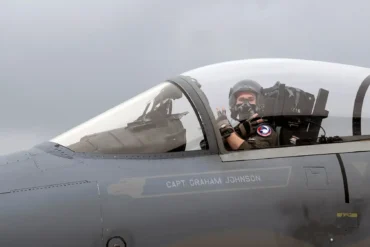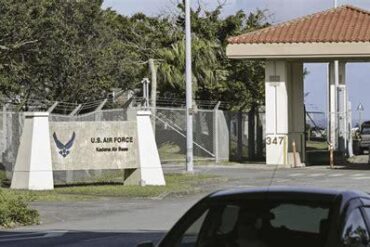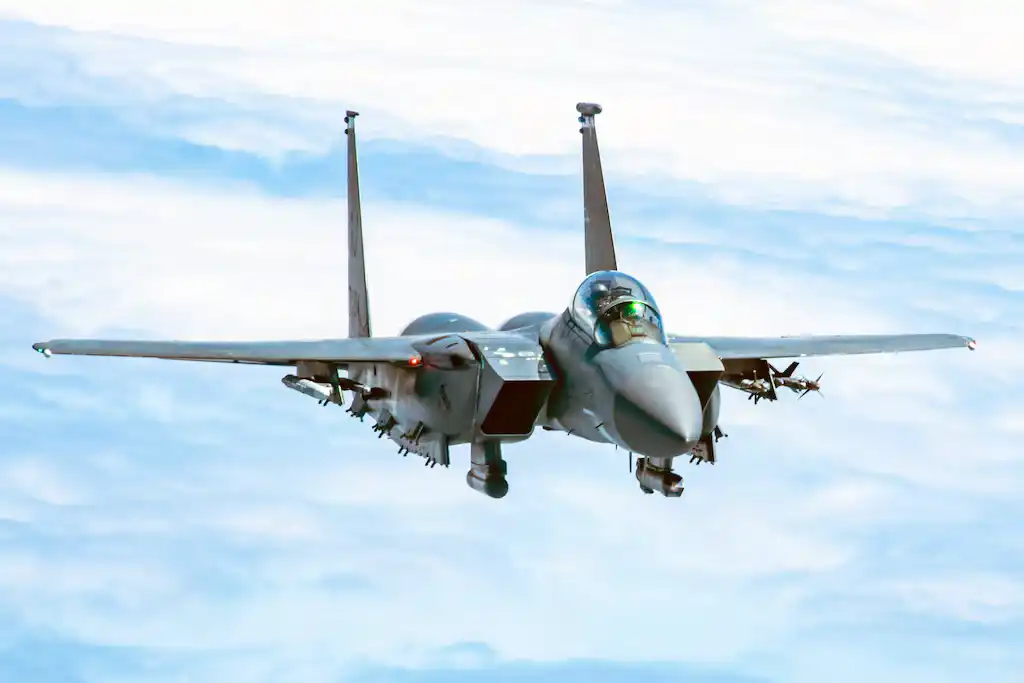
An F-15E Strike Eagle made an emergency landing on only two wheels at Kadena Air Base, Okinawa, Japan, on August 4, 2025, after a wheel detached during takeoff from Naval Support Facility Diego Garcia in the Indian Ocean. Both the pilot and the weapon systems officer emerged unharmed, but the incident has prompted immediate attention from U.S. Air Force safety investigators and raised questions about maintenance, operational readiness, and the risks of long-range fighter deployments.
Incident Overview and Immediate Response
The 18th Wing at Kadena, which oversees flight operations on Okinawa, confirmed that the F-15E’s wheel was discovered missing mid-flight as the aircraft was en route from Diego Garcia to Kadena. Upon landing, the crew successfully managed to control the fighter despite the absence of one landing gear wheel. The missing component was later found on the flight line at Diego Garcia.
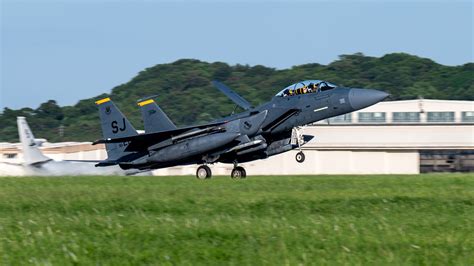
While Air Force officials have not yet disclosed which wheel was lost—whether a main landing gear tire or a nose wheel—the complexity of safely landing a 31,700-pound fighter with asymmetric landing gear cannot be overstated. Any deviation in gear alignment significantly increases the risk of fuselage scraping, hydraulic system damage, or structural compromise. In this case, runway preparations and emergency response teams were placed on alert as the F-15E approached Kadena for its landing attempt.
The Air Force issued a brief statement: “The pilot and crew landed safely, and there were no injuries. A safety investigation is underway to determine the cause.”
Deployment Background: Why the F-15E Was Operating from Diego Garcia
The F-15E was part of a fighter rotation deployed to Diego Garcia in May 2025 to provide force protection for the strategic island base. This deployment coincided with a broader U.S. military campaign aimed at deterring Houthi attacks on commercial shipping in the Red Sea and signaling U.S. presence in response to Iranian military activities in the region.
Over recent months, B-2 Spirit stealth bombers and B-52 Stratofortress heavy bombers also operated out of Diego Garcia, demonstrating the island’s importance as a launch point for long-range operations in the Indo-Pacific and Middle East. The F-15E’s long-range strike capability, combined with its ability to carry heavy ordnance loads, made it a natural choice for supporting the bomber task force missions.
The Unit Behind the Aircraft: 336th Expeditionary Fighter Squadron
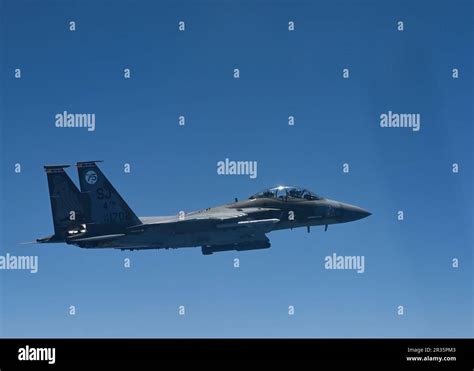
The aircraft involved in the landing incident belonged to the 336th Expeditionary Fighter Squadron (EFS), deployed from Seymour Johnson Air Force Base, North Carolina. The squadron has been operating out of Kadena since April 2025, augmenting the air defense mission while Kadena transitions its fleet from F-15C/D models to the modernized F-15EX Eagle II. Publicly available flight tracking data confirmed that Seymour Johnson jets had recently flown to Diego Garcia for joint exercises and support operations.
This temporary rotation is part of the U.S. Air Force’s Dynamic Force Employment strategy, which emphasizes unpredictable and flexible deployments to deter adversaries and reassure allies. The F-15E’s presence in Diego Garcia provided rapid strike capability within range of key maritime shipping lanes.
The Complexity of a Two-Wheel Landing in a Modern Fighter Jet
Landing with a missing wheel on a high-performance jet like the F-15E is an intricate process requiring precision and training. The aircraft’s dual main landing gear supports the majority of the jet’s weight, while the nose gear ensures forward stability. Losing any one of these components shifts balance dramatically and can cause uneven drag, ground looping, or runway excursions.
To prepare for the landing, emergency crews at Kadena reportedly foamed the runway and positioned firefighting vehicles along the strip. The pilot likely had to maintain a near-perfect angle of attack and gradual descent rate, ensuring that the remaining wheels bore the impact without collapsing the gear assembly or compromising the fuselage.
A similar emergency occurred in 2022, when Maj. Brady Augustin executed a belly landing in an F-16 after losing a left main landing wheel. In that case, the jet slid for hundreds of feet but sustained only repairable damage. The F-15E’s heavier weight and dual-engine layout, however, add complexity and risk, making this recent landing particularly noteworthy.
Safety History of Landing Gear Failures in U.S. Air Force Aircraft
Landing gear malfunctions, though rare, are not unprecedented in the Air Force. Notable incidents include:
- 2017: Capt. Brett DeVries landed an A-10 Thunderbolt II without wheels and canopy after an in-flight emergency, earning the Distinguished Flying Cross.
- Famed test pilot Tom Morgenfeld once landed an F-117 Nighthawk without its nose wheel, relying on a drag chute to slow the stealth aircraft.
- Multiple training aircraft such as the T-6 Texan II and T-38 Talon have experienced gear collapses, requiring belly landings on prepared surfaces.
These cases highlight the importance of redundant training, quick decision-making, and crew coordination under high-stress scenarios. The successful landing at Kadena adds another example to the Air Force’s long record of preventing loss of life and aircraft despite severe equipment failures.
Questions Surrounding Maintenance and Operational Stress
The loss of a wheel inflight raises questions about aircraft maintenance protocols at both home and deployed locations. Diego Garcia, while equipped for major operations, presents logistical challenges for immediate part replacement and repair, especially for fighters stationed temporarily without full maintenance infrastructure.
Factors that investigators are likely to examine include:
- Wheel assembly integrity and whether there was a structural failure or improper installation.
- Takeoff runway conditions at Diego Garcia and whether foreign object damage contributed.
- Operational tempo stress, as repeated sorties in high-humidity environments can affect hydraulics, tires, and seals.
The Air Force has confirmed that a full safety investigation is in progress, but has not provided a timeline for its findings or whether the aircraft can be returned to flight status quickly.
Implications for Kadena’s Transition to F-15EX Fleet
Kadena Air Base is currently undergoing a phased transition as it retires aging F-15C/D models and awaits delivery of the F-15EX Eagle II. During this period, squadrons from other bases—including Seymour Johnson and Mountain Home AFB—rotate in to maintain air superiority coverage in the region. This incident underscores the maintenance demands placed on aircraft during repeated deployments.
The F-15EX is expected to offer improved digital flight systems, advanced sensors, and more reliable components compared to its predecessors, potentially reducing incidents like wheel separations. However, until the transition is complete, legacy airframes remain essential to Pacific defense posture.
Regional Significance and Strategic Messaging
The successful landing, despite the mechanical failure, demonstrates not only pilot skill but also operational resilience. In a region where tensions with China and North Korea continue to shape defense planning, every sortie carries symbolic and tactical weight.
By operating fighters from Diego Garcia and Kadena, the U.S. Air Force sends a clear message: its assets are flexible, long-reaching, and capable of adapting even under duress. For adversaries monitoring U.S. flight activity, the ability to recover an aircraft after such a failure reinforces confidence in both personnel and platform reliability.
Final Assessment and Ongoing Investigation
While no injuries occurred and the F-15E did not suffer catastrophic loss, the investigation’s findings will be critical for preventing future occurrences. Maintenance protocols, wheel assembly design, and pre-flight inspections may face scrutiny, especially as older airframes continue to perform demanding missions far from home bases.
The Air Force has not indicated when the damaged jet will return to service, nor whether additional inspections of the deployed fleet have begun. For now, the focus remains on identifying the root cause while ensuring Kadena’s fighter presence remains uninterrupted.