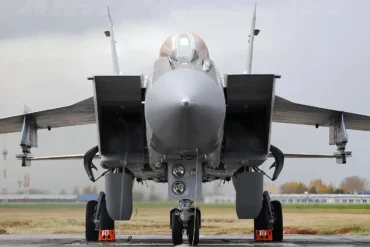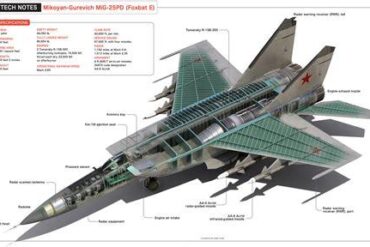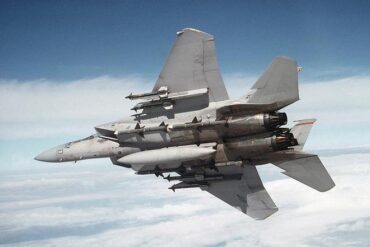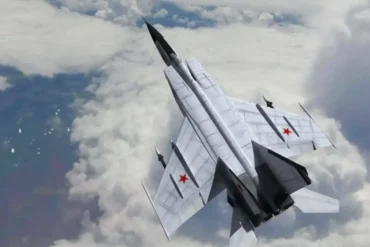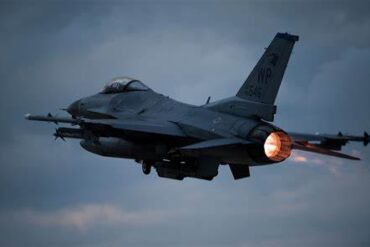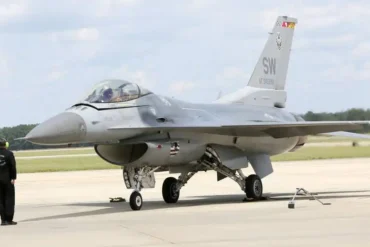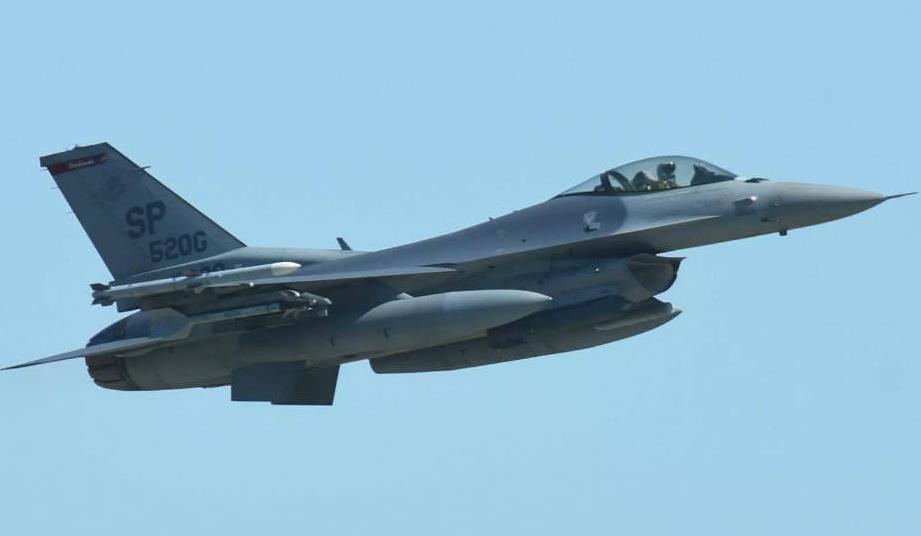
The F-16 Fighting Falcon and MiG-29 Fulcrum are two of the most well-known fourth-generation fighter aircraft. Developed by the United States and Russia respectively, these aircraft represent different design philosophies and combat strategies. The F-16 prioritizes agility, advanced avionics, and multirole capabilities, while the MiG-29 is built for raw speed, superior maneuverability, and short-range engagements. This article provides a comprehensive comparison based on performance, avionics, weaponry, and historical combat effectiveness.
Design and Performance
Engines and Maneuverability
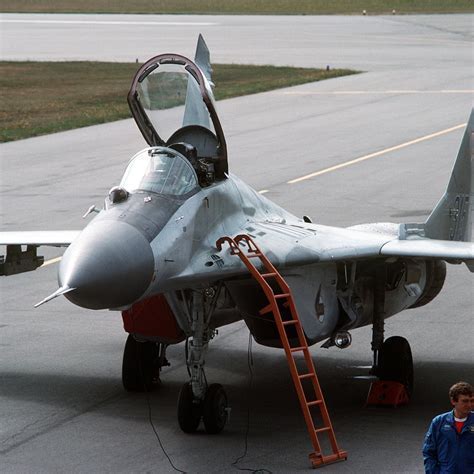
The MiG-29 is powered by two Klimov RD-33 turbofan engines, providing redundancy in case of failure and allowing for exceptional maneuverability at low speeds. Its thrust-to-weight ratio of 0.97:1 ensures rapid acceleration and high-altitude performance, enabling advanced aerobatic maneuvers such as the cobra maneuver and tail-slide.
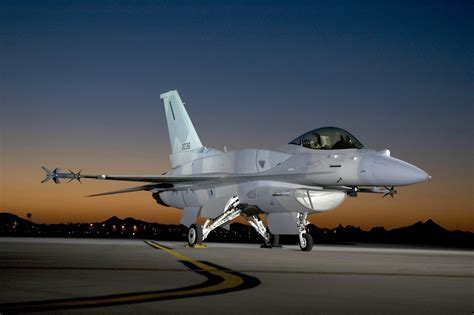
In contrast, the F-16 relies on a single General Electric F110 or Pratt & Whitney F100 engine. Though it lacks the redundancy of a twin-engine setup, its superior aerodynamics and fly-by-wire controls optimize agility, particularly at subsonic speeds. The bubble canopy provides an unmatched 360-degree field of view, a critical advantage in dogfights.
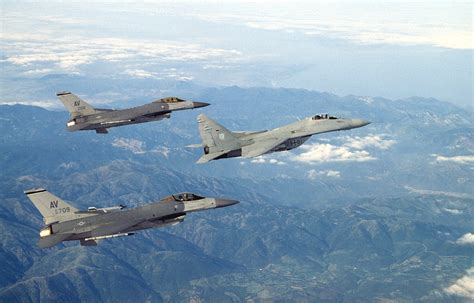
Speed Comparison:
- MiG-29: 2,300 km/h (Mach 2.25)
- F-16: 2,145 km/h (Mach 2.05)
Range and Endurance
One of the MiG-29’s biggest limitations is its short operational range of ~1,500 km. This restricts its effectiveness in prolonged missions unless supported by aerial refueling or forward deployment. The F-16, on the other hand, boasts a significantly longer combat radius of 4,220 km with external fuel tanks, making it far more versatile for long-range missions and deep strike operations.
Avionics and Weapon Systems
Radar and Sensors
The MiG-29’s N019 radar is outdated compared to the F-16’s APG-83 AESA radar in modern variants. The APG-83 provides superior target tracking, electronic countermeasures, and network-centric warfare capabilities. The MiG-29 does have an advantage with its infrared search-and-track (IRST) system, which enables passive target detection without emitting radar signals. However, its lack of integration with modern data links is a significant drawback.
Radar Capabilities:
- F-16: APG-83 AESA radar (modern variants), superior range, fire-and-forget capabilities
- MiG-29: N019 radar (older variants), relies on continuous radar lock
Weapons Loadout
Beyond-Visual-Range (BVR) Combat
The MiG-29’s R-77 missile boasts a 100 km range, exceeding the F-16’s AIM-120 AMRAAM (75 km range). However, the AIM-120 features active radar guidance, allowing for fire-and-forget capabilities, whereas the R-77 requires continuous radar lock, putting the MiG-29 pilot at a disadvantage in BVR engagements.
Close-Range Dogfighting
The MiG-29 excels in close-range combat thanks to the R-73E missile paired with a helmet-mounted sight (HMS), allowing off-boresight targeting. The F-16’s AIM-9X Sidewinder offers similar capabilities, but its effectiveness heavily depends on pilot training.
Combat Effectiveness
Historical Performance
Real-world engagements have consistently favored the F-16 over the MiG-29, particularly in conflicts involving NATO forces. During the Gulf War and Kosovo War, MiG-29s performed poorly against F-16s due to superior NATO air support, electronic warfare, and pilot training. In Kosovo, 11 MiG-29s were shot down, failing to score any kills against F-16s.
Pilot Workload and Cockpit Design
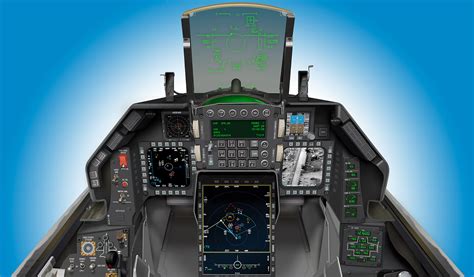
The MiG-29’s cockpit is less intuitive, increasing pilot workload and reducing overall combat efficiency. In contrast, the F-16 features an ergonomic layout, advanced HUD, and fly-by-wire system, enabling the pilot to focus on combat rather than managing flight controls manually.
Cost and Maintenance
The F-16 is priced between $34M–$120M, depending on the variant, while the MiG-29 is comparatively cheaper at $30M–$40M. However, the MiG-29 has significantly higher maintenance demands and a shorter service life. Countries like India and Algeria have faced recurring engine and structural issues with their MiG-29 fleets, leading to expensive overhauls.
Conversely, the F-16 benefits from a global supply chain, ensuring readily available spare parts and continuous upgrades. Many nations, including Taiwan, Israel, and Poland, continue to operate F-16s effectively due to ease of maintenance and long-term upgrade potential.
Modern Upgrades
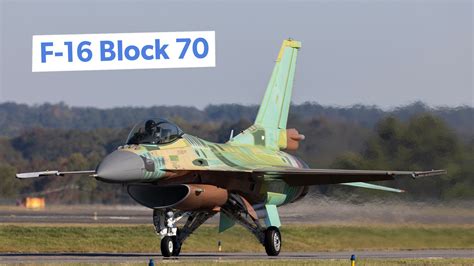
The latest F-16 variants (Block 70/72) feature AESA radar, advanced electronic warfare systems, and compatibility with fifth-generation weapons. These enhancements make it highly adaptable to modern warfare scenarios. The MiG-29’s successor, the MiG-35, introduces improved radar and avionics, but still lags behind the F-16 in sensor fusion and network warfare.
Conclusion
The MiG-29 remains a formidable dogfighter with excellent maneuverability and short-range combat abilities. However, in real-world conflicts, the F-16 consistently outperforms it due to superior avionics, long-range capabilities, and seamless integration with NATO’s combat network.
In a 1v1 duel, the MiG-29’s agility and IRST might provide an advantage, but in actual combat scenarios, the F-16’s superior radar, weapon systems, and pilot-friendly controls give it the edge. When considering cost-effectiveness, versatility, and combat history, the F-16 remains the more effective multirole fighter.
FAQ
1. Why did the MiG-29 perform poorly against F-16s in real-world conflicts?
The MiG-29 lacked NATO-level integration, suffered from inferior radar technology, and was often operated by countries with less advanced pilot training. F-16s benefited from superior AWACS support, electronic warfare, and fire-and-forget missile technology.
2. Which aircraft is better for dogfighting?
The MiG-29 has an advantage in close-range combat due to its superior maneuverability and helmet-mounted targeting system. However, the F-16’s AIM-9X Sidewinder and advanced avionics make it a formidable dogfighter as well.
3. Can the MiG-29 compete with modernized F-16 variants?
The MiG-35, an upgraded version of the MiG-29, incorporates modern avionics but still lags behind the latest F-16 Block 70/72 in sensor fusion, electronic warfare, and network-centric warfare capabilities.