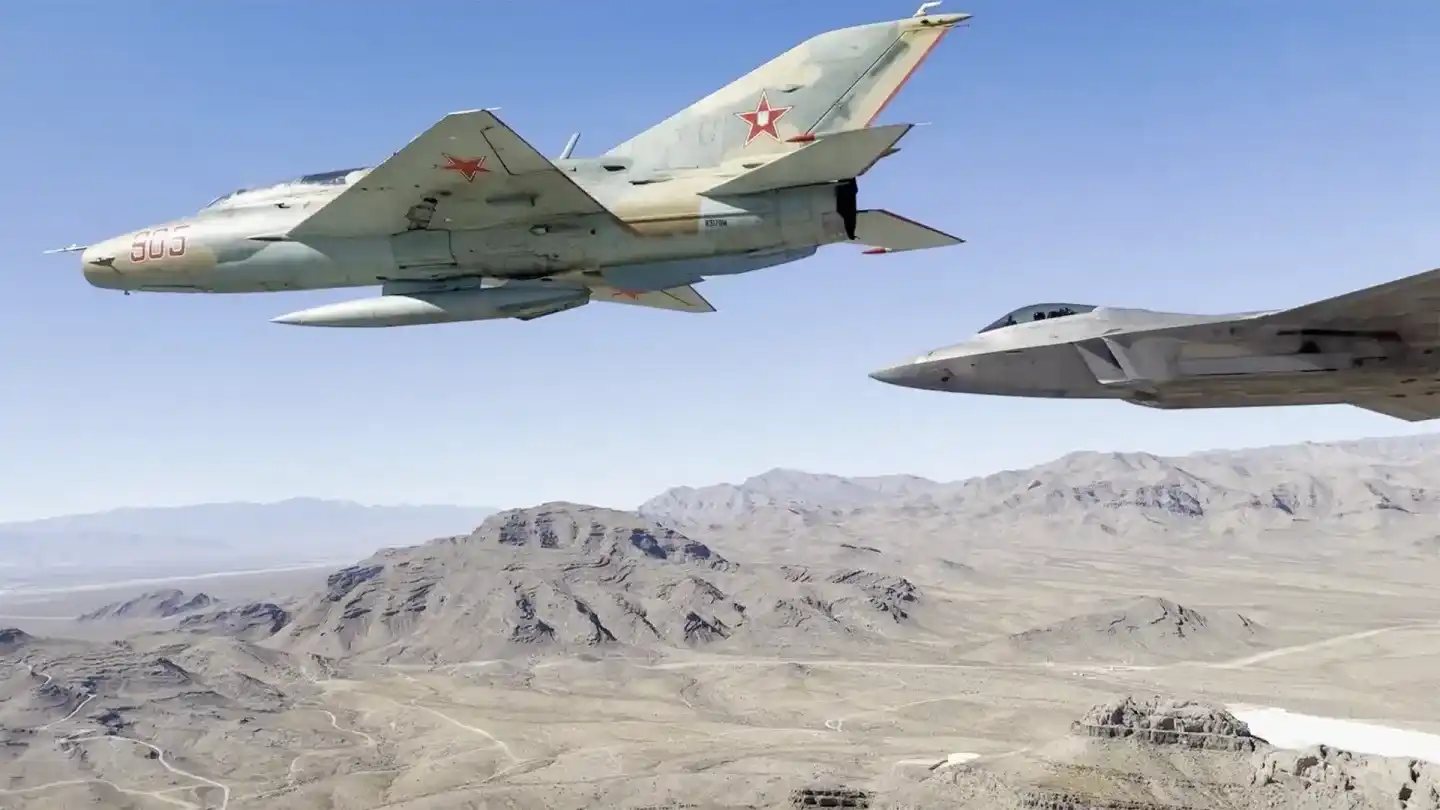
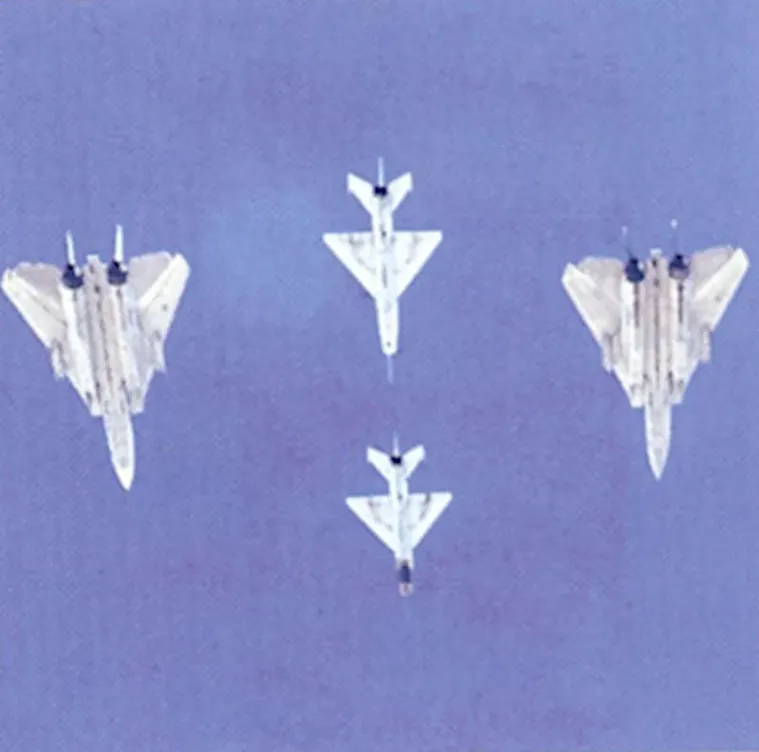
In a breathtaking and historically charged formation, U.S. Air Force F-22 Raptors recently flew alongside Soviet-era MiG-21 and MiG-29 fighters in the skies above Nellis Air Force Base, Nevada, to commemorate the legacy of Colonel Gail Peck, the visionary founder of the 4477th Test and Evaluation Squadron, better known as the “Red Eagles.” This unprecedented flyover, which took place on November 7, 2024, was a powerful symbol of the Cold War-era unit that forever altered the trajectory of American air combat training.
A Skybound Salute to a Cold War Hero
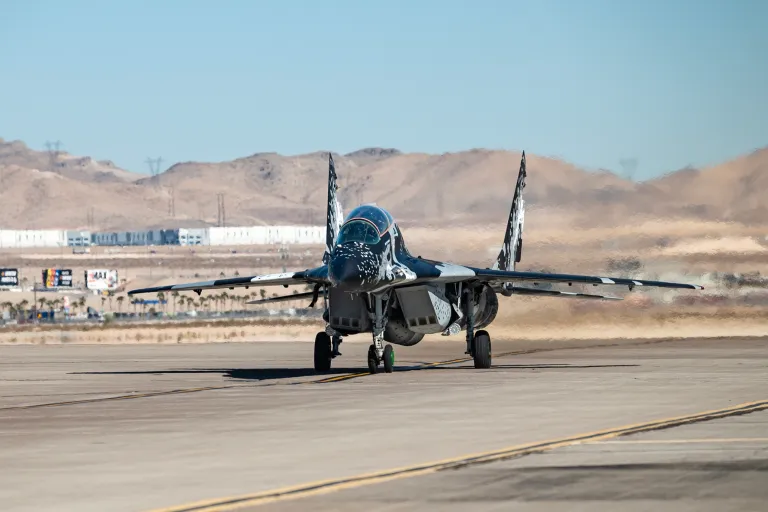
The four-ship formation included two F-22 Raptors, one each from the 422nd Test and Evaluation Squadron (tail code OT) and the 433rd Weapons Squadron (tail code WA)—units deeply rooted in Nellis’ culture of tactical innovation. Sharing the sky with them were two privately owned Soviet jets: a MiG-21UM Mongol-B, formerly of the Polish Air Force and now registered as N317DM, and a MiG-29UB Fulcrum-B, flown by none other than Jared Isaacman, the tech billionaire, astronaut, and former CEO of Draken International.
Isaacman’s MiG-29, once owned by Microsoft co-founder Paul Allen, served as the photo ship during the event. The extraordinary moment was captured on video and shared via social media platform X, offering a rare glimpse into a ceremony that united cutting-edge American stealth with vintage Soviet engineering.
Honoring the Architect of Constant Peg
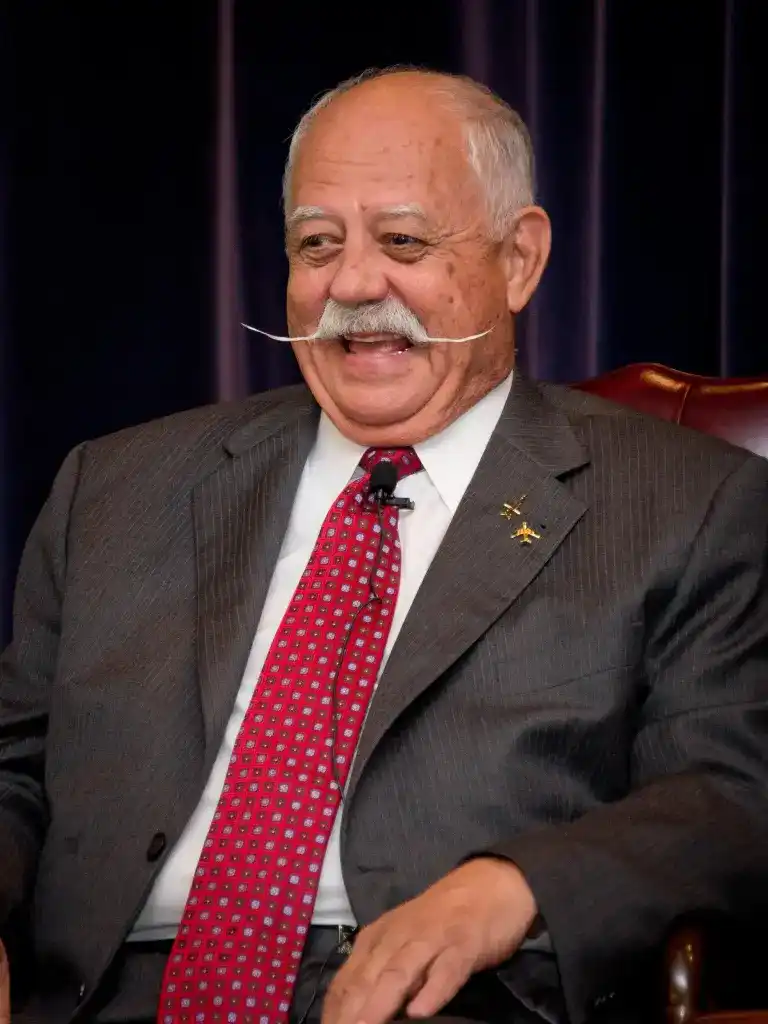
Col. Gail Peck, who passed away on October 10, 2024, was no ordinary airman. A 1962 Air Force Academy graduate and Vietnam combat veteran with 163 missions in the F-4D Phantom, Peck later became a pivotal figure in one of the most clandestine and impactful programs of the Cold War: Constant Peg.
Initiated in 1977, Constant Peg sought to give U.S. fighter pilots the opportunity to train against real Soviet aircraft, including MiG-17s, MiG-21s, and later MiG-23s. As the first commander of the 4477th, Peck helped establish a program that would revolutionize air-to-air combat tactics. The secretive squadron operated under the veil of darkness from Tonopah Test Range Airport, a remote installation that came to life based on a napkin sketch drawn by Peck during a commercial flight.
Red Eagles: Training for the Real Fight
Operating under the cover of Red Flag and other exercises, the Red Eagles unit provided realistic dogfight training against adversary jets. Prior to Constant Peg, the U.S. Air Force had only conducted limited trials, such as Have Doughnut—involving a defected Iraqi MiG-21—and Have Drill, featuring a MiG-17 captured by Israel. Peck believed more could be done and fought bureaucratic resistance to make his vision a reality.
“We oughta just be training with these airplanes,” Peck recalled a senior general saying, reflecting the mindset that propelled him to bypass red tape and build an operational training base in the Nevada desert. His wife, Peg, inspired the code name, and soon Bandit 1—Peck’s callsign—was flying and teaching from behind the stick of actual enemy fighters.
A Legacy Etched in Steel and Sky
The 4477th, though deactivated in 1988, laid the foundation for what is now a crucial pillar in American aerial warfare: Foreign Materiel Exploitation (FME). Peck’s legacy extended beyond his Red Eagles tenure. He went on to command an operational F-15 unit in Japan and flew RF-4C reconnaissance missions in West Germany. Even after retirement, he returned as an instructor, mentoring new generations of F-15 and F-22 pilots at the elite Weapons School at Nellis.
Peck’s career bridged three eras of aerial combat: Vietnam’s dogfights, Cold War secrecy, and the stealth-dominated digital battlefield of the 21st century. His direct influence is still felt in the structure of modern adversary air programs, some of which, like Draken International and Air USA, operate similar foreign aircraft for advanced dissimilar air combat training.
MiGs and Raptors: A Formation of Symbolism
The flyover was more than a ceremonial gesture; it was a rare physical manifestation of Cold War adversaries turned training tools, soaring together as allies in a salute to their former opponent and trainer. The MiG-21UM, still bearing its Polish livery, and the MiG-29UB, roaring with dual Klimov engines, flew in tight echelon with the F-22 Raptors, which symbolize America’s present-day air dominance.
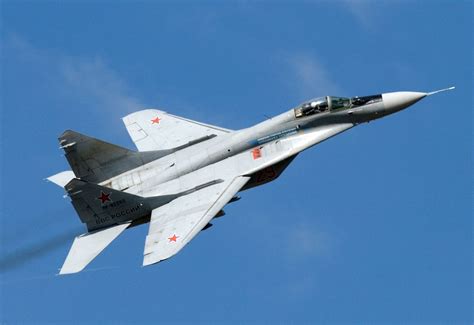
The choice of aircraft was no coincidence. The MiG-21, one of the most widely produced fighters in history, was a core component of Constant Peg training. The MiG-29, though never part of the original Red Eagles lineup, represents a continuation of adversary air tactics into the post-Soviet era. Their appearance alongside F-22s—the most advanced operational fighter in the world—emphasized the evolution of air combat doctrine shaped in no small part by Peck’s efforts.
Covert Flights, Lasting Influence
Although today’s Air Force does not publicly acknowledge the use of enemy aircraft in training, FME programs are alive and well. Units like the Foreign Materiel Exploitation Squadron at NASIC, along with unnamed detachments possibly operating out of Groom Lake or Tonopah, are rumored to continue flying, testing, and dissecting foreign jets. While the public may never again witness a MiG-F-22 formation flight, the principles of Constant Peg endure in advanced aggressor squadrons, classified R&D, and elite pilot training.
Final Salute to Bandit 1
For those who watched the formation arc above the Nevada desert, it wasn’t just a tribute—it was a poignant reflection of a legacy defined by risk, vision, and excellence. As the MiGs peeled away and the Raptors soared, they carried with them the memory of a man who dared to sketch an airbase on a napkin and taught America’s best how to defeat the very aircraft they once feared.
Col. Gail Peck’s story is not merely a chapter in Cold War history—it is a foundation stone of modern American air superiority.
In the hush that followed the roar of engines, one message echoed clearly: Bandit 1 is gone, but his tactics fly on.