The year 2025 marks a decisive turning point in aviation training, driven not by traditional simulators alone but by a new hybrid ecosystem where cloud computing, high-fidelity simulation, and consumer-grade technology merge into a professional pilot-training architecture. The collaboration between Boeing and Microsoft has produced the Virtual Airplane Procedures Trainer (VAPT), a groundbreaking training platform powered by Microsoft Flight Simulator 2024 and Microsoft Azure. What began as one of the world’s most realistic consumer aviation games has evolved into a professional-grade cockpit familiarization tool capable of preparing commercial pilots with unprecedented accessibility and accuracy.
This transformation represents more than a software upgrade. It signals a redefinition of how pilots study procedures, rehearse flows, and maintain proficiency. We explore how Boeing’s VAPT functions, why it matters, and what it signals for the future of commercial flight training.
Cloud-Based Cockpit Training: A New Era of Mobility
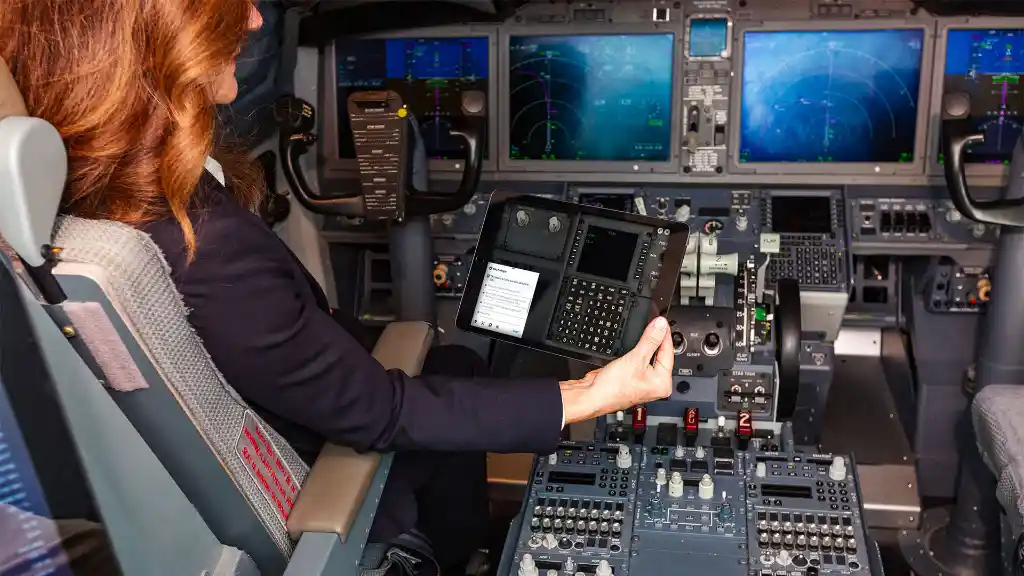
What distinguishes the VAPT from traditional training architecture is its ability to run on common personal devices while streaming the computationally heavy simulation workload directly from Azure’s cloud servers. For decades, pilots depended on full-motion simulators or fixed-base trainers, all of which required carefully scheduled sessions, travel time, and high operational cost. Now, procedures that typically demanded a trip to a training center can be rehearsed from a hotel room, crew lounge, or even during a long layover.
The flexibility this enables transforms how pilots learn. Because cockpit flows involve repetition, muscle memory, and rapid recall, VAPT makes it possible to rehearse an engine start sequence, an abnormal checklist, or an FMC initialization during brief periods of downtime. Airline scheduling realities often leave pilots working across multiple time zones, juggling long-haul layovers, and navigating unpredictable duty rotations. With cloud-supported training accessible offline when needed, proficiency no longer depends on a stable high-speed connection.
This integration of flight-deck procedure rehearsal into everyday life reduces training bottlenecks and mitigates skill fade. The ability to reference a high-fidelity cockpit model at any time is especially valuable for pilots transitioning to new fleets or returning from periods of leave. VAPT ensures procedural competence remains sharp, relevant, and consistent.
Why the 737 MAX Became the First VAPT Aircraft
The decision to introduce the 737 MAX as the inaugural VAPT platform reflects both strategic necessity and industry demand. As one of the most widely operated narrowbody jets in global aviation, the MAX requires robust training standardization. The aircraft’s troubled history and subsequent engineering and regulatory reforms underscored the need for procedural clarity and improved familiarity with onboard systems.
Using Microsoft Flight Simulator’s multi-layered rendering engine, the VAPT presents a lifelike, fully interactive 3D MAX cockpit where pilots can reach for switches exactly where they would sit in the physical aircraft. This includes normal and abnormal flows, electrical and hydraulic configuration tasks, fire-system drills, and high-workload problem-solving scenarios.
Boeing’s focus on the MAX signals its commitment to ensuring every pilot—regardless of airline, fleet size, or training resources—has an opportunity to rehearse essential procedures in a standardized way. This restores pilot confidence, raises safety margins, and demonstrates how modern simulation, paired with cloud computing, can close training gaps that previously relied only on in-person devices and scheduled simulator blocks.
A Customizable Training Ecosystem for Airlines
Boeing’s VAPT incorporates an authoring tool that empowers airline training departments to produce custom content aligned with their own Standard Operating Procedures (SOPs). Instead of relying solely on manufacturer documentation, airlines can integrate company-specific checklists, flows, callouts, and scenario variations.
This customization capability addresses one of commercial aviation’s longstanding challenges: the need for uniform training across large, diverse pilot groups. Airlines operating global networks must ensure that thousands of pilots follow identical procedures. VAPT’s centralized update model, distributed instantly through Azure, ensures pilots receive the most recent procedural modifications without lag or inconsistency.
The result is an agile, scalable training model. With a few updates, airlines can respond to regulatory changes, new safety advisories, or updates in fleet configuration. VAPT synchronizes procedure training across continents in seconds, an enormous improvement over the slow, manual update cycles of desktop or printed training materials.
How Azure Powers the Virtual Cockpit
Azure sits at the core of the VAPT ecosystem. Its role extends far beyond simple data storage. Azure hosts the simulation logic, terrain data, cockpit interactions, and airline-specific content, then streams all of this to the pilot’s device with minimal latency. The underlying technology mirrors the architecture of cloud gaming but applies it to a professional training environment.
Microsoft Flight Simulator’s global dataset, built from Bing Maps imagery and AI-assisted topographical rendering, creates a visually rich, geographically accurate environment. This matters for procedural training because spatial awareness—pattern entry, taxi routing, SID/STAR interpretation—is influenced by visual cues. Azure’s processing ensures these cues appear reliably on lightweight devices.
Azure also forms the foundation for potential future analytical tools. Pilot inputs, task completion times, procedural errors, and common missteps may eventually be anonymized and aggregated to identify training trends. If implemented, these insights could pave the way for adaptive training modules and targeted coaching programs.
Portable Devices, Professional Results
One of the most dramatic advantages of the VAPT lies in its minimal hardware requirements. Traditionally, realistic flight simulation demanded powerful workstations, specialized graphics cards, and often proprietary hardware. In contrast, VAPT runs on common PCs and iPads, placing professional cockpit familiarization squarely within reach of every pilot.
By delivering high-fidelity visual rendering through cloud streaming, the system removes the financial and logistical barriers that once separated preliminary training from full-motion simulators. Pilots are not required to purchase joysticks or throttle quadrants; the system is built around procedural rehearsal rather than manual flying. The interaction design emphasizes switch manipulation, mode selection, checklist execution, and system monitoring—all core elements of airline training.
This design philosophy aligns the tool’s strengths with real-world cockpit demands. Most airline flying relies on automation, system management, and checklist fluency rather than hand-flying aerobatics. VAPT focuses precisely on those operational aspects that matter most for proficiency, reliability, and safety.
Maximizing Full-Motion Simulator Time
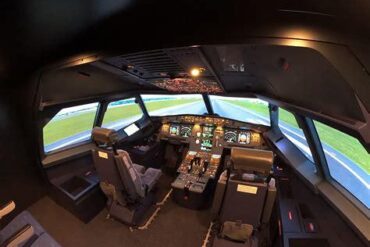
Full-motion simulators remain irreplaceable for licensing, handling practice, and evaluating real-time decision-making under pressure. However, the cost to operate them is enormous. Any delay, mistake, or need to repeat a flow increases expenses and disrupts training timetables.
VAPT acts as a procedural warm-up. Pilots arrive for full-motion simulator sessions already confident in the location of cockpit controls and the sequence of flows. This shifts limited simulator time toward scenario-based evaluation instead of basic orientation. Airlines benefit from reduced time spent teaching fundamental procedures, and pilots can focus more on handling, communication, and emergency management.
The outcome is a more efficient training pipeline. By improving preparation levels, VAPT indirectly reduces costs, accelerates training throughput, and allows training centers to allocate simulator hours more strategically.
Lessons From Tragedy: Why Safety Demanded a New Training Model
The development of VAPT is inseparable from the lessons learned after the crashes of Lion Air Flight 610 and Ethiopian Airlines Flight 302, incidents that exposed fundamental deficiencies in training consistency and system familiarization. Pilots lacked clear knowledge of the MCAS system, and the absence of standardized training amplified confusion during critical moments.
These events reshaped Boeing’s approach to training. Regulators and operators worldwide recognized that procedural familiarity cannot depend solely on in-person training events. Skill fade, especially in an era of increased cockpit automation, is a known risk. VAPT addresses these shortcomings by giving pilots consistent, repeatable access to system information, abnormal procedures, and cockpit interaction sequences.
While no digital tool can replace hands-on simulator training entirely, VAPT offers a modern, structured way to reinforce system awareness. It enhances readiness, improves confidence, and helps prevent incomplete knowledge from becoming a safety hazard.
Bridging Consumer Tech and Professional Aviation
What makes the Boeing–Microsoft collaboration extraordinary is its philosophical shift. The aviation industry traditionally operates with bespoke hardware, tightly controlled technical standards, and lengthy certification cycles. Microsoft Flight Simulator, in contrast, evolves rapidly and uses consumer technology to push visual and computational innovation.
Now, for the first time, a major airframe manufacturer has embraced consumer simulation technology as a professional training foundation. The gaming world’s pursuit of immersion, realism, and scalability has converged with aviation’s need for standardization, safety, and procedural mastery.
This convergence signals a broader industry trend: the adoption of hybrid training ecosystems where cloud-based simulation complements physical devices. It is not hard to imagine future VAPT expansions including the 787, 777X, or even airline-specific fleet variations. With Azure’s global reach and the flexibility of cloud streaming, scaling to new aircraft types is a matter of development, not infrastructure.
The Future of Pilot Training: Hybrid, Global, and Always Connected
The industry is moving toward a distributed training model where professional-grade simulation is no longer reserved for training centers. Instead, pilots practice frequently, on familiar personal devices, with airline-specific configurations available on demand. This shift strengthens safety, improves procedural retention, and empowers pilots to take control of their own training rhythm.
The VAPT serves as a bridge between paper theory and full-motion simulation—a missing link that has long limited the efficiency of commercial pilot development. Its introduction marks the beginning of an era where procedural mastery is cultivated through continuous access rather than periodic immersion.
As Boeing and Microsoft continue to refine the platform, VAPT represents the foundation of what will likely become a global standard: a hybrid training ecosystem that blends the power of cloud computing with high-fidelity virtual simulation to elevate pilot readiness across every stage of their career.
The story of aviation training in 2025 is no longer centered solely on simulators. It is a story of accessibility, technology, and the merging of gaming engines with professional standards. It is a story of a cockpit that now lives in the cloud—ready whenever pilots are.