China’s relentless ambition in transportation innovation has birthed a magnetic marvel that is set to disrupt global speed benchmarks: the CR450 maglev train. Operating on the cutting-edge principle of magnetic levitation, this engineering feat has surpassed traditional limitations, stunning experts with speeds exceeding 620 miles per hour (1,000 km/h). This is not science fiction—it’s the dawning reality of high-speed rail in the world’s most populous nation.
This places the CR450 squarely in a league of its own, eclipsing even the cruising velocity of many commercial jetliners, which average around 480 to 575 mph. More astonishing is the acceleration. In one high-profile test, the CR450 leapt from 0 to 400 mph in under seven seconds—a velocity climb usually reserved for fighter jets and not ground-bound vehicles.
The Science Behind the Speed: Why Maglev Beats Conventional Rail
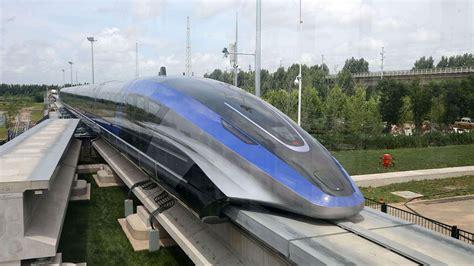
The extraordinary velocity of the CR450 is possible due to its use of magnetic levitation—a propulsion system that eliminates virtually all ground contact and rolling resistance. By floating above the tracks, friction is removed from the equation. In its place, the train uses electromagnetic force fields to push and pull the train forward, leaving aerodynamic drag as its main obstacle.
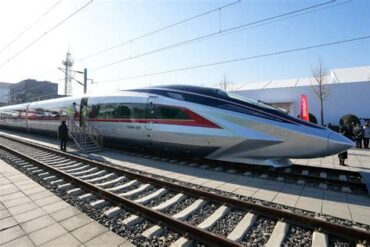
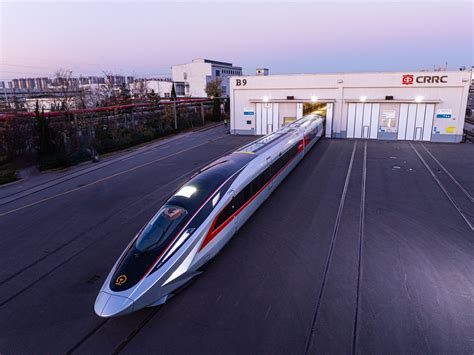
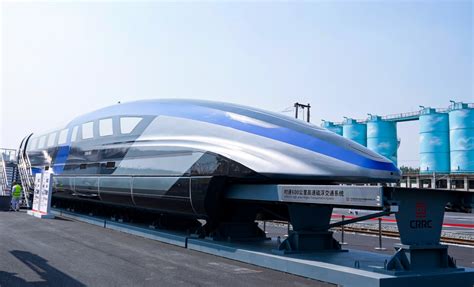
To mitigate even this remaining resistance, engineers have focused on aerodynamic design. Recent visuals of the CR450AF prototype from 2024 reveal a dramatically tapered nose, sculpted for minimal air resistance at breakneck speeds. It’s not just a visual cue but a strategic advantage, inspired by the same aerodynamic physics seen in supersonic aircraft.
From Fuxing Hao to CR450: The Evolution of China’s High-Speed Ambition
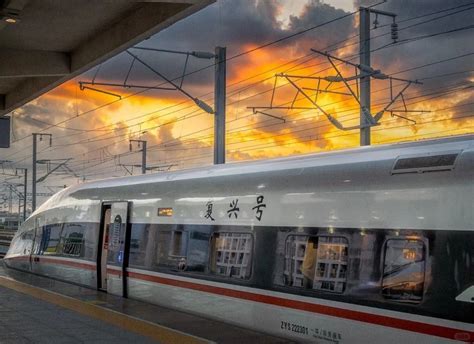
China has spent decades cultivating a reputation for railway dominance, and the CR450 is its most ambitious leap yet. Following the success of the Fuxing Hao bullet trains—which already boasted impressive speeds and reliability—the CR450 marks a shift from fast to ultra-fast. While Fuxing Hao can travel up to 217 mph, the CR450 would leave it far behind in the dust.
However, such advancements don’t come cheap. China, the fourth largest country on Earth, faces logistical and economic hurdles in laying down a nationwide maglev infrastructure. Estimates suggest that building a maglev rail system costs up to five times more than traditional high-speed rail. These expenses aren’t just from laying tracks, but also from ongoing maintenance and the need to construct entirely new rail corridors.
The Hidden Costs: Infrastructure, Noise, and Exclusivity
One of the most critical limitations of maglev systems is infrastructure incompatibility. CR450 maglev trains cannot use existing rail lines, and other trains cannot share maglev tracks. This exclusivity means that every mile of maglev track is a massive capital investment with limited flexibility.
Beyond costs, there’s a surprisingly insidious factor—aerodynamic noise. At high speeds, even with no mechanical friction, the movement of air around the train’s body produces significant noise. For instance, the Shanghai maglev, which maxes out at 267 mph (430 km/h), generates 96 decibels of sound at just 35 meters away. That’s roughly equivalent to a gas-powered lawnmower or power tools—tolerable for a short burst, but oppressive for people living near the lines.
This necessitates the construction of sound barriers, tunnels, and acoustic dampening infrastructure, all of which drive up both cost and complexity. Simply building tracks isn’t enough. Mitigating the collateral impact on urban and rural soundscapes is a prerequisite for public acceptance.
Shanghai Maglev vs. CR450: Not Even Close
The Shanghai maglev, launched in 2004, was once the envy of the high-speed world. It holds the current operational record for maglev trains, running at 267 mph. Yet the CR450 is designed to blow past that ceiling, potentially reaching two and a half times that speed.
Even more notable is how the CR450 shifts the narrative from urban shuttling to inter-regional transformation. The Shanghai maglev covers a 19-mile stretch between the city and Pudong airport. The CR450, by contrast, is being groomed to connect entire provinces and megacities, reducing what used to be multi-hour flights into sub-hour train journeys.
A Train Faster Than Planes: Societal Impact of the CR450
A train that travels faster than most passenger airplanes doesn’t just change transport—it reshapes economic and social geographies. With the CR450, it becomes conceivable to live in one province and work in another, allowing for massive decentralization of economic opportunity. Suddenly, the requirement to be based in a megacity for top-tier work evaporates.
This isn’t just theoretical. It directly addresses one of China’s most enduring issues: urban congestion. The CR450 could decongest Tier-1 cities like Beijing, Shanghai, and Guangzhou, which suffer from chronic overpopulation and infrastructure strain. And the benefits ripple outward. Real estate development could blossom in Tier-2 and Tier-3 cities, now only minutes away from industrial or financial hubs.
One historical reminder of the stakes involved is the notorious 2010 traffic jam on Highway C110, which spanned over 60 miles and lasted for 12 days. The CR450 represents not just efficiency, but resilience against such logistical failures.
Why the World Should Watch China’s CR450
The significance of the CR450 extends beyond national borders. It sets a precedent for transportation supremacy. The U.S., Japan, Germany, and South Korea have all invested in high-speed and maglev technologies, but none have come close to China’s current scale, speed, or integration roadmap.
The CR450 isn’t just about velocity—it’s about logistical superiority. Unlike air travel, maglev trains require no airports, no long check-in procedures, and minimal weather disruption. The implications for international transit, trade corridors, and regional economic integration are profound.
As China’s Belt and Road Initiative expands, the CR450 could become a vital artery of its high-speed transport web, further entwining regional economies with China’s infrastructure ecosystem. Imagine a high-speed maglev linking Beijing to Moscow, or even Beijing to Europe through Central Asia.
The Future of Ultra-Fast Ground Transport: What Comes Next?
As testing progresses, China’s Ministry of Transport is carefully evaluating the commercial viability of the CR450. There are discussions about test corridors between major hubs like Chengdu and Chongqing, and even more ambitious projects that could span 2,000 km+ regions. If successful, the CR450 may launch by 2030, redefining what it means to commute.
While critics remain skeptical about sustainability, China is betting on technological dominance to outweigh initial costs. Advances in superconducting magnets, AI-based track monitoring, and automated maintenance systems could significantly reduce long-term expenses.
If these developments pan out, maglev may not just be China’s future—it may be the world’s.
Conclusion: When Speed Becomes Strategy
The CR450 maglev train is not just an engineering feat. It’s a strategic move in the global race for infrastructure, innovation, and influence. With a top speed surpassing 620 mph, it holds the potential to fundamentally alter how nations build economies, cities, and connections.
Whether or not the world follows China’s path remains to be seen. But one thing is certain: the age of magnetic propulsion has truly begun, and China is leading the charge.