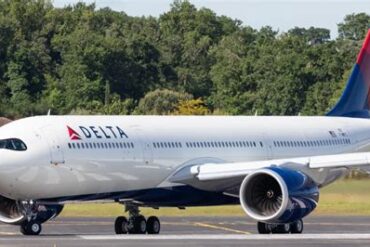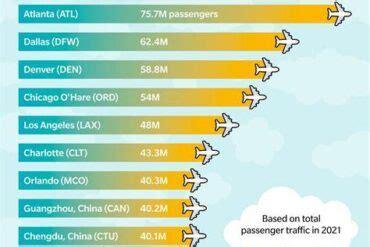
In the fiercely competitive skies of American aviation, Delta Air Lines has not only maintained its dominance but also expanded it, carrying a staggering 202 million passengers between September 2024 and August 2025. Despite rising capacity slightly outpacing traffic growth—leading to a modest drop in seat load factor to 84.4%—Delta’s strategic route planning has delivered significant passenger density in key markets. Among its expansive network, 17 airport pairs stood out, each hosting over 1 million passengers within the twelve-month period, representing 11% of the airline’s entire traffic volume. These routes, fueled by a blend of direct and connecting travelers, reveal the backbone of Delta’s North American operations.
Atlanta’s Commanding Role in Delta’s Traffic Network
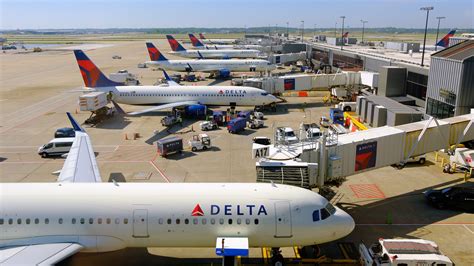
It comes as no surprise that Atlanta, Delta’s most formidable hub, dominates the list. The airline’s headquarters and busiest fortress, Hartsfield-Jackson Atlanta International Airport (ATL), anchors the majority of these million-passenger routes. This high-traffic status is not merely due to local demand but is heavily influenced by Delta’s vast connecting operations through Atlanta. Its strategic central location allows seamless connectivity between major markets on both coasts, the Midwest, and the South.
Aside from Atlanta’s omnipresence, only New York JFK to Los Angeles (LAX) managed to break into the million-passenger club without relying on Atlanta. This route, long established as a prestigious corridor between two cultural and economic giants, frequently sees Delta’s widebody aircraft, including the Boeing 767-300ER and 767-400ER, ensuring a premium experience on both ends.
Delta’s 5 Top-Performing Routes by Volume
Among the 17, five routes emerged as the heaviest trafficked, collectively transporting 7.8 million passengers, or an average of 21,300 travelers daily. Each of these operates at high seat load factors, above the system-wide average, signaling intense utilization and operational efficiency.
The busiest of all was Atlanta to Orlando, tallying 1.94 million passengers, followed by:
- Atlanta – New York LaGuardia (1.52M)
- Atlanta – Tampa (1.50M)
- Atlanta – Los Angeles (1.44M)
- Atlanta – Fort Lauderdale (1.40M)
What stands out is the significant volume of connecting passengers on these routes. For example, 71.4% of the traffic from Atlanta to Tampa and 70% from Atlanta to Orlando were connecting travelers, underscoring the importance of Delta’s hub-and-spoke model.
A Deep Dive Into Atlanta-Orlando: Delta’s #1 Route
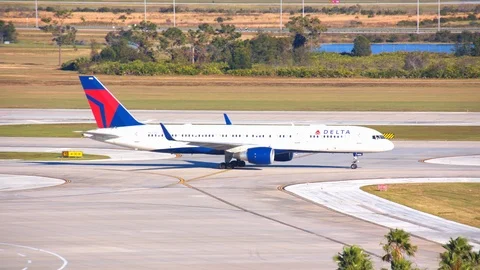
Delta’s Atlanta-Orlando corridor provides a case study in operational scale and network power. Over the year, Delta averaged 15 daily departures, adjusting frequency based on seasonal demand—from a low of 10 to a high of 17 daily flights. The route primarily used high-capacity aircraft like the Boeing 757-200 and 757-300, with occasional services on widebodies such as the A330, A350-900, and 767 variants, especially during peak periods.
Approximately 1.36 million of the 1.94 million passengers on this route connected through Atlanta, with 87% of those onward trips being domestic. Yet a remarkable 177,000 passengers transited internationally, with popular long-haul connections to Mexico, Brazil, Italy, Canada, and Argentina. Notably, the Orlando-Atlanta-Buenos Aires segment emerged as a leading intercontinental pairing.
The Power of the Connecting Hub: Hidden Origins and Destinations
Atlanta’s design as a connection nexus means that many travelers on these top routes are not originating or terminating at the endpoints. Instead, they are part of more complex journeys. For the Orlando route alone, the top ten feed markets—Huntsville, Memphis, Las Vegas, Little Rock, Nashville, Birmingham, Kansas City, Greenville/Spartanburg, Milwaukee, and Indianapolis—each funnel substantial volumes of connecting passengers.
To illustrate, Huntsville-Orlando had 75,300 round-trip passengers over the year. Despite competition from Breeze Airways’ nonstop flights, about 33,000 passengers still chose to fly via Delta’s Atlanta hub. This loyalty is driven not only by frequency and connectivity but also by advantages such as loyalty program accrual, scheduling reliability, and wider destination options—elements that low-cost carriers struggle to match.
Moreover, Breeze’s plans to increase frequency to daily service next summer, in response to Allegiant’s planned Huntsville-Sanford entry, reveal the growing competition in secondary markets and the pressure on Delta to maintain dominance through premium service and expansive reach.
Strategic Implications of Route Concentration
Delta’s ability to concentrate such significant traffic into a handful of routes without over-relying on any single market is a risk mitigation strategy. For instance, even the most heavily trafficked route—Atlanta to Orlando—accounts for less than 1% of Delta’s total traffic. This dispersion ensures resilience: a local downturn in one market won’t severely impact the airline’s broader performance.
At the same time, high-frequency deployment and diversified equipment usage allow Delta to adapt quickly to demand fluctuations. Whether accommodating business travel on premium transcontinental routes like JFK-LAX or catering to family traffic between Southern cities and Florida’s theme park corridor, Delta has engineered its network with both density and flexibility.
Conclusion: A Reflection of Operational Strength
These 17 million-plus passenger routes are more than just busy corridors—they are the lifeblood of Delta Air Lines’ strategic architecture. Anchored by Atlanta’s pivotal role, supported by widebody deployments, and fueled by both point-to-point and connecting demand, they showcase the airline’s deep understanding of passenger behavior, capacity optimization, and market positioning.
As competition heats up in both legacy and low-cost segments, Delta’s control over these ultra-dense routes gives it an unparalleled advantage. The data reveals not just popularity but a network engineered for endurance, adaptability, and sustained profitability in a dynamic aviation landscape.