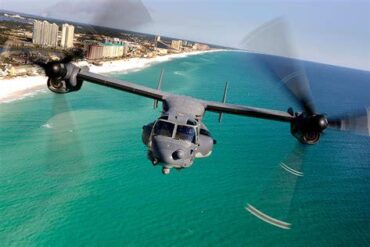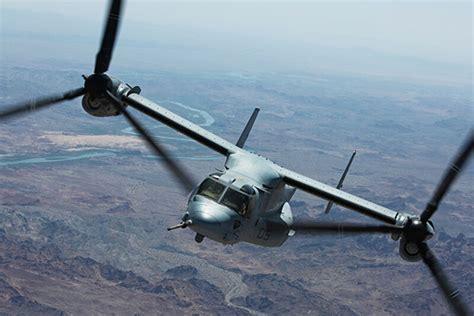
The Bell Boeing V-22 Osprey is a marvel of modern military aviation — a hybrid aircraft that blurs the line between helicopter and turboprop plane. With its ability to take off and land vertically and then convert into a high-speed, high-altitude aircraft mid-flight, the V-22 has revolutionized battlefield mobility. Since its initial flight in 1989 and its full-rate production approval in 2005, over 475 Ospreys have been delivered to the U.S. military. But behind this transformative aircraft lies a vast and complex manufacturing operation involving thousands of workers across dozens of states.
The Heart of Production: Amarillo, Texas
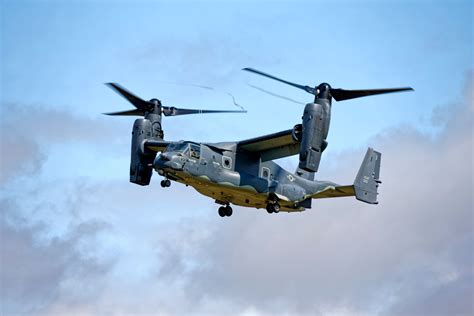
Known as “Rotor City, USA,” Amarillo, Texas, is the central hub of V-22 Osprey assembly. The plant belongs to Bell Helicopter Textron Inc., which leads the construction of all Osprey variants including the MV-22 (Marine Corps), CV-22 (Air Force), and CMV-22 (Navy) models. The sprawling facility is a cornerstone of U.S. rotary-wing aircraft manufacturing, and it is here that the aircraft comes together in its final form.
The Amarillo plant doesn’t operate in isolation. Instead, it functions as a crucial node in a much larger network of suppliers, engineers, and logistics professionals. Known collectively as “Team Osprey,” this network consists of 27,000 employees working across more than 500 companies in 44 states. It is one of the largest and most coordinated defense manufacturing programs in the world, underscoring the complexity and scale of modern aerospace engineering.
Boeing’s Crucial Role: Ridley Park, Pennsylvania
While Bell Helicopter leads final assembly, Boeing’s Vertical Lift division plays a critical role in producing the V-22’s fuselage. Located in Ridley Park, Pennsylvania, this Boeing facility has a rich industrial history — it operates from an 85-year-old former steel foundry that has been repurposed into a cutting-edge aerospace manufacturing site.
The same facility is responsible for producing the legendary CH-47 Chinook, which shares assembly lineage with the V-22. In the case of the Osprey, Boeing’s plant crafts the central airframe structures, which are then shipped to Amarillo for final integration and systems installation. The location has become synonymous with heavy-lift vertical airframes and now holds a dual legacy in rotary-wing history.
Key Contributors to the Team Osprey Ecosystem
Although Bell and Boeing are the leading forces behind the Osprey, several top-tier aerospace suppliers also contribute to its complex design and functionality:
- BAE Systems: Supplies mission systems and control integration.
- Moog Inc.: Provides the fly-by-wire flight control actuators that are essential for managing the tilt-rotor mechanism.
- Honeywell International: Contributes avionics, engine control systems, and auxiliary power units.
These collaborations showcase the intricacy of the V-22’s design and highlight why the aircraft is often described as one of the most engineering-intensive military platforms in service today.
The V-22’s Tilt-Rotor Innovation
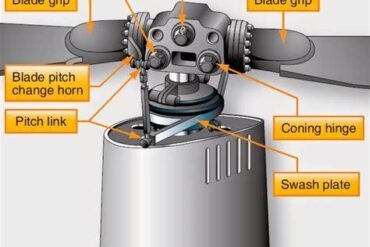
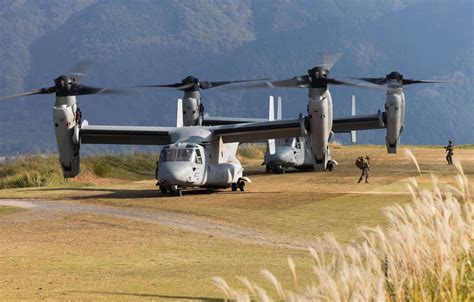
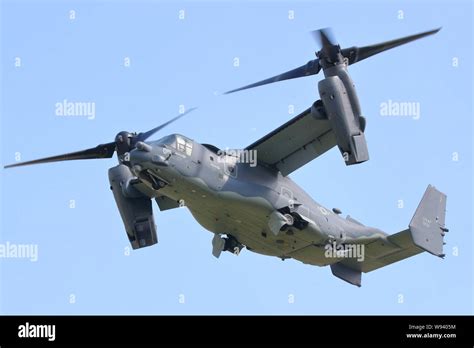
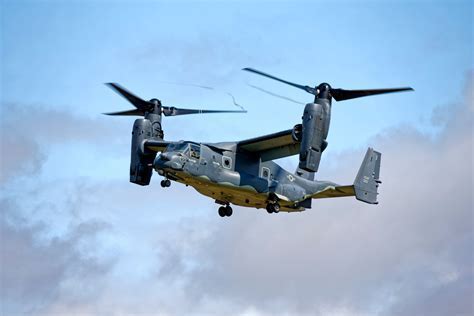
What sets the V-22 Osprey apart from traditional helicopters and fixed-wing aircraft is its revolutionary tilt-rotor system. This design enables the aircraft to transition between vertical and horizontal flight. During takeoff and landing, the nacelles tilt upwards like a helicopter. Once airborne, they rotate forward, transforming the V-22 into a turboprop aircraft capable of much higher speeds and altitudes.
This dual-mode capability addresses one of the longest-standing limitations of helicopters: their slower speed and limited range. With a maximum cruise speed of 306 mph, the V-22 is nearly twice as fast as most helicopters in its class. It also boasts a combat radius of 500 nautical miles, allowing it to operate deeper into contested territories without refueling.
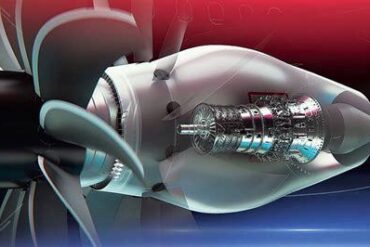
The aircraft is powered by two Rolls-Royce Liberty AE1107C engines, each generating 6,200 shaft horsepower. This gives the Osprey ample power to operate with one engine if needed, although hovering in such a scenario is not possible. Still, this feature offers a valuable margin of safety in hostile environments.
Multi-Role Capability Across All Military Branches
The V-22’s versatility allows it to serve a multitude of roles within the U.S. military. Originally developed for the U.S. Marine Corps, the aircraft now operates under three primary configurations:
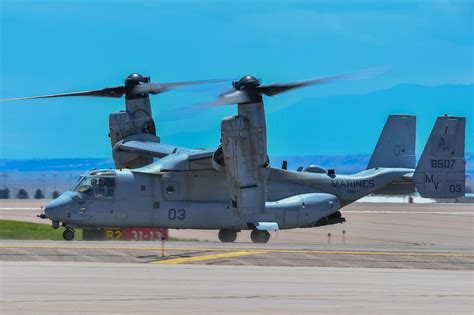
- MV-22B: Used by the Marines for assault support missions, troop transport, and cargo delivery.
- CV-22B: Operated by the U.S. Air Force Special Operations Command (AFSOC), this variant is optimized for long-range infiltration and exfiltration of special ops forces.
- CMV-22B: Used by the U.S. Navy to replace the C-2 Greyhound for Carrier Onboard Delivery (COD) missions, transporting personnel, mail, and high-priority cargo to aircraft carriers.
This adaptability has made the V-22 one of the few military aircraft to be adopted across all major service branches, cementing its importance in joint operations.
Engineering Challenges and Innovations
The path to success for the V-22 wasn’t without setbacks. Early in its development, the aircraft faced multiple challenges, from flight instability to mechanical complexity. However, years of rigorous testing and design refinement transformed the V-22 into a robust platform capable of operating in the most demanding conditions.
A key innovation lies in its fly-by-wire control system, which translates pilot input into computer-mediated responses that adjust the aircraft’s complex flight mechanics in real time. This system is critical when managing the tilt of the rotors, balancing the asymmetric forces during transition phases, and maintaining flight stability across multiple flight regimes.
In addition to advanced control systems, the V-22 includes runway independence technologies, such as retractable landing gear, ruggedized undercarriage for unprepared surfaces, and onboard diagnostic systems to streamline field maintenance.
Economic and Strategic Impact of Osprey Production
The Bell Boeing V-22 Osprey’s production is more than just a technical achievement — it is a cornerstone of the U.S. defense industrial base. With 27,000 jobs linked to the program and supply chains spread across 44 states, the aircraft supports both national security and domestic economic growth. The vast scope of “Team Osprey” provides stable, long-term employment for engineers, machinists, logistics workers, and software developers.
Moreover, the program’s success reinforces U.S. leadership in rotary-wing innovation, while also serving as a template for future joint programs involving both public and private sector partners. The strategic benefits of having an aircraft that can be deployed quickly, land in tight urban or remote spaces, and carry out special operations or humanitarian missions are immense — both in peacetime and in conflict.
The Future of the V-22 and Global Partnerships
Looking ahead, the V-22 is expected to remain in service well into the 2040s, thanks to planned upgrades and life-extension programs. This includes digital avionics enhancements, improved situational awareness tools, and integration with next-generation communication networks. Bell and Boeing continue to invest in the platform, ensuring its relevance on future battlefields.
In addition to U.S. forces, foreign military customers like Japan’s Self-Defense Forces have begun acquiring the Osprey, expanding its operational footprint globally. These international partnerships bring new dimensions to the production process, further enhancing the importance of Amarillo and Ridley Park as key global aerospace hubs.
Conclusion
The Bell Boeing V-22 Osprey is far more than a military workhorse — it is a symbol of industrial collaboration, engineering prowess, and strategic innovation. From the final assembly lines of Amarillo, Texas, to the fuselage factories of Ridley Park, Pennsylvania, the Osprey embodies what can be achieved when multiple companies, states, and workers unite under a single vision. With ongoing upgrades and a solid production infrastructure, the V-22 remains a transformative aircraft that continues to redefine the possibilities of military aviation.