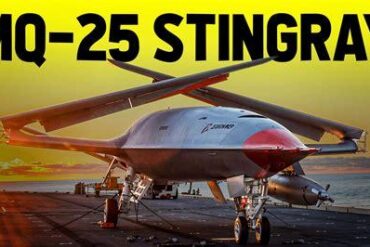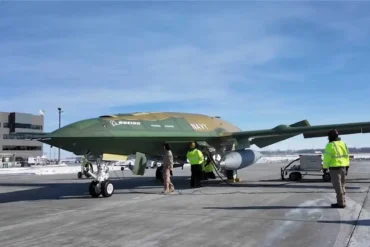
The United States Navy is entering a new era of carrier aviation where fighter pilots will no longer operate alone in the sky. Instead, they will command autonomous unmanned aircraft directly from their own cockpits while flying combat missions hundreds of miles from an aircraft carrier. At the center of this transformation is the Boeing MQ-25A Stingray, the Navy’s first operational carrier-based unmanned aerial refueling drone and one of the most important technological leaps in modern naval aviation.
For decades, Navy strike fighters have been forced to perform the exhausting and inefficient “buddy tanker” mission, where combat aircraft sacrifice weapons and range to carry fuel tanks for other jets. The MQ-25 changes that equation entirely. Rather than using expensive frontline fighters as airborne gas stations, the Navy is deploying a purpose-built autonomous tanker capable of extending the reach of the carrier air wing while simultaneously acting as a surveillance platform.
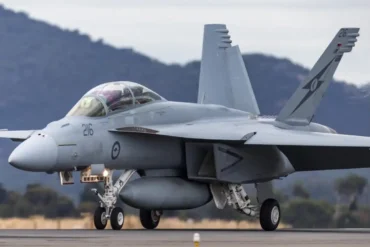
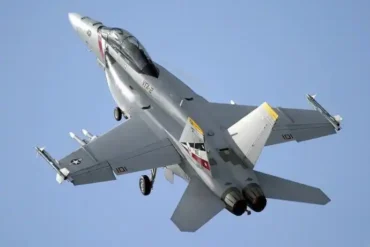
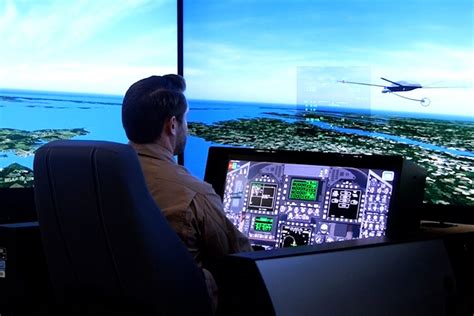
What makes the Stingray especially revolutionary is not merely its autonomy, but the way manned fighters like the F/A-18E/F Super Hornet Block III and F-35C Lightning II can directly interact with it during flight. A pilot will be able to summon the drone, reposition it, command its sensors, and initiate aerial refueling procedures without needing a traditional remote-control operator manipulating every movement from the carrier deck.
That capability fundamentally changes how naval aviation operates.
The MQ-25 is not just another drone. It is the Navy’s first large-scale implementation of manned-unmanned teaming, commonly called MUM-T, where human aviators and autonomous aircraft cooperate seamlessly during missions.
The implications stretch far beyond refueling.
Why The MQ-25 Stingray Matters To The Future Of Naval Aviation
Carrier aviation has long suffered from a simple but severe operational limitation: range. Modern anti-ship missile systems developed by potential adversaries have dramatically expanded the danger zone surrounding aircraft carriers. To survive in contested environments, Navy aircraft must strike from farther away while still carrying meaningful payloads.
That is where the MQ-25 becomes indispensable.
The Stingray can offload between 14,000 and 16,000 pounds of fuel at distances exceeding 500 nautical miles from the carrier. That single capability dramatically extends the operational reach of Super Hornets, Growlers, and F-35Cs.
Today, many Navy strike fighters spend significant portions of deployment cycles serving as tankers for their own squadrons. Estimates suggest that between 20% and 33% of combat-capable fighters in a carrier air wing are routinely tied up in this secondary role. By transferring aerial refueling responsibilities to the MQ-25, the Navy effectively gains additional strike fighters without buying new jets.
The change also reduces fatigue on aging aircraft fleets.
Super Hornets performing tanker duty accumulate flight hours rapidly while carrying heavy external fuel loads that stress airframes and engines. The Stingray absorbs that burden instead, preserving the lifespan of frontline fighters for actual combat operations.
The strategic value of that shift cannot be overstated. Every additional combat-ready fighter available for strike missions increases the lethality and flexibility of the carrier strike group.
How An F/A-18 Pilot Commands The MQ-25 From The Cockpit
The most fascinating aspect of the MQ-25 program is how naturally the drone integrates into existing fighter operations.
The Navy did not design the Stingray to be flown like a traditional remotely piloted drone where an operator manually controls every movement with a joystick. Instead, the aircraft uses advanced autonomy systems capable of executing complex flight patterns independently.
The pilot inside the Super Hornet simply issues tactical instructions.
The drone handles the rest.
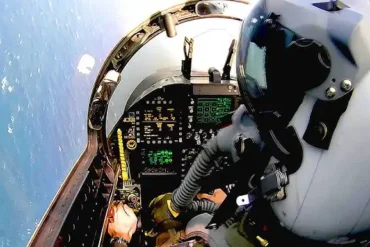
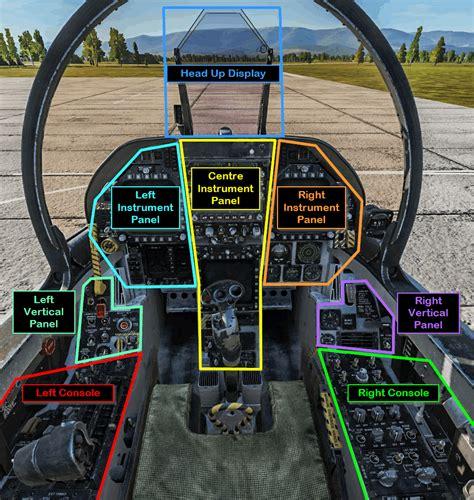
Using the large-area touchscreen display inside the Block III Super Hornet cockpit, aviators can communicate with the MQ-25 through secure high-speed data links. Pilots can summon the drone to a rendezvous point, command it to deploy its hose-and-drogue refueling system, redirect its flight path, or assign surveillance tasks.
The interaction resembles commanding a highly intelligent robotic wingman rather than directly flying another aircraft.
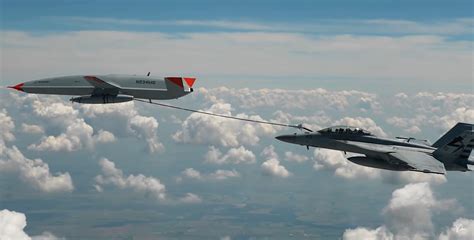
For example, during an aerial refueling mission, a pilot might request the Stingray to move into a designated orbit pattern. Once commanded, the drone autonomously calculates the flight route, stabilizes itself, deploys the drogue basket, and maintains proper tanker parameters while the fighter approaches to refuel.
The pilot does not micromanage the drone’s flight controls.
Artificial intelligence and onboard automation handle the difficult work.
This approach dramatically reduces pilot workload during already demanding missions.
The Technology That Makes Drone Control Possible
Several advanced technologies inside the Block III Super Hornet enable this unprecedented level of integration between manned fighters and autonomous aircraft.
The first is the Distributed Targeting Processor-Networked (DTP-N) computer system. This avionics upgrade delivers approximately 17 times more processing power than earlier Super Hornet mission computers. That enormous computing capability allows the aircraft to process massive amounts of sensor data, networking information, and drone-control applications simultaneously.
The second critical component is the Tactical Targeting Network Technology (TTNT) data link.
TTNT functions as an ultra-fast communications pipeline connecting the fighter to the Stingray and other networked platforms. Unlike older data links with higher latency and limited bandwidth, TTNT enables near real-time transmission of targeting data, command instructions, and even live video feeds.
That means a Super Hornet pilot could potentially receive live surveillance imagery directly from the MQ-25 while coordinating strikes with other aircraft.
The result is a fighter cockpit transformed into a flying battlefield command node.
Touchscreen interfaces simplify interaction with the drone, but critical combat functions are integrated into the aircraft’s hands-on throttle-and-stick controls to minimize pilot distraction during high-threat situations.
In practice, commanding the MQ-25 is designed to feel as intuitive as adjusting radar settings or changing navigation waypoints.
That usability is essential because fighter pilots already operate under immense cognitive pressure during combat missions.
The Navy’s objective is clear: make drone coordination almost effortless.
How The MQ-25 Operates Autonomously At Sea
Although fighter pilots can direct the Stingray during missions, the drone remains heavily autonomous throughout most phases of operation.
On the aircraft carrier, specialized operators known as Air Vehicle Pilots (AVPs) supervise the drone from the Unmanned Carrier Aviation Mission Control System MD-5 Ground Control Station.
Before launch, flight deck crews taxi the aircraft using handheld control devices while coordinating with traditional yellow-shirt directors. Once positioned on the catapult, the MQ-25 launches like any conventional naval aircraft.
After takeoff, control transitions largely to the drone itself.
The aircraft navigates through predefined waypoints autonomously while AVPs monitor system status rather than manually steering the platform. This supervisory-control model allows a relatively small number of operators to oversee multiple drones simultaneously.
The MQ-25 can autonomously execute takeoffs, navigate long-range routes, stabilize during refueling operations, and even recover aboard aircraft carriers using the Joint Precision Approach Landing System (JPALS).
That last capability is especially important because carrier landings are among the most difficult maneuvers in aviation. Automating them reliably represents a major achievement in naval aerospace engineering.
If communications are interrupted during flight, the drone can automatically execute contingency procedures such as re-establishing contact, returning to preplanned holding points, or recovering aboard the carrier independently.
The Navy is effectively building a drone capable of surviving and operating in highly contested maritime environments with minimal human intervention.
The MQ-25’s Intelligence And Surveillance Capabilities
Although the Stingray is primarily marketed as a tanker drone, its surveillance capabilities may ultimately prove just as valuable.
The aircraft is expected to carry a retractable electro-optical/infrared (EO/IR) sensor turret beneath the nose, allowing it to conduct persistent intelligence, surveillance, and reconnaissance missions across vast ocean regions.
Unlike high-performance fighters that burn fuel rapidly, the MQ-25’s efficient Rolls-Royce AE3007N engine provides approximately 10 hours of loiter time. That endurance allows the drone to remain on station for extended periods while monitoring maritime activity.
The aircraft can identify ships, monitor suspicious movements, gather imagery, and relay targeting information back to the carrier strike group in real time.
This creates enormous tactical advantages.
Instead of sending expensive fighters deep into dangerous areas simply to locate targets, the Navy can use Stingrays as forward-deployed sensor nodes. Super Hornet crews or E-2D Hawkeye airborne command aircraft can direct the drone toward areas of interest while remaining safely farther away.
The MQ-25 effectively becomes the carrier air wing’s robotic scout.
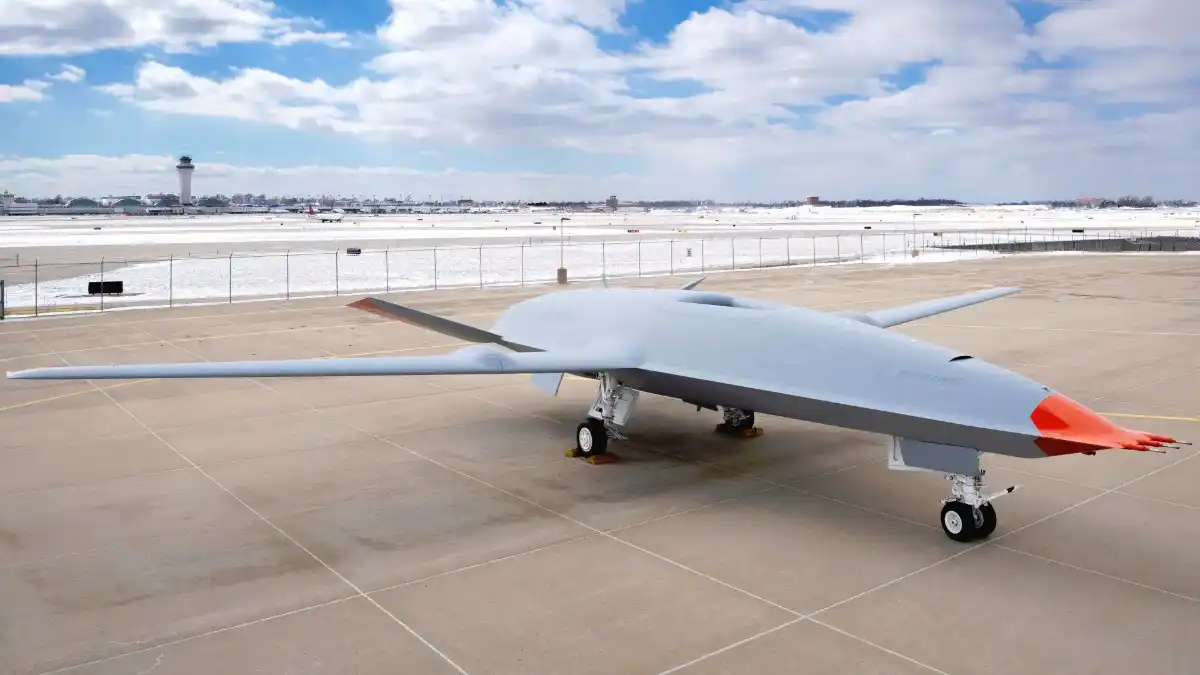
The drone may also cooperate with other Navy and joint-force assets including:
- EA-18G Growlers conducting electronic warfare
- P-8 Poseidon maritime patrol aircraft
- F-35C stealth fighters
- E-2D Hawkeye command-and-control aircraft
Because the MQ-25 is networked into the Navy’s broader combat architecture, information gathered by the drone can instantly populate the common operational picture across multiple platforms.
That level of integration is critical for future distributed maritime operations where situational awareness determines survival.
The Stingray’s Development Timeline And Testing Progress
The MQ-25 program has moved steadily from concept to operational reality over the past several years.
Boeing secured the Navy’s engineering and manufacturing development contract in August 2018 with an award worth approximately $805 million. Just over a year later, the T1 prototype completed its maiden flight in September 2019.
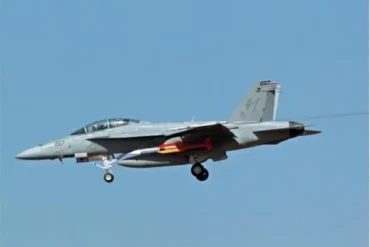
One of the program’s most important milestones occurred in June 2021 when the MQ-25 successfully refueled an F/A-18F Super Hornet in flight for the first time. That demonstration proved the aircraft could safely perform its core mission under operational conditions.
Carrier integration testing followed aboard USS George H.W. Bush (CVN-77), where deck handling procedures validated how the drone would operate alongside manned aircraft in crowded carrier environments.
The first production-representative MQ-25A completed its maiden flight on April 25, 2026. During the 2.5-hour test sortie, the aircraft demonstrated engine performance, autonomous flight controls, taxi operations, takeoff, and landing functionality.
Unlike the earlier T1 demonstrator, this production-standard version includes mission systems expected on operational aircraft, including the retractable EO/IR turret.
The next phase of testing will focus heavily on carrier suitability trials involving catapult launches and arrested recoveries at sea.
USS George H.W. Bush is expected to play a central role in these evaluations because it already hosts the Navy’s first dedicated Unmanned Air Warfare Center.
Current Navy planning aims for Initial Operational Capability (IOC) in 2029, although that target has shifted from earlier projections.
Specifications Of The MQ-25 Stingray
The Stingray’s physical design reflects its unique role as a carrier-based tanker and ISR platform.
Key specifications include:
- Length: 51 feet
- Wingspan extended: 75 feet
- Wingspan folded: 31.2 feet
- Height: 10.8 feet
- Engine: 1x Rolls-Royce AE3007N
- Thrust: 10,000 pounds
- Operational range: 500+ nautical miles
- Fuel offload capability: 14,000–16,000 pounds
Its broad wings maximize fuel efficiency and endurance, while folding wing mechanisms allow storage aboard crowded aircraft carriers.
The aircraft’s shape also incorporates low-observable design elements intended to reduce radar visibility compared to conventional support aircraft.
Why The MQ-25 Is Only The Beginning
The Stingray is not the final destination for naval unmanned aviation. It is the opening chapter.
The Navy ultimately envisions future carrier air wings where up to 60% of aircraft are uncrewed. That transformation would fundamentally alter naval warfare by combining manned fighters with autonomous collaborative systems capable of refueling, surveillance, electronic warfare, reconnaissance, and eventually strike operations.
The MQ-25 serves as the technological bridge toward that future.
It allows the Navy to solve an immediate operational problem — aerial refueling — while simultaneously teaching carrier strike groups how to integrate autonomous aircraft into day-to-day combat operations.
That institutional experience is arguably as valuable as the aircraft itself.
Every carrier landing, every autonomous taxi movement, every in-flight refueling operation, and every data-link interaction between pilot and drone helps build the foundation for a much larger unmanned ecosystem.
Future Navy drones may carry weapons, penetrate defended airspace, escort stealth fighters, or swarm hostile naval formations.
The Stingray proves that those possibilities are no longer theoretical.
A New Era Of Human-Machine Naval Warfare
For more than a century, naval aviation revolved around human pilots flying manned aircraft from aircraft carriers. The MQ-25 introduces a new operational philosophy where autonomous systems become integrated teammates rather than distant support assets.
An F/A-18 pilot commanding a robotic tanker and reconnaissance platform from a touchscreen cockpit would have sounded like science fiction only a generation ago.
Now it is rapidly becoming standard procedure.
The combination of advanced autonomy, secure networking, powerful onboard computing, and intuitive pilot interfaces is reshaping how air combat missions are conducted at sea. Instead of treating drones as isolated platforms requiring dedicated operators, the Navy is embedding unmanned capability directly into frontline fighter operations.
That shift dramatically expands what a single pilot can accomplish during combat.
The MQ-25 Stingray may not possess the glamour of a stealth fighter or the destructive power of a cruise missile, but it represents something equally important: the beginning of the Navy’s transition toward a deeply networked, semi-autonomous carrier air wing built for future high-end warfare.
And inside the cockpit of the Super Hornet, the pilot remains firmly at the center of it all.