Flying halfway across the planet compresses geography into a single, elongated stretch of time. The human body, however, stubbornly refuses to compress along with it. Fifteen to seventeen hours in the air is not just a journey—it’s a physiological experiment in sleep cycles, hydration, and patience. This is precisely where the Airbus A380 reshapes the experience, turning what could be endurance into something closer to indulgence.
Business class on these ultra-long-haul routes is not merely a seat upgrade. It is a carefully engineered environment designed to mitigate fatigue, restore circadian rhythm, and—if done well—make time feel less like an adversary. But comfort at 40,000 feet comes at a price, and on the world’s longest A380 routes, that price climbs into the realm of luxury economics.
What follows is not just a breakdown of fares, but a dissection of what travelers are actually buying when they commit thousands of dollars to a single round-trip ticket.
The Longest A380 Routes: Where Distance Meets Design
The A380 wasn’t built for short hops or efficiency records. It was built for space—a rare commodity in aviation. Airlines deploy it where distance is vast and demand for premium travel is even greater. Three routes stand out as the most extreme examples of this philosophy in action.
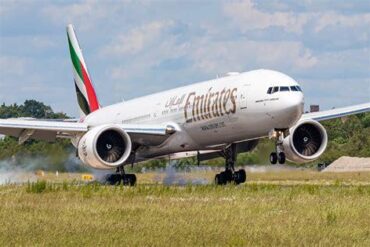
The first is operated by Emirates, linking Dubai International Airport to Auckland Airport. This flight stretches across roughly 8,800 miles and regularly exceeds 16 hours in the air. It is, in many ways, the ultimate test of long-haul comfort.
The second, run by Qantas, connects Sydney Kingsford Smith Airport with Dallas/Fort Worth International Airport. This route traverses the Pacific and clocks in at up to 17 hours depending on winds.
The third returns to Emirates, linking Dubai with Los Angeles International Airport, a route that sometimes arcs over polar regions, turning geography into something almost abstract.
Each of these flights exists in a peculiar category: too long to tolerate discomfort, too important for airlines to compromise on premium offerings.
Dubai to Auckland: The Benchmark for Ultra-Long Luxury
There is something almost absurd about flying from the Arabian desert to New Zealand’s green coastline without stopping. Yet this is precisely what Emirates has normalized.
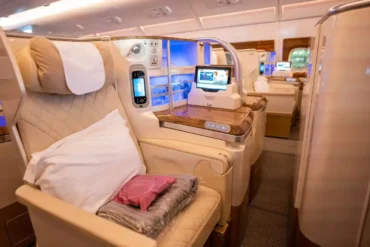
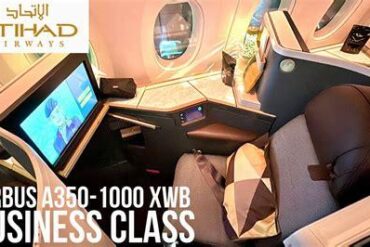
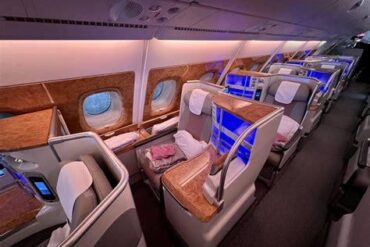
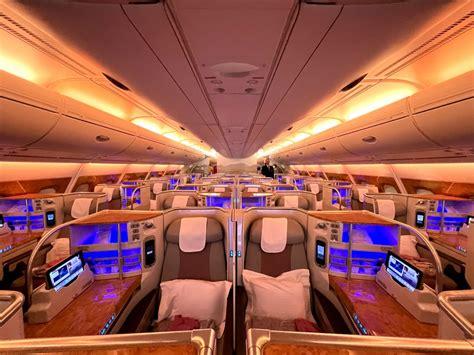
On this route, business class is designed as a temporal buffer. The seat transforms into a fully flat bed, but more importantly, the cabin itself is structured to allow phases of activity—dining, working, socializing, sleeping—rather than a single prolonged period of passive sitting.
Passengers step into an environment where the seat pitch, aisle access, and cabin layout eliminate the micro-frictions of travel. No climbing over strangers. No negotiating elbow space. The design quietly removes stressors before they can accumulate.
The onboard lounge—arguably the A380’s most theatrical feature—acts as a social pressure valve. Humans are not designed to remain seated for 16 hours, and Emirates acknowledges this with a standing bar area where movement is encouraged.
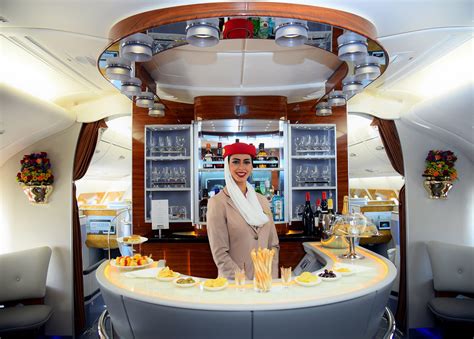
Dining follows a restaurant logic rather than airline logic. Multi-course meals, flexible timing, and curated wine lists shift the experience away from rigid service schedules toward something more fluid.
The result is a paradox: the longer the flight, the more valuable this environment becomes.
What It Actually Costs: Dubai to Auckland Business Class
The price spectrum on this route reflects both demand and flexibility. A round-trip business class ticket typically ranges from $3,500 to over $10,000, depending on how much control a traveler wants over their itinerary.
Lower-tier fares strip away flexibility. Change a date, and penalties appear. Cancel a trip, and value evaporates. Higher-tier fares, on the other hand, function almost like insurance policies—allowing adjustments without financial pain.
But here’s the subtle truth: the real cost is not just the ticket price. It’s the trade-off between money and physical strain. Sixteen hours in economy is not simply cheaper—it is a fundamentally different physiological experience.
The business class premium buys sleep quality, reduced fatigue, and the ability to arrive functional rather than depleted. For corporate travelers, that difference can translate directly into performance.
Sydney to Dallas: Qantas and the Psychology of Distance
The Sydney–Dallas route is less about spectacle and more about precision engineering of comfort. Qantas approaches long-haul travel with a slightly different philosophy: minimize disruption to the passenger’s biological rhythm.
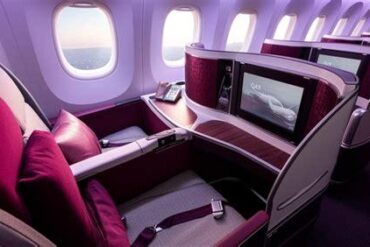
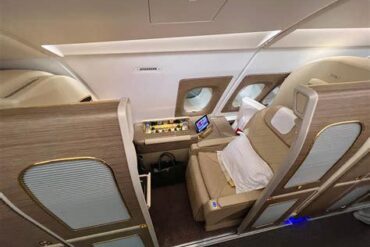
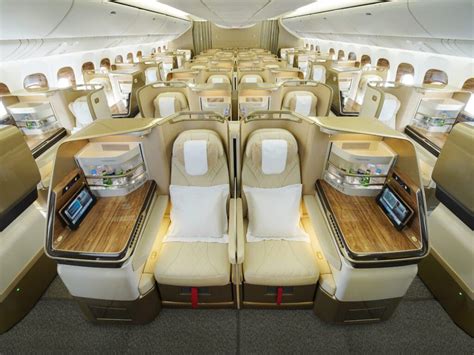
The business class cabin on the A380 is arranged in a 1-2-1 configuration, ensuring direct aisle access for every passenger. This isn’t just a convenience—it’s a design decision rooted in human behavior. People sleep better when they know they won’t be disturbed.
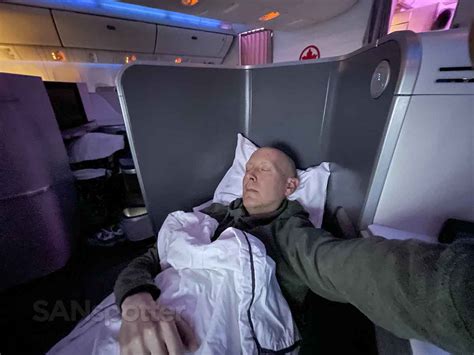
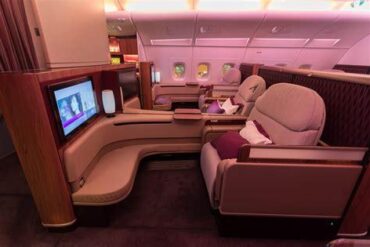
The seat converts into a bed nearly two meters long, accommodating a wide range of body types without forcing awkward compromises. Storage compartments, privacy screens, and lighting controls create a personal micro-environment within the larger cabin.
Food plays a different role here. Qantas leans into its Australian identity, offering menus shaped by regional ingredients and wine selections. This is not just branding—it’s sensory anchoring. Familiar flavors can subtly reduce travel fatigue by grounding passengers in something recognizable.
Business Class Pricing on Sydney to Dallas
This route sits firmly at the higher end of the pricing spectrum. Round-trip fares generally fall between $7,000 and $11,000, with seasonal spikes pushing prices even higher.
The Pacific crossing amplifies demand. Business travelers, expatriates, and long-haul leisure passengers all converge on this route, creating consistent upward pressure on fares.
Booking strategy becomes almost a game of probability. Early reservations can unlock relatively lower fares, while last-minute bookings often collide with peak pricing. Frequent flyer programs add another layer, allowing savvy travelers to convert accumulated miles into outsized value.
Yet again, the underlying equation remains unchanged: time in discomfort versus money spent on comfort.
Dubai to Los Angeles: Long-Haul as a Global Connector
The Dubai–Los Angeles route represents something slightly different. It is not just long—it is strategically long, linking two global hubs across continents and cultures.
The A380’s role here is to make that connection seamless. Emirates replicates much of its flagship experience from the Auckland route, including lie-flat seats, expansive entertainment systems, and the signature onboard lounge.
The flight often tracks routes that curve over polar regions, a reminder that aviation operates on a spherical planet, not a flat map. This subtle geometric reality adds both distance and fascination to the journey.
Pricing mirrors the Auckland route closely, typically ranging from $3,000 to $10,000, with averages clustering around $8,000 for peak travel periods.
The consistency in pricing across these ultra-long routes reveals something important: once flights cross a certain duration threshold, cost becomes less about distance and more about experience design.
What You’re Really Paying For at 40,000 Feet
It’s tempting to think of business class as a bundle of features—seat, food, entertainment. That’s a surface-level interpretation. The deeper reality is that airlines are selling control over time and discomfort.
A fully flat bed is not just a seat—it’s the ability to maintain cognitive function after landing. Priority boarding is not just convenience—it’s the removal of friction from the travel process. Lounge access is not just luxury—it’s a transition space that reduces stress before the journey even begins.
There’s also an architectural advantage baked into the A380 itself. Its double-deck design allows for wider cabins, higher ceilings, and social spaces that simply don’t exist on smaller aircraft. This isn’t aesthetic—it’s functional. Space reduces stress. Reduced stress improves the travel experience.
Why Ultra-Long A380 Flights Command Premium Prices
The economics of these routes are as complex as the flights themselves. Operating an A380 is expensive. Fuel, maintenance, crew logistics, and airport infrastructure all scale upward with aircraft size and distance.
But the more interesting factor is demand elasticity. Passengers willing to spend $8,000 on a ticket are not just buying transportation—they are buying certainty. Certainty of comfort. Certainty of rest. Certainty of arriving ready.
Corporate travel policies often reinforce this dynamic. When productivity matters, the cost of a business class ticket becomes trivial compared to the cost of a fatigued executive missing a critical meeting.
There’s also a psychological component. Humans are remarkably bad at valuing long-term discomfort. The idea of enduring 16 hours in economy may seem manageable—until the experience begins. Business class pricing, in a sense, monetizes that gap between expectation and reality.
The A380’s Enduring Role in Long-Haul Luxury
In an aviation world increasingly obsessed with efficiency and smaller twin-engine aircraft, the A380 remains an outlier. It is not the most economical plane to operate, but it is arguably the most experiential.
Airlines continue to deploy it on routes where experience matters as much as capacity. The aircraft’s ability to host lounges, spacious cabins, and premium-heavy configurations ensures its relevance in the luxury segment.
For passengers, the equation is simple but not trivial: pay more, suffer less. Yet beneath that simplicity lies a deeper truth about modern travel. When distances stretch beyond 15 hours, comfort stops being a luxury and becomes a functional necessity.
And that is where the A380, with all its improbable scale and deliberate design, quietly justifies its existence—one long-haul flight at a time.