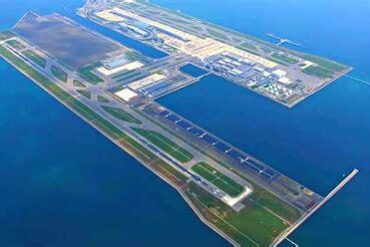
Japan’s Kansai International Airport (KIX), hailed as an engineering marvel when it opened in 1994, stands today as both a symbol of human ingenuity and a stark reminder of nature’s immutable forces. Built on an artificial island in Osaka Bay, the airport was envisioned as a long-term solution to alleviate congestion at Osaka’s Itami Airport. Spanning two man-made islands, Kansai was constructed with a staggering investment of over $20 billion, heralded worldwide as the only true offshore airport. Three decades later, Kansai Airport remains Japan’s third-busiest aviation hub, handling nearly 26 million passengers in 2023 alone. Yet beneath its sleek terminals and bustling runways, an unrelenting geological battle threatens its very existence: Kansai is sinking into the sea at a pace that has exceeded early projections.
The airport’s location, while advantageous for minimizing noise pollution and accommodating growth, sits atop a foundation of alluvial clay and silt—materials notorious for their compressibility under immense weight. From the outset, engineers anticipated some degree of settlement. However, the magnitude of the subsidence has proven far greater than forecast. Construction began in 1987, and by 1990, even before the first flight landed, the island had sunk nearly 27 feet—far surpassing the predicted 19 feet. To accelerate the settling process, engineers employed sand drains to force water out of the seabed, hastening consolidation. Despite these efforts, Kansai’s artificial island continues its slow descent.
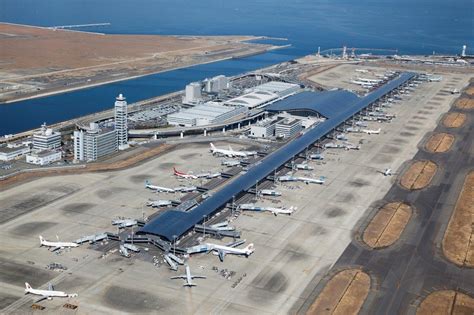
At its peak, the sinking rate reached more than 19 inches per year. Thanks to a combination of innovative engineering countermeasures, including raising the seawalls and installing hydraulic jacks with iron plates to elevate the structure incrementally, the rate has slowed considerably. By 2008, it was reduced to 2.8 inches per year, and more recent data from 2023 places the rate at approximately 2.3 inches annually. Despite these advancements, the sinking is not uniform across the site, leading to uneven surfaces and additional maintenance challenges.
The root causes of Kansai’s predicament are multi-faceted. The seabed’s natural composition—a treacherous blend of loose clay and silt—has never offered a stable foundation. Compounding this is the sheer weight of the fill material used to create the island, totaling approximately 69.5 square miles of dredged soil and rock. The method of construction, which involved layering this material onto the soft seabed before full consolidation, left the airport vulnerable to ongoing settlement. Complicating matters further were initial engineering miscalculations, which underestimated the long-term behavior of the seabed under sustained pressure.
While the pace of sinking has moderated, the threat to Kansai’s viability is not confined to subsidence alone. The airport is situated in a region frequently battered by typhoons, storm surges, and seismic activity. The catastrophic flooding triggered by Typhoon Jebi in 2018, which inundated the airport and stranded thousands of passengers, underscored the vulnerability of this coastal infrastructure. As climate change accelerates, the risks posed by rising sea levels and intensified weather events will likely exacerbate Kansai’s existing challenges.

In response to these existential threats, Kansai Airports, operated by the Orix-Vinci consortium, has invested heavily in ongoing mitigation strategies. Over $150 million has been dedicated to strengthening seawalls, while hydraulic systems continue to be refined to maintain the airport’s elevation. Despite these efforts, the reality remains that the cost of maintaining Kansai will escalate over time, posing significant financial and logistical hurdles.
Interestingly, the airport’s decline is not halting its ambitions. Kansai is pursuing an expansion plan aimed at increasing its annual passenger capacity from 25.9 million to 40 million. This paradox of growth amidst geological instability reflects a broader commitment to preserving Kansai’s status as a premier aviation hub. Engineers remain cautiously optimistic, with some projections indicating that certain sections of the airport may fall below sea level as early as 2056, but the overall operational viability could extend for many decades thanks to advanced monitoring and adaptive infrastructure.
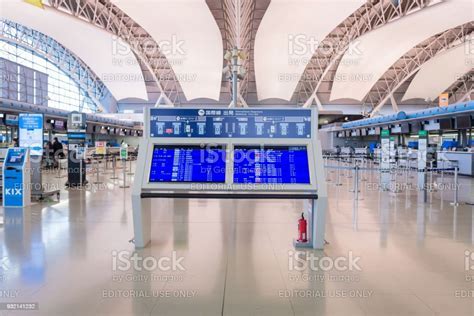
Kansai’s story is not merely one of sinking foundations; it is a testament to the dynamic interplay between human ambition and environmental reality. The airport’s resilience, bolstered by technological ingenuity and relentless maintenance, exemplifies the lengths to which modern society will go to sustain critical infrastructure. However, it also serves as a cautionary tale—a reminder that nature, no matter how masterfully we attempt to tame it, often has the final word.
In the coming years, Kansai International Airport will continue to navigate these treacherous waters, both literally and figuratively. The combination of geological challenges, climate pressures, and economic imperatives ensures that Kansai remains not only a vital node in Japan’s transportation network but also a focal point of global engineering discourse. Whether Kansai can outlast its environmental obstacles remains to be seen, but one thing is certain: the eyes of the world will be watching as this floating marvel fights to stay afloat.