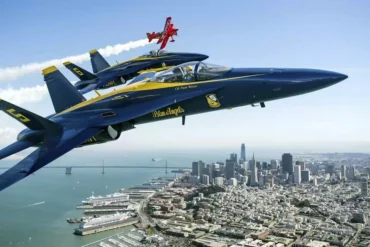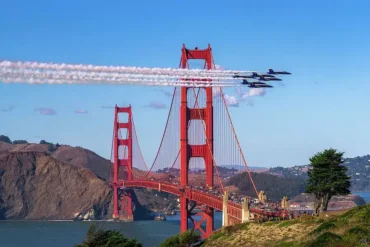
The Blue Angel Pilots are elite aviators whose precision and commitment to excellence have made them icons in military aviation. They combine rigorous training, advanced technical skills, and a deep-seated sense of duty to create aerial performances that are both breathtaking and technically flawless.
Meet the 2024 Blue Angel Pilots
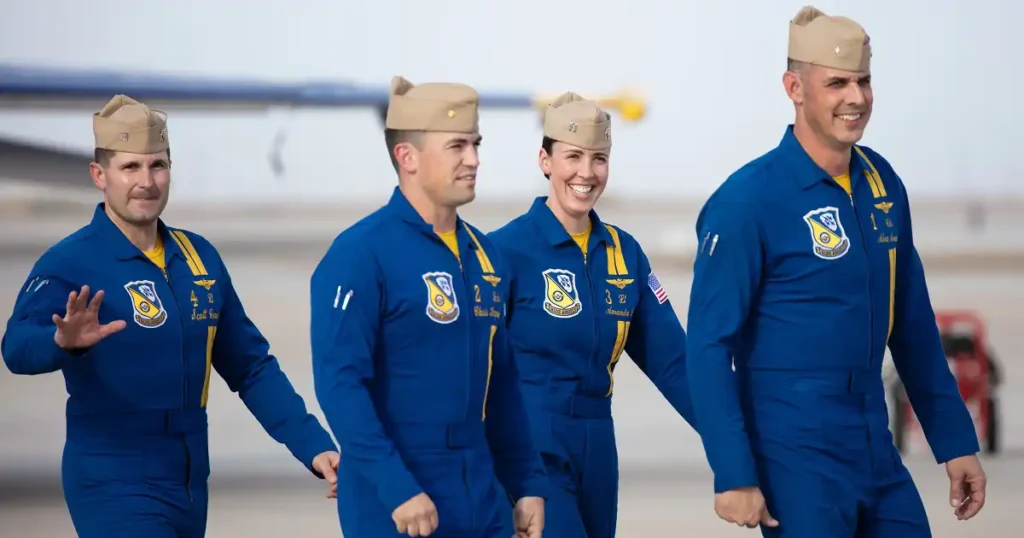
Cmdr. Alexander P. Armatas – The Visionary Flight Leader
Cmdr. Alexander Armatas is a native of Skaneateles, New York, and a graduate of the United States Naval Academy with a Bachelor of Science in aerospace engineering. As the Flight Leader, Commanding Officer, and pilot of the No. 1 jet, his technical expertise and leadership set the tone for the entire team.
Lt. Cmdr. Jack Keilty – The Determined Strategist
Hailing from Oklahoma City, Lt. Cmdr. Jack Keilty is known for his strategic mindset and robust background. A Virginia Military Institute alumnus with a history degree, he has advanced from Naval Air Station Pensacola to a pivotal role within the team, showcasing a career dedicated to precision and performance.
Lt. Wesley Perkins – The International Talent
Born in Italy and raised in Georgetown, Texas, Lt. Wesley Perkins brings a diverse background to the Blue Angels. A Texas A&M University graduate in ocean engineering, his technical prowess and varied experiences contribute significantly to the team’s dynamic approach to formation flying.
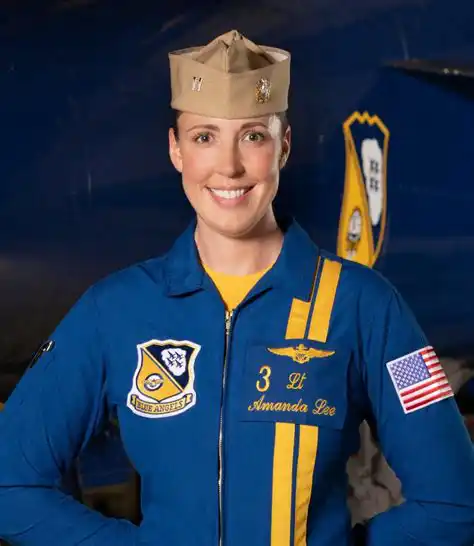
Lt. Cmdr. Amanda Lee – Pioneering Female Excellence
Lt. Cmdr. Amanda Lee from Mounds View, Minnesota, represents groundbreaking progress in military aviation. A former athlete and a graduate of the University of Minnesota Duluth and Old Dominion University (with a Bachelor of Science in biochemistry), she now serves as the left wing and pilot of the No. 3 jet. Her achievements highlight the evolving diversity and skill within the team.
Lt. Cmdr. Griffin Stangel – The Master of Solo Maneuvers
From Madison, Wisconsin, Lt. Cmdr. Griffin Stangel has a strong background in air traffic control, earned from the University of North Dakota. As the opposing solo pilot of the No. 6 jet, his expertise in executing intricate maneuvers under high pressure is indispensable to the team’s success.
Cdr. Thomas Zimmerman – The Esteemed Narrator
Cdr. Thomas Zimmerman of Baltimore, Maryland, serves as the voice of the Blue Angels. With a solid foundation from the United States Naval Academy, Zimmerman’s engaging and insightful narration connects the audience to the high-octane performances in the sky.
Lt. Connor O’Donnell – The Operational Strategist
A native of Freeport, Maine, Lt. Connor O’Donnell graduated from the United States Naval Academy with a degree in operations research. His analytical skills are crucial for planning and executing complex aerial formations, making him a key player as the opposing solo pilot.
Lt. Cmdr. Brian Vaught – The Dynamic Events Coordinator
Completing the pilot roster, Lt. Cmdr. Brian Vaught from Englewood, Colorado, holds a Bachelor of Science in business administration from the University of Colorado Boulder. His early career in sports marketing and his role as the events coordinator ensure that every air show is meticulously organized and executed.

The Backbone of the Blue Angels: Fat Albert Pilots
In addition to the F/A-18E/F Super Hornet pilots, the team is supported by the iconic C-130J Super Hercules, affectionately known as Fat Albert.
| Name | Service Branch | Role |
|---|---|---|
| Capt. Sam Petko | USMC | Lead C-130J “Fat Albert” pilot |
| Capt. Isaac Becker | USMC | C-130J “Fat Albert” pilot |
| Maj. Josh Horman | USMC | C-130J “Fat Albert” pilot |
These pilots play a crucial role in support operations, ensuring the jet demonstrations are seamlessly integrated into each air show.
Meet the 2025 Blue Angel Pilots
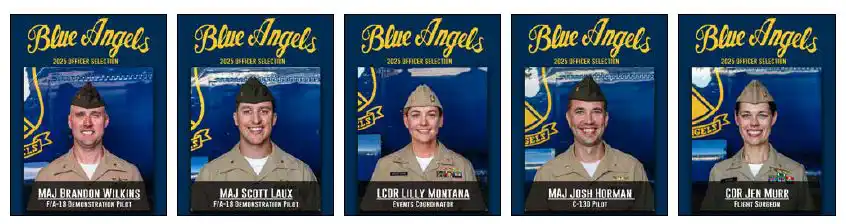
As the 2025 air show season approaches, new talent is set to join the ranks alongside seasoned veterans. The upcoming season will feature a refreshed lineup of pilots flying the F/A-18E/F Super Hornets and support aircraft, ensuring that the tradition of excellence continues. The announced roles for the 2025 season include:
| # | Name | Service Branch | Role |
|---|---|---|---|
| 1 | Cmdr. Adam Bryan | USN | Flight leader and commanding officer |
| 2 | Cmdr. Jack Keilty | USN | Right wing |
| 3 | Maj. Brandon Wilkins | USMC | Left wing |
| 4 | Lt. Cmdr. Wes Perkins | USN | Slot |
| 5 | Cmdr. Thomas Zimmerman | USN | Lead solo |
| 6 | Lt. Connor O’Donnell | USN | Opposing solo |
Simultaneously, the support aircraft known as Fat Albert will continue to be piloted by:
| Name | Service Branch | Role |
|---|---|---|
| Capt. Sam Petko | USMC | Lead C-130J “Fat Albert” pilot |
| Capt. Isaac Becker | USMC | C-130J “Fat Albert” pilot |
| Maj. Josh Horman | USMC | C-130J “Fat Albert” pilot |
This blend of experienced leadership and emerging talent ensures that the Blue Angels remain at the forefront of aerial demonstration, integrating modern technological advancements with time-honored precision flying techniques.
How to Become a Blue Angels Pilot
Becoming a Blue Angels Pilot is an honor that demands exceptional skill, discipline, and a rigorous selection process. The basic requirements include:
- Active Duty Service: Candidates must be active-duty pilots in the Navy or Marine Corps.
- Carrier Qualification: Pilots need to be qualified for aircraft carrier operations.
- Flight Hours: A minimum of 1,000 flight hours is required to demonstrate sufficient experience.
- Physical and Mental Fitness: Candidates must pass stringent physical tests, including a 20-minute, 40-pound strength test designed to simulate the physical demands of controlling a high-performance jet.
- Vetting Process: Potential pilots undergo an exhaustive vetting process that includes peer interviews and recommendations from commanding officers. This process assesses not only flight skills but also leadership potential and teamwork capabilities.
Once selected, pilots join a period of intensive training that involves shadowing experienced team members across multiple air shows, advanced technical training, and continuous performance evaluations. This hands-on approach ensures that every pilot is prepared to execute the precise, high-risk maneuvers that define the Blue Angels’ performances.
Blue Angels Pilot Salary
Blue Angels Pilot Salary is determined by standard military pay scales, based on rank, years of service, and specific job roles. It is important to note that serving with the Blue Angels is a voluntary assignment and does not come with extra pay beyond the standard military compensation. For many pilots, the opportunity to fly with this prestigious team is considered an honor and a career highlight rather than a source of additional income.
The pay structure emphasizes that the role is more about prestige, skill development, and public service. The experience gained as a Blue Angels pilot significantly enhances an officer’s career, opening doors to further advancement and specialized opportunities within military aviation.
Streamlined Path to Excellence
The journey of the Blue Angel Pilots is built on a foundation of rigorous training, continual performance evaluation, and a strong commitment to teamwork. Every pilot undergoes a disciplined process to ensure they are ready for the challenges of precision flight:
- Selection: The initial vetting process focuses on a candidate’s flying experience, technical expertise, and leadership potential.
- Training: Selected pilots participate in an intensive training program that includes simulator sessions, live flight exercises, and real-time performance evaluations.
- Continuous Improvement: Even after joining the team, pilots are constantly challenged to improve and adapt, ensuring that every performance meets the highest standards of safety and precision.
This streamlined approach not only enhances the operational efficiency of the Blue Angels but also ensures that every team member upholds the tradition of excellence that has defined the team for decades.
The Blue Angels Team: A Cohesive Force
While the pilots are the face of the Blue Angels, the team’s success is built on a network of support personnel. Approximately 158 active-duty service members, including around 100 enlisted sailors and Marines, contribute to the smooth operation of every air show. These support teams are organized into 45-member groups that travel to each show site, handling maintenance, logistics, and on-ground coordination.
The rigorous selection and training process for enlisted personnel mirrors that of the pilots, ensuring that every member is capable of maintaining the high standards required for air-show certification. This cohesive force, with every individual contributing their specialized skills, enables the Blue Angels to deliver world-class performances time and again.
A Legacy of Service and Innovation
The Blue Angel Pilots are not only symbols of aviation excellence—they represent a commitment to service and national pride. Every flight, every maneuver, and every training session reflects the dedication of military personnel to their country and their craft. Serving with the Blue Angels is seen as a career milestone, an opportunity to hone one’s skills, and a chance to inspire future generations of aviators.
The combination of rigorous selection, extensive training, and a cohesive support structure creates an environment where precision, innovation, and discipline thrive. This dynamic approach allows the Blue Angels to continually elevate the standards of military aviation and to remain a powerful symbol of national strength and pride.
Conclusion
The Blue Angel Pilots epitomize the highest levels of skill, discipline, and commitment in military aviation. From the rigorous path to selection and training to the distinguished performance on display at every air show, their journey is marked by both individual excellence and cohesive teamwork. With transparent salary structures reflecting standard military compensation and a clear, competitive process for joining the team, becoming a Blue Angels pilot is as much about passion and honor as it is about technical mastery.
As the team evolves with fresh talent and innovative techniques, the legacy of the Blue Angels continues to inspire awe and admiration. Their aerial demonstrations not only showcase the precision of modern military aviation but also serve as a powerful reminder of the dedication and sacrifice that underpin every flight. The Blue Angel Pilots stand as beacons of excellence—a legacy forged in the skies and a promise of continued innovation and service for generations to come.