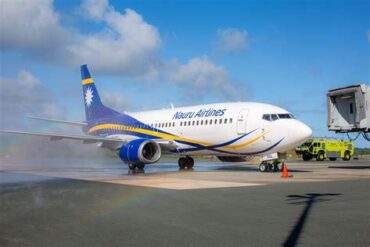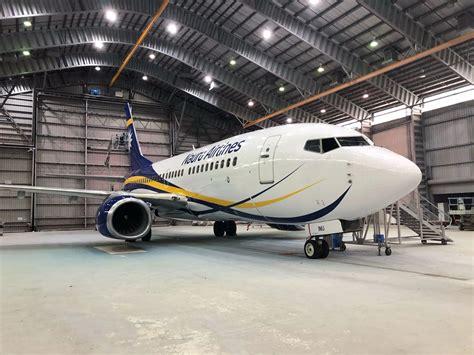
Founded in 1969 as Air Nauru, Nauru Airlines remains one of the Pacific’s most persistent carriers—an emblem of sovereignty for the Republic of Nauru and a lifeline for the island nation’s fragile connectivity. Its journey from ambitious regional operator to a modest but strategic airline reflects the broader geopolitical and economic transformations of Oceania. Operating today from Nauru International Airport with a key operations hub in Brisbane, Australia, Nauru Airlines continues to serve as a bridge between isolated communities and major regional centers.
Throughout its history, Nauru Airlines has weathered extreme economic volatility, changing political landscapes, and technical setbacks. Yet, against these odds, it has consistently rebuilt itself. Its role is not just commercial but nationalistic—ensuring connectivity for Nauru’s citizens and visibility for the nation on the world stage.
The Origins: Air Nauru’s Bold Pacific Vision
The airline’s founding on 17 September 1969, followed by its inaugural flight on 14 February 1970, coincided with Nauru’s post-independence ambitions. Buoyed by immense phosphate revenues during the 1970s, the Nauruan government positioned Air Nauru as a powerful expression of autonomy and reach. Initial acquisitions of Fokker F28 Fellowship jets in 1972 were a symbol of modernity, while expansion to Boeing 727-100 and 737-200 aircraft reflected an aim to dominate air traffic across the central and western Pacific.
At its height in the early 1980s, Air Nauru operated a fleet of seven aircraft, flying to destinations as far-flung as Tokyo, Singapore, Hong Kong, Honolulu, Auckland, and Sydney. This was made possible by the country’s immense phosphate-derived wealth, which subsidized loss-making routes that were otherwise unviable in terms of passenger demand. The airline served as a diplomatic instrument, connecting Pacific Island nations with one another and to larger economies.
However, the model was deeply unsustainable. Political interference, ad hoc route management, and a lack of commercial accountability plagued operations. Aircraft were at times deployed for non-commercial missions, including search-and-rescue operations across the vast oceanic region, stretching the airline’s logistical and financial limits.
Collapse, Rebirth, and Rebranding
The 1990s ushered in harsh realities. A steep fall in phosphate income, coupled with unresolved disputes between airline pilots and management, precipitated operational instability. The government corporatized the airline as the Nauru Air Corporation in July 1996, attempting to isolate it from direct political control, yet this did little to resolve underlying inefficiencies.
By 2005, Nauru Airlines had lost all operational aircraft. Its last remaining jet, a Boeing 737, was repossessed in Melbourne due to unpaid leasing fees. This forced a complete suspension of services. With no aircraft and mounting debt, Nauru’s connectivity with the outside world was severed, sparking a national and regional crisis.
Rescue came in October 2006, through foreign aid and diplomatic backing from Taiwan, which enabled the acquisition of a second-hand Boeing 737-300. The airline reemerged under a new name: Our Airline. This rebranding sought to restore public trust and detach the company from the financial missteps of the past.
In August 2014, the airline adopted its current name, Nauru Airlines, aligning its identity more closely with the country it represents. Under the leadership of CEO Ingo Eoe, the restructured airline focused on a sustainable model, scaling down routes, acquiring more fuel-efficient aircraft, and establishing critical partnerships.
Strategic Route Management and Realignment
Unlike its expansive past, Nauru Airlines today operates a lean but strategically vital network. As of December 2023, it serves eight international destinations:
- Brisbane (Australia) – primary operations hub
- Nauru (Yaren District) – home base
- Tarawa (Kiribati)
- Majuro (Marshall Islands)
- Koror (Palau)
- Kiritimati (Christmas Island)
- Pohnpei (Micronesia)
- Nadi (Fiji)
This trimmed network reflects a transition toward essential connectivity rather than prestige or symbolic routes. The airline’s service to remote Micronesian and Polynesian atolls ensures access to education, health, and commercial services, often unavailable locally.
Nauru Airlines applied for U.S. DOT approval in May 2023 to operate cargo and passenger flights to Guam, signaling renewed interest in expanding its commercial reach. The application coincided with the acquisition of a Boeing 737-800SF freighter, indicating a more diversified business model that includes logistics and regional freight delivery.
Fleet Modernization and Operational Capabilities
Today’s fleet is tailored to operational resilience and efficiency in the Pacific theater. As of late 2023, Nauru Airlines operates seven aircraft, comprising:
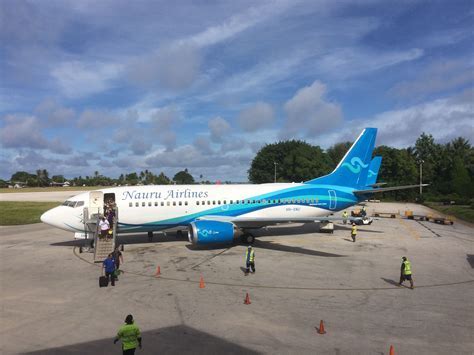
- 2× Boeing 737-300 (passenger)
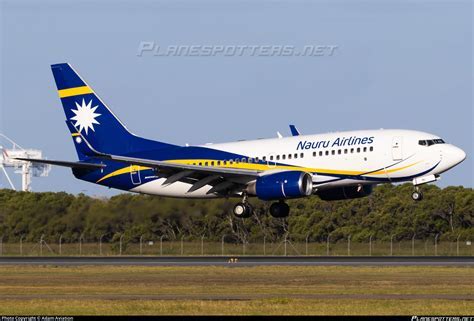
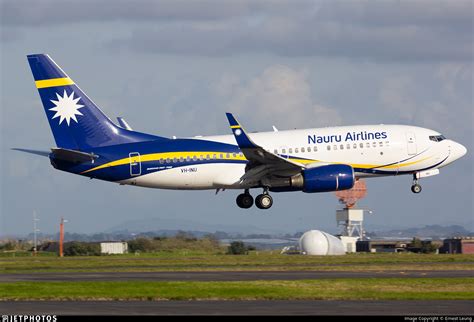
- 1× Boeing 737-700 (passenger)
- 2× Boeing 737-300SF (freighter)
- 1× Boeing 737-800SF (freighter)
These aircraft types are ideal for the relatively short regional sectors Nauru Airlines operates. The 737-700, for instance, offers greater range and fuel efficiency, enabling direct service between Brisbane and distant Pacific territories. The freighter aircraft are deployed for vital cargo services, including medical shipments, perishables, and mail, connecting otherwise logistically isolated islands.
Former aircraft in the fleet include the iconic Boeing 727-100, 737-200, and Dassault Falcon 20. The discontinuation of older models was driven by fuel inefficiency and increasing maintenance costs. Aid and external financing played a pivotal role in fleet renewal, most notably the acquisition of VH-NLK in 2008 and a rebranded 737-300 in 2013 bearing the Our Airline livery.
Partnerships and Regional Cooperation
Given its limited scale, interline agreements are central to Nauru Airlines’ network utility. Existing agreements with Air Kiribati and Hahn Air allow for more fluid bookings and passenger movement between partner networks. These alliances extend the practical reach of Nauru Airlines beyond its direct destinations.
In earlier years, the airline also played a role in supporting Norfolk Island connectivity, operating flights on behalf of Norfolk Jet Express until June 2005, and later under contract with Norfolk Air via Qantas 737-400s. Though this venture ended in March 2012 when Air New Zealand assumed the route, it exemplified Nauru Airlines’ flexibility in contract charter services.
Economic and Diplomatic Significance
For Nauru, the national airline is far more than a commercial enterprise. It is a pillar of international presence, essential to the country’s diplomatic relevance and self-reliance. The loss of air services in 2005 was not just a transport crisis—it was a national security and economic emergency. Resurrecting the airline restored a crucial link for trade, education abroad, medical evacuation, and foreign policy engagement.
Furthermore, the airline’s survival is testament to geopolitical dynamics in the Pacific. Support from Taiwan, amid its contest for influence with China, was instrumental in reviving the airline. Similarly, Australia’s interest in ensuring regional stability reinforces Brisbane’s importance as a base.
Future Outlook and Strategic Imperatives
Going forward, Nauru Airlines faces the challenge of relevance in an increasingly competitive and regulated regional aviation landscape. It must balance economic sustainability with its public service mandate. A potential Guam route, if approved, would deepen its U.S. engagement, while freight operations may offer a buffer against volatile passenger demand.
To secure its future, the airline must continue investing in:
- Fleet efficiency and modernization
- Crew training and retention
- Partnership expansion
- Regulatory compliance in new jurisdictions
- Digital booking and customer engagement tools
In conclusion, Nauru Airlines remains a critical yet understated player in Pacific aviation. Its endurance through collapse, rebranding, and restructuring is nothing short of remarkable. In an era where large carriers dominate, Nauru Airlines serves as a reminder of aviation’s role not merely in economics—but in sovereignty, diplomacy, and human connection across the oceanic expanse.