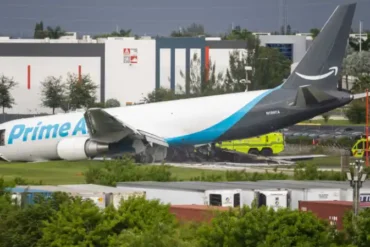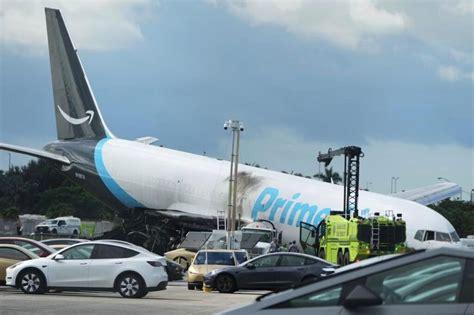
Five people on the ground were killed when Amazon Prime Air Flight 7598, a Boeing 767-300F operated by 21 Air, overran a runway at Miami International Airport (MIA). The National Transportation Safety Board’s (NTSB) preliminary report provides a detailed reconstruction of the aircraft’s final approach and landing, revealing a sequence in which excessive speed, a long touchdown, limited braking distance, and an abruptly abandoned go-around combined to leave the freighter with almost no usable runway.
The investigation remains preliminary, and the NTSB has not established a probable cause. However, the recorded data shows that the 767 arrived at Runway 30 with considerably more energy than expected for a conventional landing. By the time the aircraft crossed the displaced threshold, it was traveling at 177 knots and was approximately 105 feet above the ground. It ultimately crossed the runway end at about 113 knots.
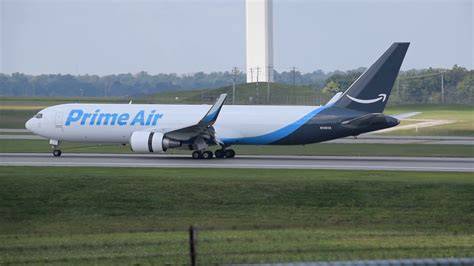
Boeing 767 Was Already Too Fast During the Approach
The warning signs appeared well before the aircraft touched down. According to the NTSB’s preliminary reconstruction, the crew selected Flaps 20 approximately one minute and 42 seconds before the cockpit voice recorder stopped. One pilot commented that the aircraft was too fast, and additional concerns about excessive speed followed during the approach. The report indicates that some of those comments did not receive an apparent verbal response.
The autopilot was disconnected roughly 23 seconds after the initial speed concern. The approach then included automated “sink rate” and repeated “too low terrain” warnings. Flaps 30 was not selected until approximately 41 seconds before the recording ended, leaving little time for the aircraft to settle into a normal landing profile.
When Flight 7598 crossed the Runway 30 displaced threshold, it was still around 105 feet above ground level and moving at a ground speed of 177 knots. A conventional landing profile generally places an aircraft at approximately 50 feet above the threshold. A Boeing 767-300 approaching with Flaps 30 would typically have an approach speed in the approximate range of 135 to 150 knots, depending on aircraft weight and wind conditions.
That difference mattered because the aircraft was carrying substantially more kinetic energy while also remaining higher than the normal approach path. The combination left less opportunity to dissipate altitude and speed before touchdown and consumed a significant portion of the runway before the landing roll was fully established.
Miami Runway 30 Offered Less Landing Distance Than Its Physical Length
The physical length of Miami International Airport’s Runway 12/30 is 9,360 feet, or approximately 2,853 meters. However, the displaced threshold meant that the landing distance available for Flight 7598 was only 7,913 feet, or about 2,412 meters.
That distinction is critical when reconstructing the accident. The airplane did not have the full physical runway length available for landing. It crossed the threshold with excessive speed and height, then traveled thousands of feet before the landing sequence was fully established.
FAA landing-performance guidance uses a 50-foot threshold crossing height as a reference point and recognizes the substantial effect that additional height can have on landing distance. An extra 50 feet of height can add approximately 1,000 feet to the landing distance under relevant conditions. In this case, the 767 was about 105 feet above the ground when it crossed the displaced threshold.
The 767 Touched Down Thousands of Feet Down Runway 30
The flight data recorder provides an unusually precise picture of what happened next. The nose and right main landing gear registered the beginning of the touchdown sequence at around 158 knots, while the left main landing gear did not register touchdown until the aircraft had slowed to approximately 134 knots. Wheel braking began at about 146 knots.
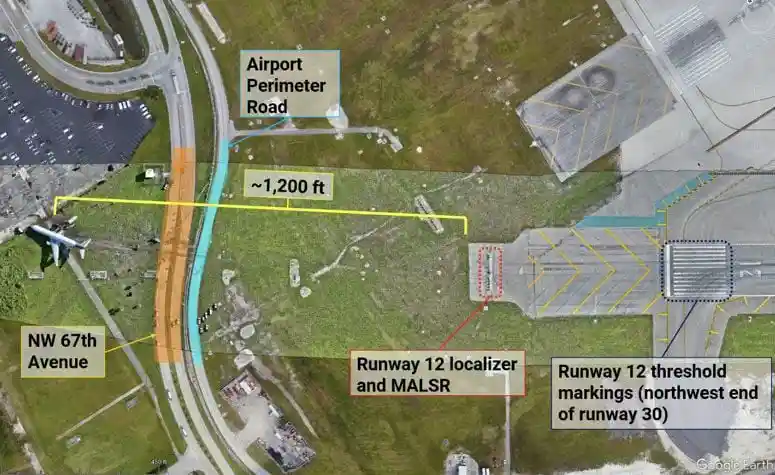
Most importantly, the aircraft had already traveled approximately 3,750 feet beyond the threshold when the touchdown sequence began. That left only about 4,163 feet of landing distance available.
The sequence then developed rapidly. At approximately 2,750 feet of landing distance remaining, the aircraft was traveling around 146 knots and wheel braking had begun. But the NTSB found no recorded indication that the 767’s speed brakes deployed during the landing roll. There was also no recorded indication that either engine’s thrust reverser was used.
The absence of those additional deceleration devices is significant because the aircraft was already deep into the available landing distance. As speed decreased, the remaining runway diminished faster than the aircraft could create sufficient stopping margin.
A Go-Around Was Attempted With Only 930 Feet Remaining
One of the most striking elements of the preliminary report is the attempted go-around near the end of the runway. At approximately 120 knots, with only about 930 feet of runway remaining, a pilot called for a go-around. The brakes were released and both throttles were advanced to settings consistent with go-around thrust.
At that point, however, the aircraft had already traveled through most of the available landing distance. The 767 was still on the ground, with approximately 283 meters of pavement remaining.
About four seconds later, the aircraft was traveling around 117 knots with only 415 feet of runway left. The throttles were returned to idle, and braking was reapplied. The airplane nevertheless continued toward the runway end.
The aircraft eventually crossed the end of the pavement at approximately 113 knots. It struck localizer and approach-lighting equipment before leaving the airport perimeter and colliding with ground vehicles. Five people on the ground died, while three others sustained serious injuries. Both pilots survived with minor injuries.
Tailwind and Missing Wind Information Under Investigation
Investigators are also examining the weather and air traffic control circumstances surrounding the landing. Winds around the time of the accident were reported from approximately 190 degrees at 17 knots, with gusts reaching 26 knots. For an aircraft landing on Runway 30, those conditions produced a tailwind component.
According to the preliminary information, the controller did not provide Flight 7598 with wind information in the landing clearance despite procedures requiring wind direction and velocity to be provided when a tailwind component exists. The NTSB has not determined that the missing wind call caused or contributed to the accident.
The tailwind nevertheless forms an important part of the broader investigation because wind conditions directly affect groundspeed, energy management, approach planning, and landing performance. A high groundspeed combined with a late touchdown can substantially reduce the margin available to stop an aircraft.
Crew Experience and Crew Coordination Are Also Being Examined
The NTSB is examining the pilots’ backgrounds and their operation of the aircraft, although the preliminary report does not identify experience or crew coordination as a cause.
According to information cited by CBS News, the captain had accumulated approximately 7,267 total flight hours but only around 150 hours on the Boeing 767. He joined 21 Air in April and obtained his 767 type rating the following month. The first officer had approximately 2,800 total flight hours and had been with the airline since February 2025.
The two pilots were reportedly flying together for the first time on Flight 7598. Those circumstances do not establish a causal connection, but investigators will examine how the crew communicated, responded to the excessive-speed warnings, managed the approach, and made decisions during the landing roll.
NTSB Investigation Continues After Amazon Ends 21 Air Partnership
The preliminary data leaves several major questions unresolved. Investigators must determine why the approach continued despite repeated concerns about excessive speed, why the aircraft crossed the threshold so high and fast, why the speed brakes and thrust reversers were not recorded as being used, and why the go-around was initiated only after most of the available runway had disappeared.
Amazon Air ended its partnership with 21 Air following the accident. The damaged aircraft was subsequently removed, and the affected runway reopened nine days later after inspections and repairs.
The NTSB’s preliminary findings establish the sequence of events but do not provide a final explanation for why that sequence occurred. The investigation will continue to examine the aircraft systems, crew actions, operating procedures, weather, air traffic control, runway characteristics, and other potentially relevant factors before the agency determines a probable cause. Until that work is complete, the extraordinary final seconds of Flight 7598 remain a reconstruction of what happened—not yet a final explanation of why it happened.