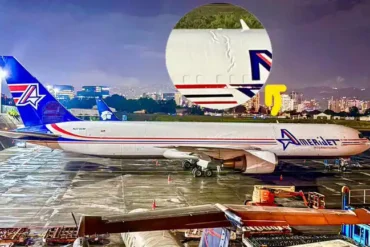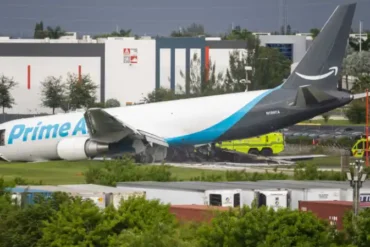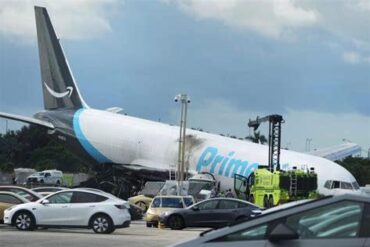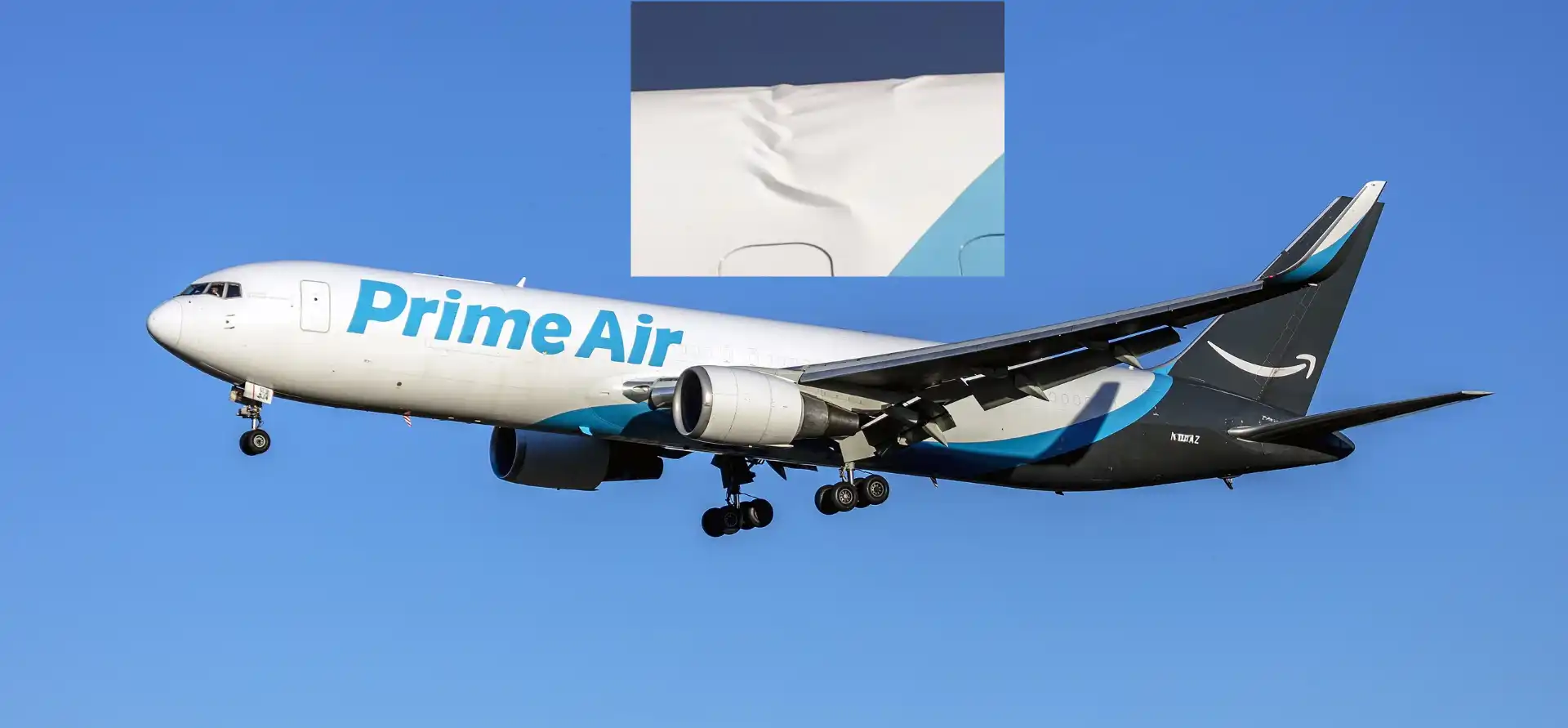
An Amazon Air Boeing 767-300F sustained visible structural damage following a hard landing at San Bernardino International Airport (SBD), underscoring the growing operational and maintenance pressures facing one of the world’s most intensively used cargo fleets. The incident occurred on January 15, 2026, when the 33-year-old freighter arrived from Spokane, Washington, completing what should have been a routine domestic cargo sector.
Photographs circulating among aviation observers shortly after the event revealed pronounced wrinkling along the fuselage, a classic indicator of excessive vertical load during touchdown. While the aircraft remained upright and controllable, the damage was severe enough to immediately raise questions about the long-term viability of repairing an airframe that has already logged decades of demanding service.
The aircraft, registered N443AZ, was operating as Amazon Air flight 8C-4340 at the time of the mishap. According to tracking data from FlightAware, the jet was later ferried to Austin, Texas, a location frequently used for heavy maintenance and structural repair work on widebody freighters. Its post-incident movement alone suggests that operators believe repairs are technically possible, though not necessarily economical.
Hard Landing Triggers Federal Investigation
The National Transportation Safety Board (NTSB) opened an investigation after ground crews discovered substantial fuselage and landing gear damage during post-landing inspections. Despite the severity of the impact, the aircraft was able to taxi clear of the runway without further incident, preventing additional operational disruption at San Bernardino.
At this early stage, investigators have not disclosed a probable cause. Hard landings typically result from a combination of factors rather than a single error. An incorrect flare, gusty or unstable wind conditions, high descent rates, or even subtle airframe fatigue can all amplify touchdown forces. On older converted freighters, where structures have already endured tens of thousands of pressurization cycles and heavy payloads, margins are thinner than they once were.
The possibility that the aircraft could be declared a hull loss remains very real. If repair costs exceed the insured or economic threshold, operators may elect to retire the jet rather than invest heavily in an aging platform with limited remaining service life.
A Veteran Airframe Near the End of Its Economic Life
The damaged 767 was originally built for American Airlines as a passenger aircraft before being converted into a freighter, a common second life for the type. Like many of its peers, it spent years hauling passengers before entering the high-cycle, high-utilization world of air cargo. According to data from Planespotters.net, the average age of aircraft wearing the Amazon Air livery now sits just over 30 years, placing much of the fleet firmly in the late stage of its economic lifespan.
While the Boeing 767 has earned a reputation as a reliable workhorse, time is an unforgiving variable in aviation. Structural fatigue accumulates invisibly until a hard event, such as this landing, reveals how little margin remains. Boeing’s plan to end 767 freighter production by 2027 due to evolving emissions standards further complicates the picture, tightening supply and making each existing airframe more strategically valuable.
Amazon Air’s Complex Operating Model
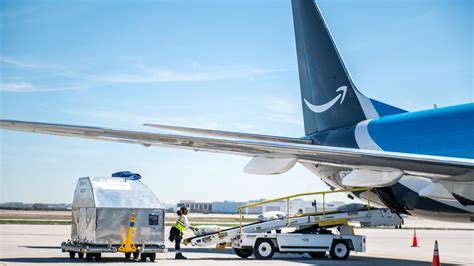
Amazon Air does not operate as a single airline but rather as a network of contracted carriers, including Air Transport International (ATI), which owns and operates N443AZ. ATI controls the majority of Amazon’s 59 Boeing 767-300F aircraft, while Atlas Air, Alaska Airlines, and other partners operate the remainder. This distributed model offers flexibility, but it also introduces variation in training, procedures, and maintenance cultures that must be tightly coordinated.
The San Bernardino incident followed closely on the heels of another January event, when an Amazon Air Airbus A330 suffered a bird strike and subsequent engine fire shortly after departure from Cincinnati/Northern Kentucky International Airport (CVG). While unrelated, the proximity of these events has drawn attention to the intense operational tempo of Amazon’s rapidly expanding air network.
Fleet Transition and Operational Pressure in 2026
Aviation analysts increasingly view these incidents as symptoms of a fleet in transition. Amazon Air continues to scale up, opening new facilities and hubs, including a recently announced operation in Jacksonville, Florida, designed to distribute traffic more evenly across the network. Higher sortie rates, tighter schedules, and dense hub operations place constant pressure on crews and equipment alike.
At the same time, Amazon is gradually shifting toward the Airbus A330-300F, an aircraft offering roughly 20% more cargo volume and improved fuel efficiency. These newer freighters are expected to assume a growing share of long-haul missions, allowing older 767s to be phased out with less operational disruption.
In the broader context, the wrinkled fuselage at San Bernardino is more than a single hard landing. It is a visible reminder that even proven aircraft have limits, and that sustaining a global, time-critical cargo network requires continuous investment in younger airframes, expanded infrastructure, and carefully managed operational growth.