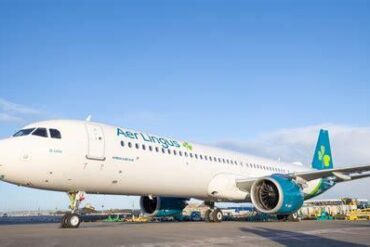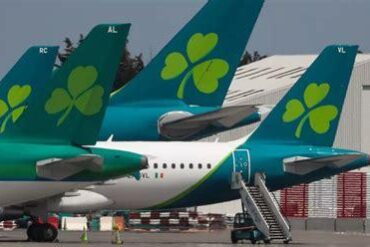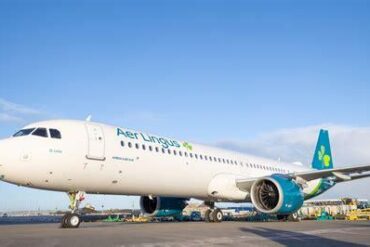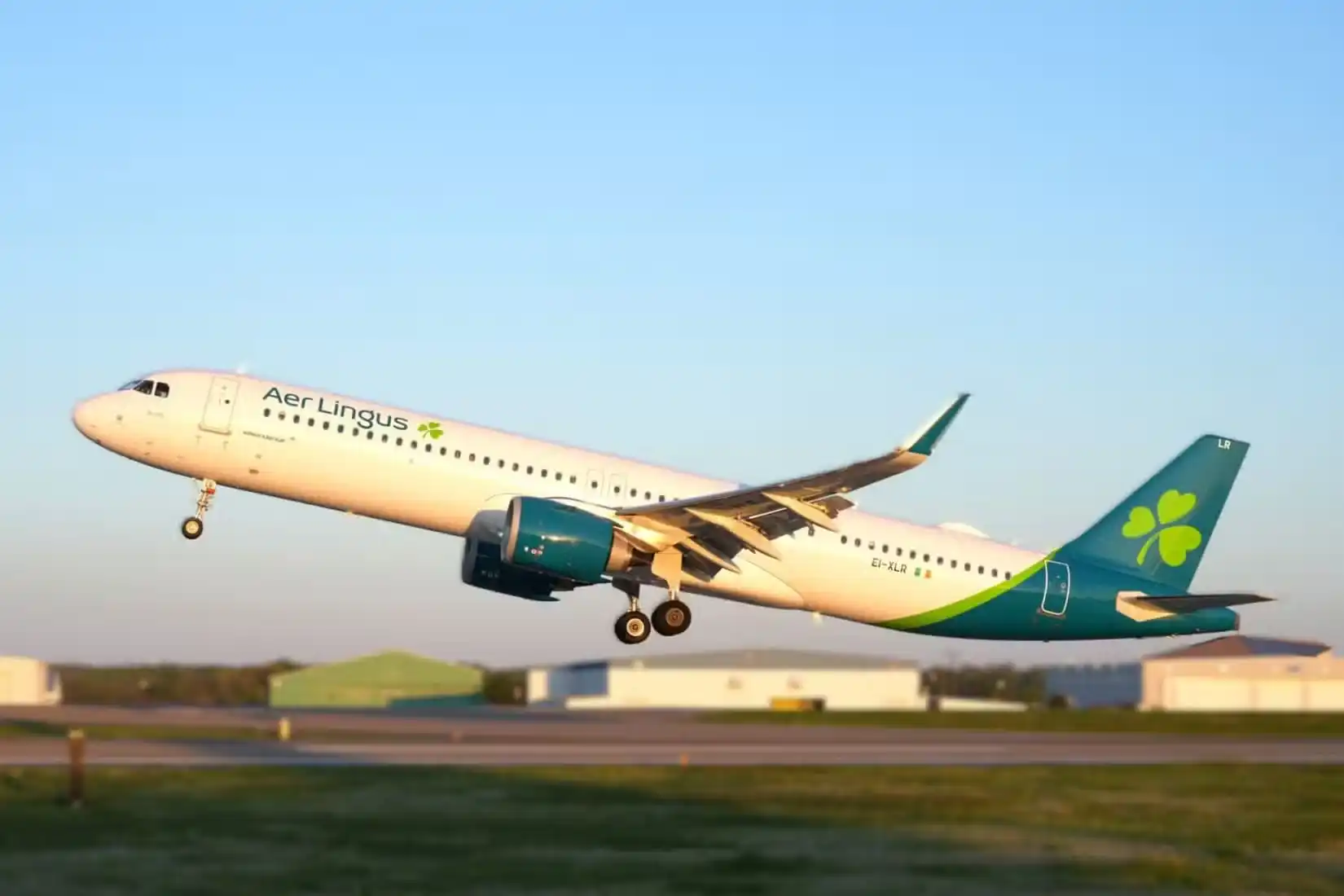
An Aer Lingus Airbus A321XLR has been severely damaged following an intense 3.3G hard landing at Dublin Airport (DUB), marking one of the most serious landing-related incidents in the airline’s recent history. The aircraft, registered EI-XLT, had just completed its journey from London Heathrow (LHR) when it struck the runway with far greater force than industry standards typically allow. The jet, delivered less than a year ago, now faces a prolonged grounding and a multimillion-dollar repair bill that includes a complete landing gear replacement.
Incident Overview: 3.3G Hard Landing Amid Strong Winds
On December 13, 2025, Aer Lingus flight EI152 encountered turbulent conditions as it approached Dublin Airport. Winds were reported to be gusting significantly, and the final descent of the A321XLR was recorded by aviation enthusiasts stationed near the runway. The video, widely shared online, captures the jet bouncing hard upon initial touchdown—a clear indicator of abnormal vertical load.
According to sources on X (formerly Twitter), the aircraft’s onboard load sensors measured the impact at 3.3G. For context, a typical landing ranges between 1.1G and 1.4G, and commercial aircraft are certified to safely withstand up to 2.0G. Anything beyond that requires immediate inspection and often reveals structural or mechanical stress. A 3.3G landing is therefore well into the “severe hard landing” category.
Landing Gear Destroyed: Complex, Costly Replacement Looms
Initial inspections confirmed that EI-XLT’s landing gear had absorbed the full force of the impact, resulting in critical structural damage. Reports now confirm that the damage is beyond routine repair, forcing Aer Lingus to order a full landing gear replacement—an incredibly complex and costly process.
The A321XLR’s landing gear is notably reinforced to accommodate its higher Maximum Takeoff Weight (MTOW) due to extended range capabilities. This added reinforcement makes the replacement more intricate than standard narrowbody aircraft, driving up labor and part costs. The price of new gear assemblies, engineering labor, tooling, and potential downtime adds up to a multi-million dollar expense.
Operational Impact: Aircraft Grounded, Routes Disrupted
EI-XLT has remained grounded at Dublin Airport since the incident. With only five A321XLRs currently in the Aer Lingus fleet—out of a planned six—losing 20% of that fleet significantly strains the airline’s transatlantic operations. The A321XLR has been instrumental in launching mid-tier long-haul routes such as those to Indianapolis, Nashville, and Boston, which are not profitable enough for widebody aircraft.
This specific aircraft had been flying multiple US East Coast routes, including New York, Washington, and Boston, and was increasingly being used on longer European rotations. The unexpected downtime will require Aer Lingus to reallocate fleet resources, potentially leasing equipment or delaying future service rollouts.
About EI-XLT: New Jet, Now in Trouble
EI-XLT is one of the first two Airbus A321XLRs delivered to Aer Lingus, arriving in December 2024. Designed to seat 184 passengers, the aircraft includes 16 lie-flat business class seats and 168 economy class seats. The model features the Airbus Airspace cabin, which includes enhanced overhead storage, improved lighting, and quieter acoustics, offering a superior passenger experience compared to older narrowbody jets.
Its standout feature is its range: the A321XLR can fly up to 4,700 nautical miles, enabling narrowbody transatlantic operations once limited to twin-aisle aircraft. This has given Aer Lingus a strategic advantage in targeting under-served North American cities without relying on the more costly A330 widebody.
EI-XLT’s brief but critical role in this strategy makes its current grounding all the more impactful.
Weather Conditions: A Key Contributor to the Incident
While an official investigation is still pending, early indicators suggest that strong crosswinds at the time of landing may have destabilized the aircraft during its final approach. Video footage shows the aircraft attempting to level out shortly before the touchdown, only to descend sharply and rebound on impact.
While crosswind landings are standard in aviation, they demand precision, especially for heavier aircraft like the A321XLR. With the added mass from fuel and structural reinforcements, recovering from a destabilized descent can be particularly challenging.
Regulatory Response and Maintenance Protocols
Any landing that exceeds standard force thresholds—particularly anything over 2.0G—triggers mandatory inspections by maintenance crews. With a reading of 3.3G, EI-XLT is not just a candidate for inspection, but requires structural and component analysis. Every inch of the aircraft’s undercarriage, from hydraulic lines to load-bearing struts, will need to be evaluated.
A full landing gear change is not routine maintenance. The aircraft must be partially disassembled and supported on jacks. Technicians will remove all affected components and carefully install new assemblies that must be recalibrated and re-certified for safe operation. The process can take weeks to months, depending on part availability and engineering scheduling.
Fleet and Financial Repercussions for Aer Lingus
The immediate financial hit is substantial. The cost of landing gear assemblies alone can reach into the hundreds of thousands of euros, with labor and additional part replacements easily pushing that into the multi-million euro range. But the real toll may be the lost revenue from the grounded aircraft.
The A321XLR’s economic advantage is its ability to open thin long-haul routes profitably. Losing one of only five such jets means diminished capacity, potential cancellation of new route plans, and reduced flexibility during peak holiday travel seasons. Aer Lingus may need to lease short-term aircraft or rebook passengers on partner airlines, increasing costs further.
The Broader Implications: A321XLR and Hard Landing Tolerances
This incident also puts the A321XLR’s durability under scrutiny. While no aircraft can be designed to routinely absorb 3.3G landings, the fact that this occurred in less than one year of service raises questions about operational margins, pilot training, and aircraft certification parameters.
Airlines and regulators alike will likely review flight data, cockpit recordings, and aircraft telemetry to determine how much of the event was due to human factors versus mechanical or environmental ones. Though Airbus has spent years perfecting the A321XLR platform, its newness means there is limited long-term data on high-stress landings.
Conclusion: Lessons for the Airline and Industry
The hard landing of EI-XLT is a costly and high-profile incident that delivers a sobering reminder of how external conditions, flight crew response, and aircraft limitations must align perfectly in modern aviation. For Aer Lingus, the challenge will be reintegrating a key asset back into its fleet without compromising safety or service reliability.
For the broader aviation world, this event underscores the importance of data transparency, maintenance readiness, and real-time pilot decision-making in ensuring that aircraft like the A321XLR live up to their promise—not just in range and efficiency, but also in resilience.
Aer Lingus has yet to make a detailed public statement, but the incident will undoubtedly influence how the airline and others manage their XLR fleets moving forward.