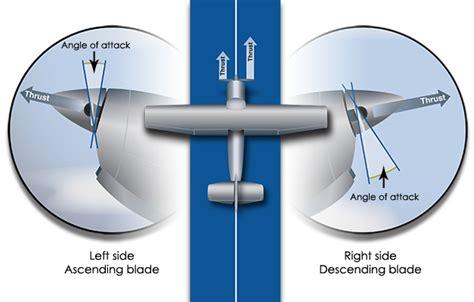
The P-factor, also known as asymmetric disk loading or asymmetric blade effect, is an important aerodynamic phenomenon related to propeller rotation. This effect occurs when different blades of a propeller experience varying loads, leading to uneven lift or thrust. As a result, an aircraft may tend to turn in a specific direction without any control input from the pilot.
You can see the P-factor in action in several scenarios. For instance, small general aviation aircraft with nose-mounted propellers often exhibit a yaw tendency during climbs. In these cases, clockwise-rotating propellers (as viewed from the cockpit) typically cause the aircraft to yaw left. Similarly, propeller-driven planes with wing-mounted engines will yaw toward the engine that has failed, although this can vary based on the direction of rotation and which engine is affected. The term “critical engine” is used to describe the engine whose failure has the most significant impact on aircraft performance.
Helicopters are another clear example of the P-factor in action. Without special hinges to compensate, main rotor blades in a counter-clockwise rotating helicopter (as seen from above) tend to roll the aircraft to the left. This is because the advancing blade encounters headwind, increasing its speed, while the retreating blade faces tailwind, decreasing its speed. This difference leads to varying lift generation between the two blades, creating a roll tendency.
Now, let’s break down the explanation further. Lift depends on three main factors: the shape of the aerofoil, the velocity of the air passing by, and the angle of attack (AoA). While aerofoil parameters remain constant, velocity and AoA can differ for each blade. Different blades on the same propeller can experience various relative wind speeds due to their rotation and the aircraft’s forward motion. Consequently, a blade with a higher velocity or greater AoA produces more lift or thrust, generating torque.
Consider a single-engine propeller-driven airplane in level flight with the propeller aligned with the wind. All blades experience equal loads and produce similar thrust. However, in a nose-up attitude (like during a climb), the downward-moving blade encounters headwind, while the upward-moving blade faces tailwind. This results in the downward blade producing more lift and thrust, while the upward blade produces less, creating a yaw tendency towards the upward-moving blade.
In the case of a wing-mounted propeller airplane, if an engine fails, the aircraft naturally yaws towards the side of the failed engine. To maintain level flight, the aircraft may need to adopt a nose-up attitude, increasing the AoA of the wings to compensate for the loss of thrust. This position will subject the propeller blades to the P-factor, potentially worsening the yaw tendency depending on which engine is still operational.
To manage the P-factor, different compensation methods are employed based on the aircraft type. Helicopters often feature blades mounted on hinges that allow for individual adjustments during rotation. This setup enables the advancing blade’s AoA to decrease while the retreating blade’s AoA increases, balancing out lift production despite their differing speeds. Some designs, like coaxial rotors in aircraft such as the KAMOV Ka-52 or Sikorsky S-69, mitigate adverse effects as each rotor compensates for the other’s asymmetry.
In twin-engine aircraft, there are three categories regarding critical engines. First, some aircraft have a critical engine where both propellers rotate in the same direction, and the critical engine is the one whose downward-moving blade is closer to the fuselage. Second, some aircraft lack a critical engine, with one engine rotating clockwise and the other counter-clockwise. Here, P-factor effects are neutral regardless of which engine fails. Lastly, some aircraft have both engines as critical, meaning one rotates counter-clockwise and the other clockwise. In these cases, engine failure could exacerbate the yaw caused by the P-factor.
For single-engine aircraft, pilots learn to compensate for the P-factor through proper control inputs, ensuring they can manage the aircraft effectively despite these aerodynamic challenges.