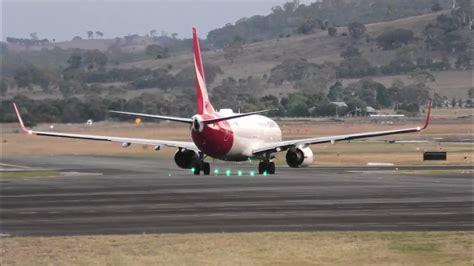
A Qantas Boeing 737-800 routing from Canberra to Sydney departed with incorrect take-off weight calculations, triggering a detailed safety review and renewing attention on how a single data entry slip can ripple through multiple aviation systems. The aircraft, originally operating a disrupted Perth–Sydney service, had diverted to Canberra due to severe weather before continuing on its revised route. During that transition, an input error in the carrier’s departure control system mistakenly listed 51 passengers as not onboard, causing a take-off weight roughly 9,460 lbs (4,291 kg) below the real figure.
The miscalculation resulted in take-off speeds set for a significantly lighter aircraft than the fully loaded 737 actually carrying passengers and bags. Attempts were made to notify the crew before departure—first by phone, then by radio—but the message never effectively reached the cockpit. Only after becoming airborne did the pilots receive an alert from operations, prompting them to enter a holding pattern while the true weight was confirmed.
How a Single Mistake Removed 51 Passengers from the System
The incident originated when an airport staff member added the Canberra–Sydney sector into Qantas’ departure control system but accidentally configured the aircraft as a Boeing 717 instead of a Boeing 737-800. The incorrect code triggered an automated process that removed 11 business-class passengers and more than a dozen economy standby travelers from the manifest. Although the mistake was later corrected, the individuals were never restored to the system, and the flight was ultimately closed using flawed data.
This directly fed into the loadsheet, which concluded that more than 50 passengers were absent, creating a substantial fuel discrepancy and skewed weight-and-balance figures. Ground teams recognized the inconsistency shortly before pushback, but communication breakdowns meant the correction never reached the pilots in time.
Increased Take-Off Risk That Passengers Never Saw
Cabin conditions seemed entirely normal to travelers, who had already endured a diversion and schedule disruption. Yet the aircraft began its take-off roll using performance numbers meant for a lighter jet—meaning rotation speeds were lower than required, and control margins narrowed. According to the Australian Transport Safety Bureau, the combination increased the risk of degraded take-off performance, despite the safe outcome.
Once airborne, air traffic control delivered a message relayed from load control, advising the crew to verify the weight discrepancy. The pilots entered a holding pattern to cross-check data with operations, confirmed the correct figures, and then proceeded uneventfully to Sydney.
Systemic Failure Across Load Control, Communication, and Diversion Procedures
For Qantas, the episode has become a case study in how small operational errors can cascade during irregular operations such as diversions. The ATSB’s findings highlight several breakdowns: inaccurate passenger data, failure of the system to repopulate removed travelers, and communication procedures that faltered at a critical moment.
Beyond the immediate operational challenge, the incident generated wider concerns regarding passenger accountability—a cornerstone of both aviation safety and security. Knowing not just how much weight is onboard, but who is onboard, influences emergency planning and post-incident investigation.
Qantas Implements New Safeguards to Prevent Recurrence
The carrier has since adjusted procedures to require mandatory headcounts when loadsheet discrepancies appear. Load controllers are now authorized to contact flight crews directly when weight-and-balance data is in doubt, aiming to prevent similar communication gaps. Local teams have also received targeted training on handovers and irregular-operations protocols.
These additional measures reflect the broader aviation principle that weight-and-balance errors, while infrequent, demand meticulous checks due to their profound influence on take-off performance and aircraft handling. As airlines worldwide continue tightening governance around digital loadsheet workflows, the Canberra departure incident underscores why precision remains one of the most essential foundations of commercial flight safety.