In light of recent announcements that the Royal Air Force will once again assume an airborne nuclear role, it is essential to revisit the 43‑year saga during which the RAF bore Britain’s Cold War deterrent from 1954 until 1998. This comprehensive review traces the strategic imperatives, technological breakthroughs, operational transformations and eventual retirement of RAF nuclear assets, setting the stage for understanding the renewed emphasis on tactical deterrence.
For over four decades, the RAF stood at the vanguard of Britain’s nuclear strategy, shouldering the burden of deterring a Soviet onslaught through airborne strike capability. Beginning with the rudimentary Blue Danube free‑fall bomb and culminating in the versatile WE.177 series, RAF platforms evolved in parallel with rapidly shifting threat perceptions, from high‑altitude overflight to low‑level penetration, and from solo British designs to joint US‑UK warhead partnerships. The story of this airborne arsenal encapsulates both the optimism of nuclear deterrence and the controversies of testing on foreign soil.
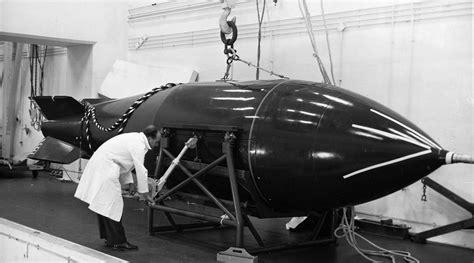
Central to Britain’s quest for a sovereign deterrent was the post‑war rupture with the United States. The 1946 McMahon Act abruptly barred British scientists from American nuclear research, compelling the UK to chart its own path. Operation Hurricane, on 2 October 1952 at Trimouille Island, marked Britain as the world’s third nuclear power. The data harvested from that fission test directly informed the hastily produced Blue Danube bomb, deployed in 1954 as the RAF’s maiden atomic weapon, with a standard yield of 15 kt and experimental variants reaching 40 kt.
Despite its strategic significance, Blue Danube’s handcrafted design proved unreliable. Only 58 bombs were produced before the RAF pivoted to thermonuclear capability. Operation Buffalo, a series of ground tests at Maralinga in October 1956, and a singular live air drop by Valiant B.1 WZ366 on 11 October 1956, ignited fierce debate. Aborigine communities and service personnel suffered from radiation exposure, casting a long shadow over Britain’s testing program.
Thermonuclear Leap: From Operation Grapple to Yellow Sun
Blue Danube’s shortcomings demanded a higher‑yield successor. Operation Grapple (1957–58) saw Valiant B(K).1 XD818 release Britain’s first hydrogen bomb on 15 May 1957 over Kiritimati. These tests yielded Yellow Sun, the RAF’s primary H‑bomb from 1959 to 1966, featuring multiple warhead “physics packages” with yields between 400 kt and 1.1 MT. The 1958 US–UK Mutual Defence Agreement then unlocked American warheads for the Mk 2 Yellow Sun variant, marrying British delivery systems with US nuclear cores.
Concurrently, the RAF integrated American tactical “E‑weapons” under NATO custody, triggering domestic unease over dual UK‑US arming keys and sovereignty concerns. Anecdotes of RAF officers joking about shooting the American key‑holder underscored the friction inherent in shared control of nuclear arms.
Birth of the V‑Force: Valiant, Victor and Vulcan
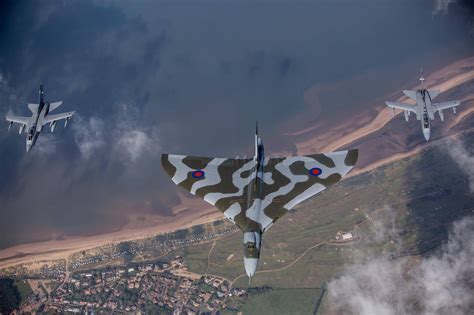
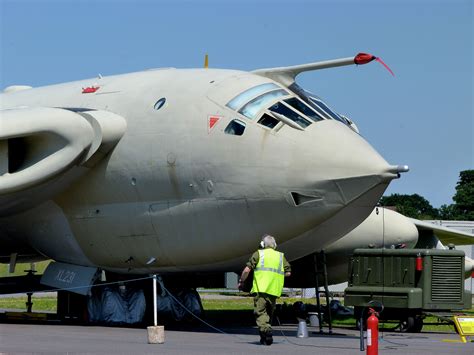
To field Blue Danube and its successors, the RAF evaluated four designs in 1954: the Valiant, Victor, Vulcan and the backup Sperrin. The Sperrin was dropped, and the V‑Force was born, comprising Vickers Valiant, Handley Page Victor and Avro Vulcan bombers. Tasked with round‑the‑clock nuclear readiness, these platforms originally flew at 55,000 ft, carrying 10,000 lb bombs at 550 knots to strike Soviet cities under a strategic counter‑value doctrine.
The paradigm shifted in 1960 when a U‑2 spy plane was downed over the USSR, rendering high‑altitude runs too vulnerable. The V‑Force adapted to low‑level penetration under radar horizons, adopting grey‑green camouflage and reinforcing airframes. Wing fatigue grounded the Valiant in January 1965; Vulcan and Victor continued until the early 1980s, even as Victors transitioned to aerial tankers.
Stand‑Off Evolution: Blue Steel, Skybolt and Polaris
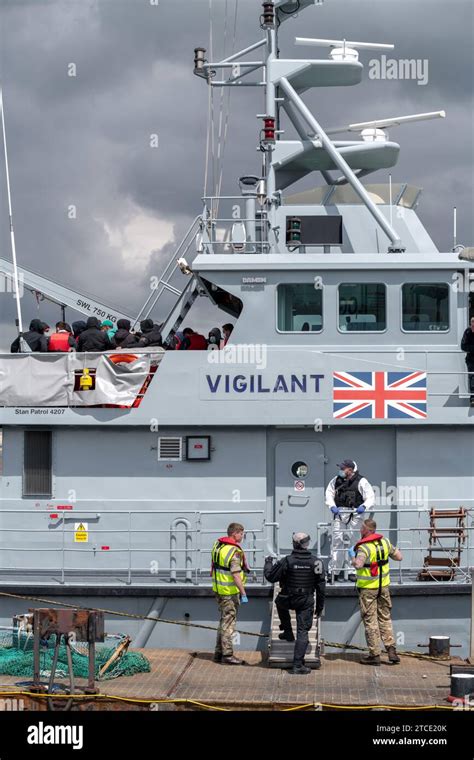
Anticipating the hazards of overflight, the RAF developed the Blue Steel missile (100 nm range) to launch from outside enemy airspace. Yet its limited low‑altitude reach rendered it an interim fix. The planned US Skybolt ALBM, slated to equip Vulcans with a 1,000 nm standoff capability, was cancelled in 1962. With Britain’s deterrent hanging in the balance, Prime Minister Harold Macmillan secured Polaris SLBMs for the Royal Navy under the December 1962 Nassau Agreement. British warheads atop American Polaris C‑3 missiles shifted the strategic leg to SSBNs like HMS Vigilant, ending RAF primacy in the nuclear strike role.
WE.177: The Pinnacle of RAF Airborne Nukes
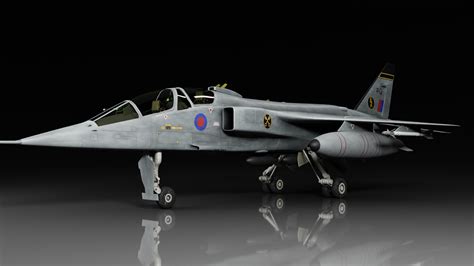
Introduced in 1966, WE.177 represented the apex of UK nuclear bomb design: compact, air‑armable in flight and engineered for both strategic and tactical missions. Deployed on TSR.2 prototypes (later cancelled), Vulcans, Victors, Jaguars and Tornados, WE.177 remained in RAF service until 1998, outlasting all predecessors.
Key variants included:
- WE.177A: 10 kt yield, the lightest UK nuke, served as a helicopter‑dropped anti‑submarine depth charge and equipped carriers during the Falklands War in 1982.
- WE.177B: 450 kt yield, low‑altitude toss‑bomb capable (50 ft release), replaced Yellow Sun until Polaris arrived in 1968; Blue Steel retired in 1970.
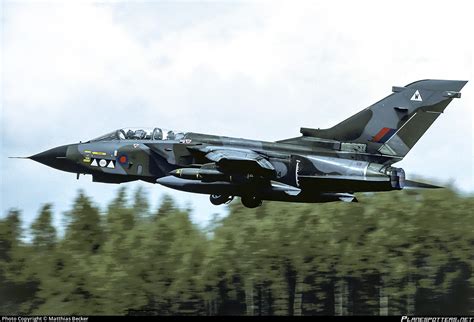
- WE.177C: 190 kt yield, dedicated to NATO tactical strike, carried by Tornado, Jaguar, Buccaneer and Sea Harrier through the mid‑1990s.
Peak Capability and Final Drawdown
By 1990, the RAF maintained 72 UK‑based nuclear‑capable strike aircraft (Tornado, Jaguar, Buccaneer) and 84 German‑based Tornados across seven squadrons. The dissolution of the Warsaw Pact in 1991 abruptly nullified the Soviet threat, prompting a rapid drawdown: WE.177 stockpiles were halved by the mid‑1990s, RAF Germany closed in 2001, planned replacements were cancelled, and WE.177 itself was retired in 1998, ending the RAF’s nuclear mission.
With the end of tactical nuclear strike, the RAF returned to a purely conventional focus—until today’s revived interest in airborne deterrence. As Britain enters a new era of great‑power tensions, the legacy of Blue Danube, Yellow Sun, Blue Steel and WE.177 informs a modern doctrine that balances sovereignty, alliance commitments and rapid response capability.
The RAF’s nuclear odyssey illustrates a continual interplay between technological innovation, strategic necessity and geopolitical shifts. From the radioactive sands of Maralinga to the decks of HMS Hermes, each weapon and aircraft variant carved a chapter in Britain’s deterrent narrative. As F‑35As prepare to assume NATO nuclear crisis missions, the lessons of past airborne arsenals—both their strengths and controversies—will shape the contours of the RAF’s future role in deterrence and warfare.