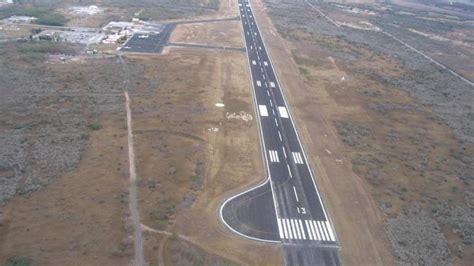
Runway Designators
Single Physical Runways
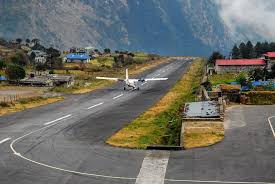
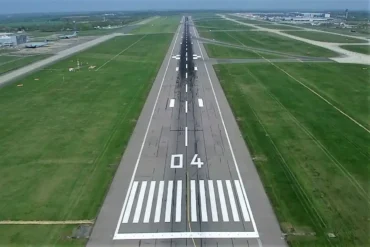
A runway designator consists of a two-digit number that reflects the magnetic heading when approaching the runway. For instance, if the centerline azimuth is 153 degrees, the designator will be 15. If the azimuth results in a single-digit number, it is preceded by a zero (e.g., an azimuth of 82 results in a designator of 08). North-oriented runways are designated as 36, not 00. In simple terms, the runway designator indicates the direction used for take-offs or landings.
When a runway can be approached from both directions, each direction has its own designator. This means that even though there is one physical runway surface, it functions as two separate runways. The difference between these numbers is always 18. For example, if one runway is designated as 12, the other will be 30.
Parallel Runways
For parallel runways, the designator is supplemented with a letter to indicate each runway’s relative position. The letters used are L (left), R (right), and C (center), based on the observer’s viewpoint at the runway threshold. For instance, two parallel runways heading East would be labeled 09L and 09R. If there are three parallel runways, the designations would be 09L, 09C, and 09R. It’s important to note that the opposite ends also reflect this viewpoint; thus, the opposite end of 09L would be 27R and vice versa.
In cases where more than three parallel runways exist, some are designated using the nearest one-tenth magnetic azimuth, while adjacent runways follow with the next one-tenth. For example, four parallel runways facing North might be designated as 36L, 36R, 35L, and 35R.
Runway Designator Marking
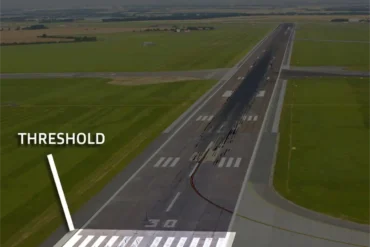
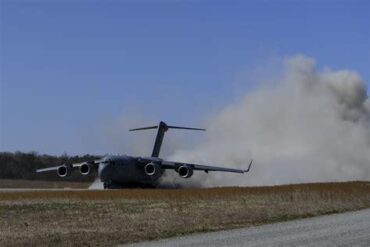
Runway designation markings are required at the thresholds of paved runways, and it is recommended to provide them at unpaved runways whenever possible. Due to the critical need for clear runway identification, the International Civil Aviation Organization (ICAO) specifies the size, shape, and spacing of these markings in Annex 14 (Aerodromes). If numbers are included in the threshold marking, they should be larger to fill the gap between the threshold stripes adequately.
For a single runway, the designator is typically placed after the threshold marking but may also be incorporated into it. For parallel runways, the letter (L, R, or C) follows the threshold marking, while the number (e.g., 11) comes after the letter.