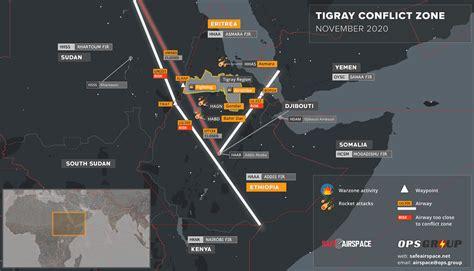
Military logistics is often described as the bloodstream of modern warfare, but that metaphor undersells its complexity. In contested airspace, every resupply mission becomes a calculated dance between physics, intelligence, and survival. Understanding how military cargo planes avoid threat zones during deployments reveals a world where technology, tactics, and discipline intersect with relentless precision.
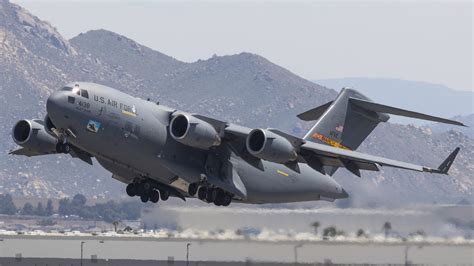
Tactical airlift is not merely about moving cargo. It is about delivering capability into danger while minimizing exposure to that danger. The Lockheed C-130 Hercules and the Boeing C-17 Globemaster III represent the backbone of this mission. They are engineered not just to carry payloads, but to navigate hostile environments shaped by radar networks, missile batteries, and unpredictable ground fire.
These aircraft operate in the gray space between strategic reach and tactical proximity. Larger platforms such as the C-5M Super Galaxy transport heavy cargo to secure hubs. From there, the C-17 and C-130 push forward into contested regions. Their survival depends on flexibility, real-time intelligence, and sophisticated defensive systems that have evolved dramatically since the Cold War.
Tactical Airlift and the Geometry of Survival
Avoiding threat zones begins long before wheels leave the runway. Mission planners construct flight paths based on satellite reconnaissance, signals intelligence, and electronic mapping of hostile radar systems. Threat envelopes—often called “threat bubbles”—are mapped as three-dimensional volumes in which aircraft are vulnerable to specific weapons.
Modern airlift missions rely on dynamic route optimization. Instead of flying direct, predictable paths, crews use non-linear ingress routes, terrain masking, and time-on-target calculations that reduce predictability. Aircraft may approach at unexpected angles, fly through mountain corridors, or adjust altitude profiles mid-mission as intelligence updates flow in.
Minimizing time inside a threat envelope is central. Aircraft cruise at higher altitudes where possible, outside the effective range of MANPADS (Man-Portable Air Defense Systems) and small-arms fire. When descent is required, it is often steep, rapid, and precisely timed to shrink exposure windows.
This philosophy transforms the aircraft from a slow-moving target into a fleeting presence.
High-Low Operational Strategy: Dividing the Risk
The C-17 and C-130 operate in a carefully structured “high-low” partnership. The C-17 Globemaster III transports heavy armor, helicopters, and bulk supplies across continents. It delivers these loads to relatively secure theater hubs or forward airbases capable of handling its size.
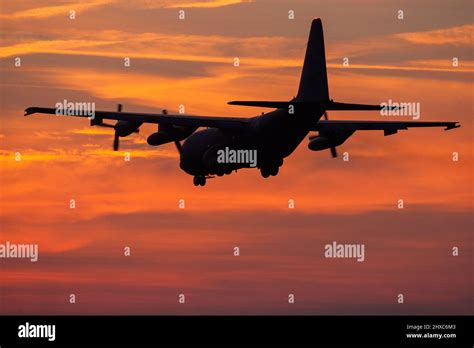
The C-130 Hercules, smaller and more rugged, then assumes the riskier role. It shuttles cargo from hubs to Forward Operating Bases (FOBs), austere airstrips, or remote landing zones. This layered approach ensures that larger, more strategically valuable aircraft avoid unnecessary exposure to intense threat environments.
If a unit urgently requires an M1 Abrams tank, only the C-17 has the capacity. If a remote outpost needs ammunition, water, and medical supplies on a dirt strip, the C-130 becomes indispensable. Dividing risk across platforms maximizes survivability without compromising logistical momentum.
Aggressive Flight Profiles: Speed as Shield
Survival in contested airspace depends heavily on flight geometry. The C-17 is capable of extraordinarily steep descent rates—up to 15,000 to 18,000 feet per minute—using its powerful turbofan engines and advanced flight control systems. This allows it to remain at higher, safer altitudes until the final moments of approach.
The aircraft’s Externally Blown Flap system enhances short takeoff and landing performance. Combined with in-flight thrust reverser deployment, the C-17 can land on runways as short as 3,500 feet, including unpaved surfaces. This means it can approach quickly, descend sharply, land, unload, and depart before adversaries can effectively respond.
The C-130 employs similar tactics but at lower altitudes. In certain scenarios, it performs terrain-following flight profiles at night, flying just above natural contours to avoid radar detection. Modern avionics allow passive navigation without emitting detectable radar signals, dramatically reducing exposure.
Avoidance is not passive. It is choreographed aggression.
Electronic Warfare and Defensive Countermeasures
Avoiding threat zones does not always mean bypassing them. Sometimes aircraft must penetrate areas where hostile systems are active. In those cases, layered defensive suites become essential.
Modern C-130J Super Hercules variants feature integrated digital defensive systems capable of detecting radar emissions and missile launches. Radar Warning Receivers (RWR) identify enemy radar types and directions, enabling crews to alter course before lock-on occurs.
The C-17 fleet underwent the Block 30 upgrade, standardizing advanced protection systems across all aircraft. A key component is Large Aircraft Infrared Countermeasures (LAIRCM). This system detects the ultraviolet signature of a missile launch and responds with a turreted laser that dazzles or blinds the missile’s infrared seeker.
Unlike traditional flares, which rely on deception through heat, LAIRCM physically disrupts the missile’s guidance mechanism. This significantly improves survival odds against advanced shoulder-fired missiles.
Complementing this are chaff dispensers that release clouds of aluminum fibers, confusing radar-guided systems by creating false reflections. Decoy systems draw incoming missiles away from engines, buying precious seconds for evasive maneuvers.
Real-Time Intelligence Integration
Modern deployments benefit from constant information flow. Systems such as Real-Time in Cockpit (RTIC) feed threat data directly into aircraft displays. Intelligence from satellites, drones, naval vessels, and other aircraft converges in the cockpit.
The C-17’s Enroute Mission Command Capability (EMC2) transforms the aircraft into a flying command center. Commanders onboard can adjust plans mid-flight, reroute forces, or coordinate with ground units before landing. This adaptability ensures aircraft avoid newly identified threats.
Threat environments are fluid. Missile batteries relocate. Radar systems activate unexpectedly. The ability to reroute instantly, based on shared digital awareness, reduces vulnerability and enhances mission success.
Avoidance becomes a networked activity rather than an isolated cockpit decision.
Historical Lessons: Forged in Fire
The evolution of these tactics is rooted in experience. During the 1968 siege of Khe Sanh, C-130 crews executed over 1,100 resupply missions under constant enemy fire, delivering more than 12,000 tons of supplies. Pilots often performed touch-and-go deliveries rather than full stops, minimizing runway exposure.
In the 1972 Easter Offensive at An Loc, C-130 aircraft descended to 600 feet under anti-aircraft fire to conduct airdrops. These perilous missions highlighted the vulnerability of predictable profiles and drove innovation in automated airdrop systems.
Today’s C-130J features precision-guided airdrop technology, allowing higher altitude releases with greater accuracy. What once required dangerous low-level approaches can now be executed from safer heights.
History carved caution into doctrine.
Special Operations and High-Altitude Insertions
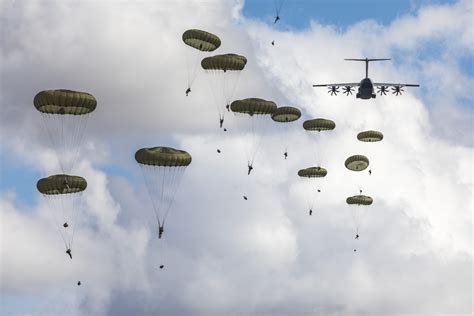
Threat avoidance also involves vertical strategy. The C-17 can execute HALO (High-Altitude Low-Opening) and HAHO (High-Altitude High-Opening) insertions. By releasing special forces at extreme altitudes, aircraft remain outside many threat envelopes while delivering personnel deep into contested territory.
These missions require precise navigation and atmospheric modeling. Paratroopers exit at high altitude, opening parachutes either low to reduce visibility (HALO) or high to glide long distances (HAHO). The aircraft avoids prolonged low-level exposure while maintaining strategic surprise.
Such tactics redefine what “delivery” means in a modern battlefield.
Short Takeoff and Landing in Austere Environments
Operational flexibility is central to avoiding threats. Aircraft that can land on dirt strips, highways, or minimally prepared runways reduce dependency on fixed airbases—often prime targets.
The C-17’s STOL capability and the C-130’s rugged landing gear enable operations in locations adversaries may not anticipate. By frequently shifting landing zones, airlift crews deny opponents the ability to establish predictable ambush patterns.
Mobility itself becomes protection.
Cyber Resilience and Electronic Protection
Modern threat zones extend beyond physical missiles. Electronic warfare and cyber intrusion represent emerging dangers. Defensive suites now feature modular, cyber-resilient architectures designed to protect avionics from hacking or signal spoofing.
Aircraft systems are hardened against jamming attempts. Data links employ encryption and redundancy to prevent adversaries from manipulating navigation signals. Protecting digital integrity ensures that threat avoidance calculations remain reliable.
The battlefield includes invisible electromagnetic terrain.
Operation Northern Delay: A Modern Benchmark
In 2003, during Operation Iraqi Freedom, Operation Northern Delay demonstrated the strategic agility of the C-17. A mass nighttime airdrop seized Bashur Airfield, followed by immediate air-land missions delivering thousands of personnel and vehicles within days.
Night operations reduced visual detection. Rapid descent profiles minimized exposure. Coordinated intelligence ensured safe corridors. The result was a successful insertion deep within contested territory with limited losses.
The operation illustrated how synchronized tactics, advanced aircraft capabilities, and precise timing can neutralize threat zones without direct confrontation.
Precision Airdrop and Remote Delivery
When landing is too risky, precision airdrop becomes the preferred method. Modern systems compute wind drift, altitude, and drop dynamics in real time. Cargo Guided Parachute Systems allow pallets to steer themselves toward designated coordinates.
By remaining higher and farther from concentrated defenses, aircraft decrease vulnerability. Supplies reach ground units without the need for prolonged runway exposure.
The concept is simple: deliver capability without lingering.
Conclusion: Calculated Exposure, Relentless Adaptation
Understanding how military cargo planes avoid threat zones during deployments reveals a disciplined interplay of engineering and strategy. The C-130 Hercules and C-17 Globemaster III embody decades of adaptation shaped by combat experience.
They avoid threats through altitude management, unpredictable routing, electronic warfare systems, rapid descent profiles, and networked intelligence. When avoidance is impossible, layered countermeasures disrupt incoming missiles and confuse tracking systems. When landing becomes too dangerous, precision airdrop bridges the gap.
Modern tactical airlift operates within a philosophy of calculated exposure. Every second inside a threat envelope is measured. Every descent is engineered. Every landing zone is chosen for both utility and survivability.
In contemporary warfare, victory often depends not just on the firepower delivered to the front line, but on the quiet mastery of the corridors that lead there.