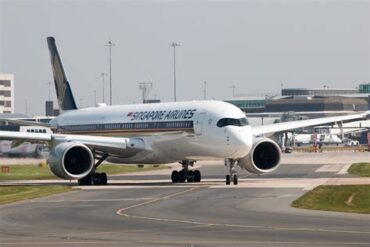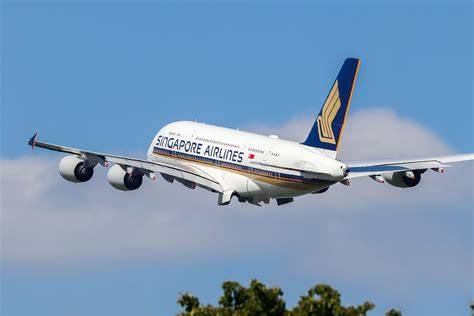
Singapore Airlines was the launch customer of the Airbus A380, making its return to the superjumbo one of the defining moments in modern commercial aviation. The first A380 entered scheduled service with the carrier in October 2007, and over the following years, the aircraft became closely associated with Singapore Changi Airport and some of the airline’s most prestigious long-haul routes. Yet the network has gradually contracted. Based on Singapore Airlines’ submitted schedules, 11 routes that previously received the A380 are no longer scheduled to operate the aircraft between September 2026 and July 2027.
The change is significant because Singapore Airlines remains one of only ten scheduled operators still flying the A380. According to ch-aviation data cited in the reference material, the carrier retains 12 Airbus A380s, each configured with 471 seats across four classes. The airline previously operated a more premium 379-seat configuration, allowing the superjumbo to concentrate an unusually large proportion of its capacity in First Class and Business Class. That strategy made the A380 particularly valuable on high-yield international markets.
The 11 discontinued A380 routes illustrate how dramatically the aircraft’s role has changed. Some were major trunk routes that supported thousands of superjumbo departures over many years, while others saw the aircraft only briefly. The schedule analysis compares Singapore Airlines’ A380 network from October 2007 through August 2026 with the planned operation from September 2026 to July 2027. Because airline schedules remain subject to change, particularly amid geopolitical and operational uncertainty, the list should be viewed as a snapshot of the planned network rather than a permanent retirement announcement.
The 11 Singapore Airlines A380 Routes No Longer Scheduled
The destinations include San Francisco, Bangkok, Los Angeles, Nagoya, Paris, Beijing, Osaka, Zurich, Kuala Lumpur, New York JFK and Tokyo Narita. The history behind each route is considerably more interesting than the list alone suggests.
| Destination from Singapore | Final A380 year | Total A380 departures |
|---|---|---|
| San Francisco via Hong Kong | 2013 | 88 |
| Bangkok Suvarnabhumi | 2016 | 5 |
| Los Angeles via Tokyo Narita | 2016 | 1,942 |
| Nagoya | 2019 | 6 |
| Paris Charles de Gaulle | 2019 | 3,506 |
| Beijing Capital | 2020 | 1,966 |
| Osaka Kansai | 2020 | 301 |
| Zurich | 2020 | 3,649 |
| Kuala Lumpur | 2021 | 30 |
| New York JFK via Frankfurt | 2023 | 3,314 |
| Tokyo Narita | 2025 | 3,923 |
The figures reveal an important distinction between routes that genuinely lost a major A380 operation and destinations where the aircraft appeared only as a temporary or exceptional substitute. Tokyo Narita recorded the most A380 departures, with 3,923 flights, followed by Zurich with 3,649, Paris Charles de Gaulle with 3,506 and New York JFK with 3,314. These numbers underline just how central the A380 once was to Singapore Airlines’ long-haul strategy.
Tokyo Narita Was Singapore Airlines’ Biggest A380 Destination
Tokyo Narita stands out as the destination with the highest number of A380 departures in the historical data. The aircraft became a familiar sight on the Singapore-Tokyo market, although the evolution of the route network eventually shifted the A380 toward other priorities. Singapore Airlines continues to serve Japan extensively, but the A380 no longer forms part of its scheduled Narita operation in the forward schedule examined.
The broader Tokyo-Los Angeles history is particularly notable. Singapore Airlines operated the A380 between Singapore, Narita and Los Angeles, with the superjumbo replacing the Boeing 747-400 on the route. The service also used fifth-freedom rights, allowing passengers to travel between Tokyo and Los Angeles on the Singapore Airlines aircraft. It represented one of the carrier’s most distinctive applications of the A380.
Los Angeles A380 Flights Combined Two Major Markets
Singapore Airlines eventually deployed the A380 to three North American airports, including Los Angeles. The SIN-NRT-LAX service became a major part of the airline’s history with the superjumbo, operating daily between July 2011 and October 2016. The route covered approximately 7,625 nautical miles, or 14,122 kilometers, each way on a great-circle basis.
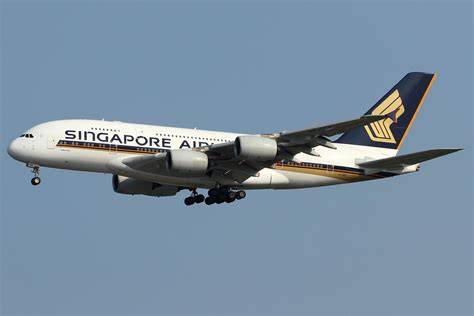
The introduction was not completely straightforward. Regular A380 operations were initially planned for March 2011, but the devastating earthquake and tsunami in Japan caused a sharp reduction in travel demand and contributed to a delay. Once introduced, however, the aircraft became an important symbol of Singapore Airlines’ presence between Asia and North America. Today, the airline still operates between Singapore and Los Angeles, but the A380 has been replaced by smaller and more flexible aircraft.
Zurich Shows Why Premium Demand Mattered
Zurich was one of Singapore Airlines’ most important A380 destinations in Europe, with 3,649 departures recorded before the superjumbo disappeared from the route. The aircraft primarily operated daily from March 2010 until March 2020, giving Zurich nearly a decade of regular A380 service.
The route was particularly suited to Singapore Airlines’ premium-heavy A380 configuration. Zurich is a major global financial center, generating substantial business and premium leisure demand. Singapore Airlines therefore deployed its higher-premium 379-seat configuration on the market, including 12 First Class Suites and 86 Business Class seats. Together, those cabins accounted for a substantial share of the aircraft’s available capacity.
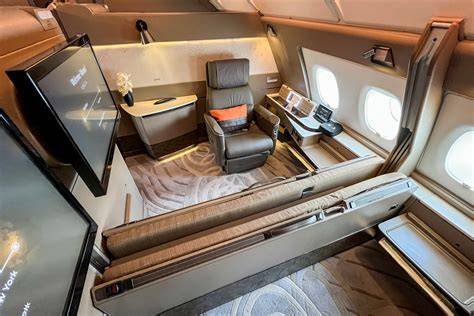
Although the A380 has disappeared from Zurich, Singapore Airlines continues to emphasize premium capacity on the route. Its Boeing 777-300ER operation includes First Class, while fellow Star Alliance carrier SWISS also uses a First Class-equipped 777-300ER. That strategy demonstrates that losing the A380 does not necessarily mean abandoning premium demand; airlines can instead use smaller aircraft with carefully selected cabin configurations.
Paris, Beijing and New York Also Lost the Superjumbo
Paris Charles de Gaulle accumulated 3,506 A380 departures, making it another major European destination in Singapore Airlines’ superjumbo history. Beijing Capital recorded 1,966 departures, although its history is more complicated because the A380 left and later returned before reaching its final end year. Osaka, meanwhile, accumulated 301 departures before the aircraft disappeared from the route.
New York JFK also had a substantial A380 history, with 3,314 departures via Frankfurt. Frankfurt itself remains an exception in the current network because the A380 continues to appear on a terminator basis. This illustrates that Singapore Airlines is not abandoning the aircraft overnight; instead, it is concentrating its remaining superjumbo fleet on markets where the economics and scheduling make the most sense.
Bangkok, Nagoya and Kuala Lumpur Had Limited A380 Operations
Not every destination on the list represented a long-running A380 route. Bangkok Suvarnabhumi saw only five A380 flights in total, with those operations occurring in April 2025 and April 2026. Nagoya was even more limited, receiving only six flights across 2014, 2016 and 2019.
Kuala Lumpur was another unusual case. The 30 recorded A380 departures were associated with crew training and familiarization ahead of the aircraft’s return to commercial service, rather than a conventional long-term scheduled route. These examples demonstrate why raw departure totals need context: a destination appearing in the historical A380 network does not necessarily mean Singapore Airlines operated a sustained commercial superjumbo service there.
Dubai and Hong Kong Are Not on the 11-Route List
Two important destinations are deliberately excluded from the 11-route list: Dubai International Airport and Hong Kong International Airport. Dubai received two A380 departures in April 2024, while the forward schedule indicates that daily A380 service is planned to return in March 2027. However, the schedule remains vulnerable to further changes because of geopolitical developments and airspace disruptions.
Hong Kong is similarly different. Singapore Airlines’ A380 service to HKG last operated in July 2026, but the aircraft is currently scheduled to return in June 2027. Consequently, neither destination can accurately be described as permanently removed from the A380 network based on the available schedule.
What the 11 Route Cuts Mean for Singapore Airlines’ A380 Fleet
The shrinking network reflects the broader challenge facing Airbus A380 operators. The aircraft offers extraordinary capacity and a premium passenger experience, but its size makes it less flexible than twin-engine widebodies such as the Boeing 777-300ER and Airbus A350 family. Singapore Airlines can increasingly match capacity to demand by using smaller aircraft while maintaining long-haul connectivity and premium cabins.
The A380 nevertheless remains an important part of the airline’s identity. Singapore Airlines helped establish the aircraft as a premium flagship, and its four-class cabin remains one of the industry’s most recognizable superjumbo products. The retirement of A380 service on these 11 routes therefore represents more than a schedule adjustment. It marks another stage in the gradual transition from very large four-engine aircraft toward more efficient twin-engine widebodies, while Singapore Airlines continues to preserve the A380 on selected high-demand markets.
For aviation enthusiasts, the disappearing routes also provide a fascinating record of how the superjumbo reshaped Singapore Airlines’ global network. From Tokyo and Zurich to Paris, Los Angeles and New York, these destinations each played a different role in the A380 story. As the remaining fleet becomes increasingly concentrated, every scheduled Singapore Airlines A380 flight is becoming a little more significant—and a little harder to take for granted.