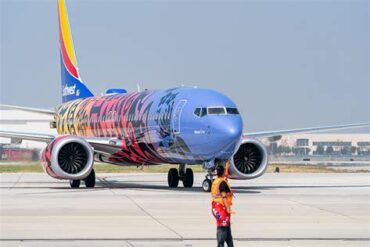
Southwest Airlines has quietly initiated a transformative step toward global expansion, marking a bold departure from its historically domestic-focused strategy. On Tuesday, the Dallas-based carrier submitted a comprehensive application to the U.S. Department of Transportation (DOT), seeking permission to transport passengers, cargo, and mail between the United States and countries covered under existing and future Open Skies agreements.
This move positions Southwest to dramatically extend its network footprint far beyond its current reach, which remains largely centered in the United States, Mexico, Central America, and the Caribbean. If granted, the permit would allow the low-cost giant to operate in key markets across Europe, Asia, Africa, and Latin America, potentially signaling a long-term transformation in both the airline’s strategy and the broader dynamics of U.S. commercial aviation.
A Measured Yet Strategic Departure from Domestic Roots
Founded in 1971 with an initial focus on intrastate flights connecting Dallas, Houston, and San Antonio, Southwest Airlines has long prided itself on simplicity and domestic reliability. The airline pioneered the low-cost, no-frills model and built a loyal customer base through transparent pricing, free checked bags, and open seating. But over the last decade, the carrier has gradually inched toward more international connectivity, beginning with select Caribbean and Latin American routes launched after the 2010 acquisition of AirTran Airways.
However, Tuesday’s DOT filing signals a qualitative shift in mindset. By explicitly requesting authority to operate in all countries under existing Open Skies treaties—and even preemptively asking for access to countries covered by future agreements—Southwest is laying the regulatory groundwork for a new era of operations.
Understanding the DOT Filing and Its Implications
The filing utilizes what the DOT calls “streamlined regulatory procedures for licensing U.S. and foreign air carriers,” an approach that simplifies bureaucratic barriers and accelerates market entry. According to a statement provided to Bloomberg, Southwest confirmed that it is “taking advantage of simplified procedures,” though the airline stopped short of announcing specific new destinations or timelines.
What makes this strategic maneuver particularly noteworthy is its proactive nature. Rather than respond reactively to market demand or competitive pressure, Southwest appears to be setting the foundation for opportunistic growth. By securing regulatory clearance now, the airline ensures that it will be able to act swiftly should demand for international travel rebound or geopolitical conditions shift favorably.
Partnership with Icelandair: A Preview of the Future
In February, Southwest announced a codeshare agreement with Icelandair, enabling seamless ticketing and baggage transfers for customers flying through Baltimore/Washington International Thurgood Marshall Airport (BWI). In April, the connectivity was expanded to include Denver and Nashville, giving customers in additional markets the ability to link up with Icelandair’s transatlantic flights.

Though limited in scope, this partnership serves as a proof of concept. It allows Southwest to test international demand without directly operating long-haul flights, while simultaneously collecting valuable data about passenger behavior, booking patterns, and logistics. This arrangement can be seen as a pilot phase—both figuratively and literally—for a larger international push.
Challenges in Timing and Demand Forecasting
Despite the bold filing, Southwest executives remain cautious about near-term execution. In public statements, the airline has indicated that it will slow overall growth in 2025, citing softening travel demand and economic headwinds in the U.S. consumer sector. Inflationary pressures, interest rate volatility, and lingering pandemic effects have all contributed to a more uncertain macroeconomic environment.
This hesitancy aligns with the airline’s traditionally conservative approach to expansion. Unlike legacy carriers like American, Delta, or United—who routinely roll out new routes based on complex yield models—Southwest tends to prioritize operational efficiency and reliability over aggressive market capture. The DOT application, therefore, should be seen not as a promise, but as strategic optionality.
Potential International Markets and Competitive Landscape
If the application is approved, Southwest will have access to dozens of international markets currently served under the U.S.’s Open Skies framework. These include high-value destinations such as:
- Germany, France, and the United Kingdom in Europe
- Brazil, Chile, and Colombia in Latin America
- Japan, South Korea, and Singapore in Asia
- South Africa, Morocco, and Ghana in Africa
However, serving these markets will require significant investment in fleet modernization, pilot training, and route planning. Southwest’s current fleet, composed entirely of Boeing 737 variants, is well-suited for domestic and near-international flights but may lack the range and capacity for longer transatlantic or transpacific services without substantial configuration adjustments.
Moreover, entering international routes will place Southwest in direct competition with entrenched full-service carriers who offer extensive lounge access, business-class products, and frequent flyer incentives. While Southwest’s loyal customer base and efficient operations are assets, its brand will need to evolve to meet the expectations of long-haul travelers.
Shifts in Business Model: Assigned Seating and Baggage Fees
Coinciding with its international ambitions are some of the most significant business model shifts in the airline’s history. At the end of this month, Southwest will begin charging for checked bags on select itineraries—a dramatic reversal from its long-standing “bags fly free” policy. This change is being tested as a response to rising fuel costs and inflationary pressures.
Additionally, the airline is in the process of retrofitting its cabins to support assigned seating, another break from tradition. Historically, Southwest’s open-seating model has differentiated it from competitors and contributed to faster boarding times. However, as the airline eyes new international markets—where assigned seats are an industry norm—it appears willing to sacrifice legacy practices in favor of global competitiveness.
These shifts are not isolated; they reflect an emerging strategic realignment aimed at enabling broader capabilities for global service. Taken together, they signal a willingness to evolve the brand in alignment with new operational realities.
Regulatory Readiness in a Post-Pandemic Landscape
Southwest’s filing comes at a time when governments around the world are recalibrating aviation regulations in the wake of the COVID-19 pandemic. Many nations have embraced Open Skies treaties as a means to stimulate tourism and economic recovery, creating a ripe environment for airlines seeking to expand. By filing now, Southwest positions itself as an early mover in the next phase of global aviation liberalization.
Furthermore, the use of streamlined regulatory procedures suggests that the DOT is also seeking to facilitate quicker decision-making in airline licensing. This mutual alignment between government policy and private sector strategy underscores the timeliness and foresight of Southwest’s application.
Conclusion: A Strategic Pivot with Global Implications
Southwest Airlines’ DOT filing is more than a bureaucratic exercise—it is a strategic pivot that could redefine the carrier’s future and reshape the competitive landscape of U.S. aviation. While the airline has not yet announced specific routes or launch dates, its intentions are clear: to build the foundation for a truly global network, one that leverages its operational strengths while embracing new norms of international service.
Whether Southwest can replicate its domestic success on a global scale remains to be seen. But with its latest moves—ranging from international filings and strategic partnerships to fundamental shifts in pricing and seating policies—the airline is undeniably charting a new course.
As the world emerges from economic uncertainty and travel demand stabilizes, Southwest’s bold regulatory groundwork may soon translate into takeoffs bound far beyond the U.S. border.