The depths of the Red Sea hide countless relics of history, but few are as haunting and fascinating as the wreck of the SS Thistlegorm. Once a British cargo ship loaded with wartime supplies, it was violently destroyed during World War II and left to sink into the dark waters of the Straits of Gubal. Today, the twisted steel hull and scattered cargo have transformed into something entirely unexpected: a thriving marine habitat often described by divers as a creepy underwater zoo.
What was once a vessel of war has become a surreal underwater world where history, nature, and tragedy quietly coexist.
The Night Bombs Destroyed the SS Thistlegorm
In the early hours of October 6, 1941, the 415-foot British merchant ship SS Thistlegorm lay anchored in the narrow shipping route between the Sinai Peninsula and the Egyptian mainland. The ship was part of Britain’s logistical lifeline during the North African campaign, transporting desperately needed supplies to Allied troops battling Axis forces across the desert.
Official shipping documents listed the cargo as motor parts. In reality, the holds were packed with military equipment, rifles, ammunition, trucks, motorcycles, and armored vehicles destined for British forces. The ship also carried two massive Stanier 8F steam locomotives, each weighing more than 73 tons, intended for railway operations in the Middle East.
At approximately 1:30 a.m., two German Heinkel He 111 bombers spotted the anchored vessel. Believing it to be an Allied troop transport, they initiated an attack.
Two bombs plunged toward the ship.
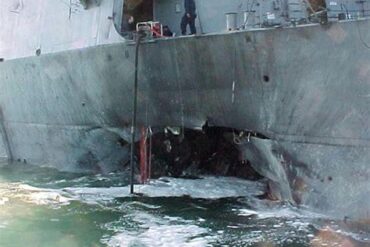
They struck hold number four near the stern, detonating directly among crates of munitions. The resulting explosion was catastrophic. Fire erupted instantly, and the blast was powerful enough to split the ship’s hull in two while launching the enormous locomotives overboard and into the sea.
A Ship Torn Apart Beneath the Red Sea
The explosion shattered the vessel so violently that its remains settled on the seabed in a distinctive “V” formation. The stern collapsed onto its port side at roughly 105 feet below the surface, while the bow settled upright in about 52 feet of water.
Despite the massive destruction, the majority of the crew survived. Of the 42 men aboard, only nine lost their lives, including five Royal Navy personnel believed to have been operating the ship’s 4.7-inch anti-aircraft gun at the stern when the bombs struck.
The fiery blast illuminated the surrounding waters so brightly that it accidentally revealed the location of another nearby vessel, the SS Rosalie Moller. Two days later, German bombers returned and sank that ship as well.
For years afterward, the wreck of the Thistlegorm remained largely forgotten beneath the waves.
Rediscovery by Jacques-Yves Cousteau
The wreck resurfaced in the public imagination in 1955, when legendary ocean explorer Jacques-Yves Cousteau located the submerged vessel during one of his expeditions in the Red Sea. Cousteau briefly documented the wreck and even recovered several artifacts.
Yet despite this discovery, the site remained relatively obscure for decades. Navigation charts marked the wreck, but only experienced explorers occasionally visited it.
Everything changed during the 1990s, when improvements in recreational diving and underwater tourism turned the site into one of the most famous wreck dives in the world.
Today, divers travel from across the globe specifically to descend into the silent corridors of this wartime time capsule.
A World War II Time Capsule on the Ocean Floor
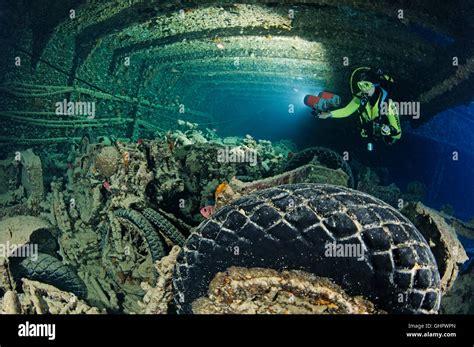
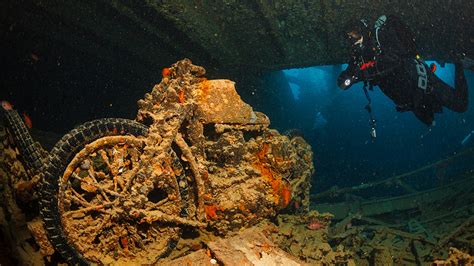
One of the most remarkable features of the SS Thistlegorm wreck is how much of its cargo still remains exactly where it was when the ship sank. The cavernous cargo holds are now open chambers where divers can glide past rows of motorcycles, trucks, rifles, ammunition crates, and spare aircraft parts.
These relics form what is essentially an underwater museum of World War II logistics.
The famous BSA motorcycles, Bedford trucks, and railway equipment remain scattered throughout the wreck, preserved by the relatively calm waters of the northern Red Sea. Even the massive locomotives thrown from the deck during the explosion now rest on the seabed beside the ship.
For divers, exploring the wreck feels less like visiting ruins and more like drifting through a frozen moment in history.
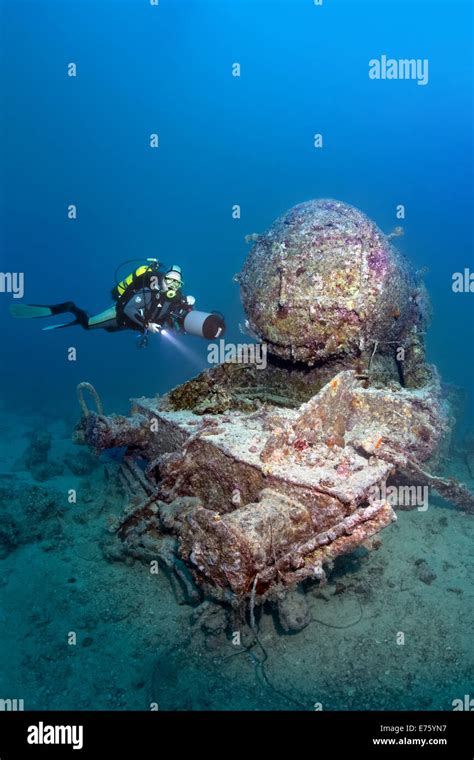
The Creepy Underwater Zoo Growing Inside the Wreck
Over the decades, the steel skeleton of the Thistlegorm has evolved into a thriving marine ecosystem. Coral growth coats the metal beams, transforming the wreck into a sprawling artificial reef.
The result is an astonishing concentration of marine life.
Divers frequently encounter:
- Lionfish drifting through cargo holds
- Moray eels hiding in twisted metal
- Batfish circling the decks
- Angelfish weaving through coral formations
- Barracuda patrolling the surrounding waters
Sea turtles occasionally glide past the wreck, while stonefish camouflage themselves along the seabed.
Perhaps the strangest resident is the crocodilefish, a rare ambush predator whose flattened head and textured skin make it resemble a small crocodile resting on the ocean floor.
The contrast between wartime destruction and vibrant marine life gives the site its eerie nickname: an underwater zoo built from a battlefield.
Why the SS Thistlegorm Remains One of the World’s Most Fascinating Shipwrecks
Wreck diving is inherently dangerous, and the interior spaces of the Thistlegorm require skill and caution. Because of the risks posed by tight corridors, unstable debris, and strong currents, divers typically need at least twenty logged dives before exploring the ship’s interior.
Yet those who visit often describe the experience as unforgettable.
Few places on Earth combine World War II history, preserved military cargo, and thriving marine ecosystems in such a dramatic way. The SS Thistlegorm began its life as a wartime supply ship carrying the machinery of conflict.
Eighty years later, its shattered hull has become something far stranger and more poetic: a silent reef where history sleeps beneath coral and fish glide through the shadows of war.