The Approach Controller
The approach controller plays a vital role in managing air traffic for both departing and arriving flights within a Terminal Movement Area (TMA). They act as the crucial link between Tower and Area controllers, focusing on aircraft during their climb, descent, and approach phases. Typically, an approach control unit is set up only when traffic demand justifies it. Many airports, even those with controlled airspace, may only have tower controllers available. In such cases, flights are often handed off from the tower to a neighboring Area Control Center (ACC) or Flight Information Center (FIC). Even when an approach control unit is operational at an airport, transfers can still occur directly from the tower to the ACC, depending on prior coordination.
Unlike Tower controllers, who manage a single airport or sometimes just one runway, APP controllers handle flights from multiple nearby airports. Their primary focus remains on traffic arriving at or departing from aerodromes within the TMA. While some transit overflights do occur, they usually represent a small fraction of overall traffic. APP controllers can apply a minimum separation of 3 nautical miles when resolving conflicts between aircraft, a reduction from the typical 5 nautical miles used by area control. However, this is contingent upon the availability of specific radar systems and compliance with wake turbulence separation minima.
Specific Challenges
APP controllers share the overarching goals of all air traffic controllers: ensuring safety by maintaining aircraft separation and promoting efficiency by establishing a steady flow of traffic. Nonetheless, each position presents unique challenges that set them apart from others. Some specific challenges faced by APP controllers include:
Sequencing: While Tower controllers mainly concentrate on departures, APP controllers prioritize handling arrivals. This involves safely and efficiently sequencing two consecutive arrivals to ensure they are neither too close—risking a go-around for the second aircraft—or too far apart, which could lead to unnecessary airborne time for the second arrival. Sequencing methods include vectoring, where specific headings are assigned, allowing the controller to adjust the aircraft’s arrival path as needed. While vectoring offers extensive control options, it increases the controller’s workload as each heading change must be communicated as a separate instruction.
RNAV STARs: These are defined routes comprising navigation points that aircraft must pass over. The flight paths can be intentionally curved, enabling controllers to provide shortcuts or delays, reducing workload and frequency occupancy. The point merge system, a specific RNAV structure, allows precise sequencing while maintaining reduced workload, as all aircraft on the arc are directed towards the same merging point.
Holding stacks: This method accommodates large numbers of aircraft, especially when runway capacity is exceeded. Aircraft hold at designated points at varying altitudes, and when conditions permit, the lowest aircraft is cleared for landing while others move down the stack. Multiple stacks may be necessary for different directions of inbound flights, requiring the controller to alternate between them.
Integration of departures and arrivals: APP controllers must separate and integrate different traffic flows. Unlike en-route flights, most aircraft are climbing or descending, making level-offs less efficient and more costly in fuel consumption. To maintain efficiency without compromising safety, APP controllers must devise plans for constantly changing flight parameters. Departures and arrivals often intersect, particularly during high traffic levels, necessitating restrictions in Standard Instrument Departures (SIDs) and Standard Terminal Arrivals (STARs) to manage crossing paths.
Lack of a hold position: While Tower controllers can instruct grounded aircraft to hold in place, APP controllers must manage moving aircraft without that option, adding complexity to their tasks.
Diversity of aircraft types: Most modern jets perform similarly during descent and approach phases, but turboprops and general aviation aircraft can fly significantly slower, complicating integration into the traffic flow. This challenge arises because these aircraft are typically separated vertically during cruise by substantial altitudes.
Cooperation with the Tower: This collaboration is crucial at aerodromes where the same runways are used for both takeoffs and landings. APP controllers need to keep the Tower informed about landing sequences and ensure sufficient spacing for departures within gaps created by arrivals.
Terrain and obstacle clearance: APP controllers often contend with terrain and obstacles that en-route controllers might not encounter. While standard instrument arrivals are designed to maintain vertical clearances, deviations can place the responsibility for safety regarding terrain and obstacles on the controller.
Transition layer: APP controllers must navigate both altitude and flight levels, adjusting to changes in QNH and transition levels while keeping flights informed.
Missed approaches: When an aircraft executes a missed approach, it requires integration into the arrival sequence, significantly impacting the APP controller’s workload.
Example Scenario
This section illustrates a typical scenario for an APP controller managing an arrival. Note that procedures may vary by approach control unit due to factors like traffic demand and airspace structure.
Initial contact: The pilot informs the controller that they have received ATIS information, which the controller either confirms or updates. The controller then provides details on the type of arrival (STAR, vectoring, etc.), expected runway, and approach type (ILS, VOR/DME, RNAV, visual, etc.). The STAR may have been assigned by the previous ACC sector.
Flying the arrival procedure: Depending on the arrival type, this stage may involve a few exchanges (for STARs) or be busier (for vectoring). The goal here is to position the aircraft appropriately for the final approach.
The final approach: The controller clears the flight for the final approach, specifying the type. A report from the pilot is typically expected at this stage, confirming their established position on the ILS or visual sighting of the runway.
Transfer to the Tower: This transfer occurs when the APP controller believes the aircraft will complete landing successfully, often following a report from the pilot. The controller may inform the Tower about the distance from touchdown before initiating the transfer.
Working Positions and Roles
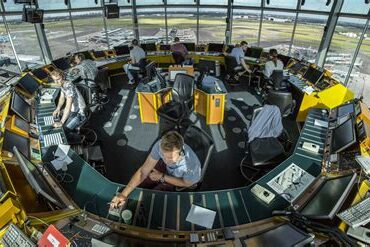
An APP unit may operate with a single sector manned by one or two controllers if traffic levels allow. Increased complexity can be managed by adding sectors, which can be organized by roles or airspace divisions, such as separating departures and arrivals or creating distinct positions for the STAR phase.
Equipment
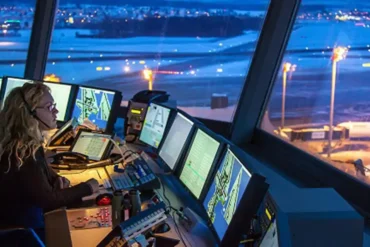
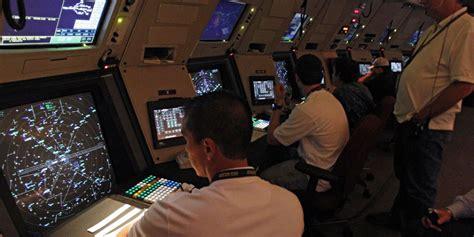
APP controllers typically use a situation display connected to an automated ATS system, similar to those used by area controllers. However, the tools differ significantly. For example, an important tool for APP is the “Distance to go” indication, which informs controllers of the distance from an aircraft to the selected runway’s touchdown point, accounting for trajectory adjustments. While APP does not rely heavily on tactical tools due to changing groundspeeds, trajectory-based tools enhanced with downlinked data from aircraft are being developed. Additionally, APP controllers benefit from surface movement radar/A-SMGCS views to enhance situational awareness. Fast communication with Tower controllers is often facilitated by dedicated hotline tools, separate from other communication systems. Tools like the Arrival Manager (AMAN) assist in data collection and traffic sequencing, while the Approach Path Monitor serves as a safety net, warning about potential risks during final approaches. In low traffic conditions, approach control services can be provided without surveillance data, relying instead on basic radio communication and flight data processing systems.