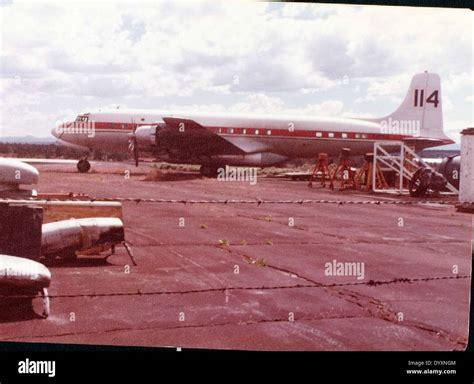
The roar of a large piston-engine airliner is unlike anything in modern aviation. It is not the smooth turbine hum passengers hear aboard today’s jetliners, nor the subdued rhythm of modern turboprops. Instead, it is mechanical thunder — raw, metallic, and deeply alive. Few aircraft embodied that sensation more completely than the Douglas DC-7, the last major American piston-engine airliner ever built before the Jet Age swept the skies clean of propeller-driven giants.
For a brief and fascinating period during the 1950s, the DC-7 represented the absolute peak of piston-powered aviation technology. It was fast, luxurious, ambitious, and mechanically complex. Airlines viewed it as the future of long-range travel even as the first commercial jets were already preparing to make it obsolete. The aircraft arrived at the exact moment aviation was about to transform forever.
The DC-7 was not simply another propeller aircraft. It was the final expression of an engineering philosophy that had dominated aviation since the 1930s. Every improvement in piston technology — more horsepower, greater range, better cabin comfort, higher cruising speeds, and nonstop transcontinental capability — culminated in this aircraft. In many ways, the DC-7 was both the pinnacle and the farewell of America’s great radial-engine airliner era.
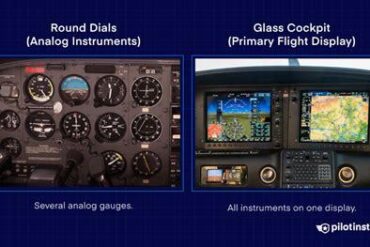
The aircraft still survives today in museums and restoration hangars, where aviation enthusiasts gather to hear stories of roaring Wright engines, coast-to-coast luxury flights, and an age when pilots wrestled with powerful mechanical systems instead of quietly monitoring digital screens.
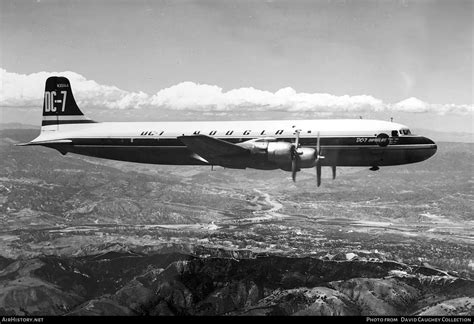
The Douglas DC-7 Was Built to Conquer America’s Longest Routes
By the early 1950s, commercial aviation was evolving rapidly. Air travel demand surged after World War II, and airlines competed aggressively to offer faster nonstop routes between America’s biggest cities. Passengers no longer wanted lengthy fuel stops scattered across the country. They wanted speed, convenience, and prestige.
Douglas Aircraft Company responded with the DC-7.
Introduced in 1953, the aircraft was developed from the successful DC-6 platform, but it pushed piston-engine technology to levels never seen before in commercial service. Powered by four enormous Wright R-3350 Duplex-Cyclone radial engines, the DC-7 delivered extraordinary performance for its era. The aircraft could fly nonstop from New York to Los Angeles in under eight hours, an astonishing feat during the early 1950s.
That capability mattered enormously. Transcontinental air travel had become a status symbol in postwar America. Airlines wanted aircraft that could reduce travel times while offering luxurious cabins filled with sleeper berths, elegant seating arrangements, and premium dining service. The DC-7 allowed carriers to market coast-to-coast flights as both practical and glamorous.
Competition also played a major role in the aircraft’s creation. Lockheed’s elegant Super Constellation had become one of the most admired airliners in the world, and Douglas needed a direct response. The DC-7 became that answer — faster, longer-ranged, and capable of challenging Lockheed’s dominance in premium long-haul routes.
At cruising altitude, the aircraft represented the absolute limit of what piston-engine aviation could achieve. Engineers extracted enormous power from the R-3350 engines, producing performance levels that earlier generations of aviation designers could scarcely imagine. Yet those achievements came with consequences.
The engines were powerful, but notoriously temperamental. Overheating issues plagued operations, especially during long-distance flights under heavy loads. Maintenance crews worked relentlessly to keep the aircraft flying safely. Airlines accepted these challenges because the DC-7 offered unmatched capability in the piston era, but the complexity hinted at a larger truth: piston technology was approaching its practical limits.
Why the DC-7 Became the Last Great Propeller Airliner in America
The DC-7 occupies a unique place in aviation history because it arrived during a technological crossroads. It represented the final triumph of piston-powered engineering just before jet propulsion fundamentally changed commercial aviation.
For decades, piston engines had powered everything from military bombers to luxury passenger transports. They defined aviation’s golden age. But by the mid-1950s, the industry began recognizing that the future belonged elsewhere.
Jet engines changed everything.
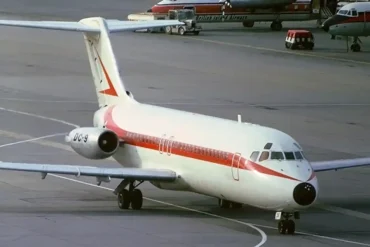
Compared to piston-powered aircraft, jets offered dramatically higher speeds, smoother flights, lower vibration levels, and far greater reliability. Aircraft like the Boeing 707 and the Douglas DC-8 quickly demonstrated that piston airliners could no longer compete economically or operationally.
The difference in performance was staggering. While the DC-7 cruised at roughly 400 miles per hour, early jetliners approached 600 miles per hour. Flight times shrank dramatically. Passenger appeal skyrocketed. Airlines rapidly realized that the public associated jets with modernity, prestige, and progress.
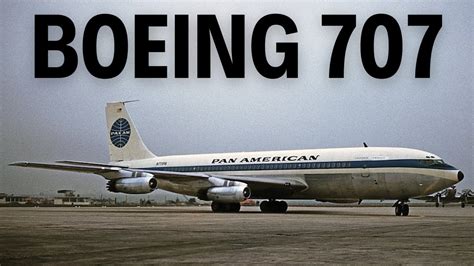
Piston engines also demanded enormous maintenance resources. The Wright R-3350 engines powering the DC-7 required constant attention, inspections, and costly overhauls. Engine fires and overheating incidents were recurring concerns throughout the aircraft’s operational life. Airlines operating increasingly busy route networks found these maintenance burdens difficult to justify once jets entered service.
Noise was another factor. Radial piston engines produced tremendous vibration and sound levels compared to the quieter cabin experience offered by jetliners. As commercial aviation evolved into a mass transportation system rather than a luxury adventure, airlines prioritized efficiency, reliability, and scalability above the mechanical romance of giant propeller aircraft.
Ironically, the DC-7 was too advanced for its own survival. Douglas engineers had squeezed nearly every possible improvement from piston technology, but there was simply nowhere left to go. The aircraft stood at the very edge of an engineering cliff, and beyond that cliff waited turbine propulsion.
Airlines That Turned the DC-7 Into a Transcontinental Icon
During its relatively short service life, the DC-7 became a flagship aircraft for many major airlines across the United States and abroad. American Airlines, United Airlines, Delta Air Lines, Eastern Air Lines, and Braniff all operated the aircraft extensively during the 1950s and early 1960s.
American Airlines used the DC-7 to expand premium nonstop coast-to-coast operations, giving travelers faster schedules and greater convenience. United Airlines similarly embraced the aircraft for high-demand domestic routes, while Delta viewed the DC-7 as a transformational step toward becoming a major long-haul carrier.
The aircraft’s spacious cabin helped reinforce its premium reputation. Depending on configuration, passengers experienced sleeper accommodations, large reclining seats, and refined onboard service that reflected the glamorous identity of mid-century air travel. Flying aboard a DC-7 was often considered an event rather than simple transportation.
Internationally, the aircraft reached operators in more than 30 countries. Douglas introduced improved variants including the DC-7B and the ultra-long-range DC-7C, sometimes nicknamed the “Seven Seas” due to its ability to handle overseas operations more effectively. These later models added greater fuel capacity and enhanced intercontinental performance, allowing airlines to expand global route networks before jets became dominant.
Yet the aircraft’s reign proved remarkably brief.
Within only a few years of entering service, jetliners began displacing piston aircraft across major routes. Airlines discovered that passengers overwhelmingly preferred jets, even when ticket prices were higher. The speed advantage alone transformed scheduling economics and route planning strategies.
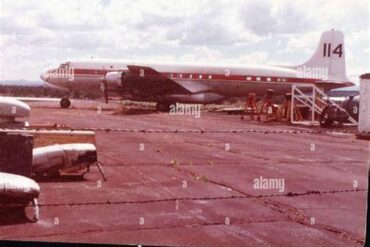
By the late 1960s, most passenger DC-7 operations had disappeared. Some aircraft transitioned into cargo service as converted DC-7F freighters, while others found secondary roles in charter operations and aerial firefighting missions. But the age of piston-powered commercial supremacy had ended permanently.
Inside the Mechanical Genius of the Wright R-3350 Engines
The heart of the DC-7’s legend lies within its engines.
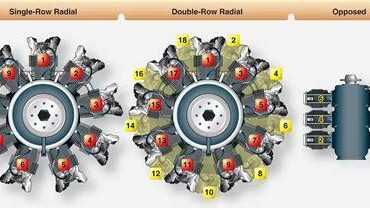
The Wright R-3350 Duplex-Cyclone radial engines represented one of the most ambitious piston aircraft powerplants ever developed in the United States. Each engine produced immense horsepower and drove massive propellers capable of pulling the large airliner across entire continents without refueling.
From a technical perspective, the engines were masterpieces of mechanical engineering. They featured complex turbo-compounding systems designed to recover exhaust energy and improve efficiency. At the time, this technology appeared revolutionary. Engineers pushed piston engine development to extraordinary extremes in pursuit of greater speed and range.
But complexity often creates vulnerability.
The R-3350 developed a reputation for overheating and maintenance difficulties, especially in demanding airline service. Mechanics needed extensive training and constant vigilance to keep the engines operating safely. Oil leaks, cylinder failures, and thermal stress became familiar concerns for flight crews and maintenance teams alike.
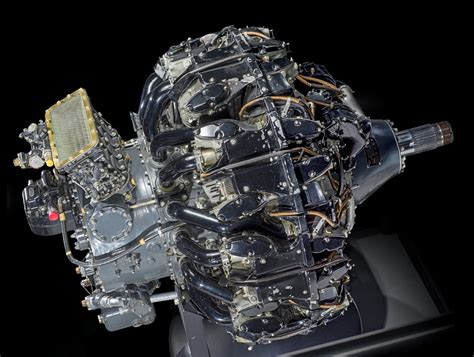
Pilots respected the engines because they delivered tremendous performance, but they also understood their unforgiving nature. Operating a DC-7 required careful engine management and deep technical knowledge, qualities that defined the piston era of aviation.
Modern turbine engines, by comparison, dramatically simplified long-range flight operations. They produced more power with fewer moving parts and far greater reliability. Once jets proved commercially viable, the fate of aircraft like the DC-7 was effectively sealed.
Still, among aviation historians and vintage aircraft enthusiasts, the sound of an R-3350 starting to life remains unforgettable. The coughing ignition sequence, the clouds of smoke, and the synchronized roar of four radial engines capture an era when flying felt intensely physical and mechanical.
Where the Remaining Douglas DC-7 Aircraft Survive Today
Although the DC-7 vanished from commercial passenger service decades ago, several surviving examples remain preserved across the United States. These aircraft now serve as historical artifacts representing the final chapter of piston-engine airline travel.
One of the best-known examples resides at the Delta Flight Museum in Atlanta, where visitors can examine the aircraft up close and appreciate the scale of its engineering. Another important survivor is displayed at the Pima Air & Space Museum in Tucson, Arizona, where aviation enthusiasts can still admire the aircraft’s sleek fuselage and towering radial engines.
Some surviving aircraft spent years operating as cargo transports after their passenger careers ended. Others transitioned into aerial firefighting roles, carrying retardant loads over wildfires deep into the late twentieth century.
One particularly famous aircraft, known as Tanker 60, became one of the last airworthy DC-7s in existence before completing its final flight in 2020. Its retirement symbolized the near-total disappearance of large piston-engine transports from active operations.
Restoration work continues on several surviving airframes, but maintaining these aircraft has become extraordinarily difficult. Replacement parts are scarce, experienced radial-engine mechanics are increasingly rare, and certification requirements create enormous financial challenges for restoration organizations.
For most aviation fans, museums remain the only realistic opportunity to encounter a DC-7 today.
Standing beside one reveals just how enormous and ambitious these aircraft truly were. The polished propeller blades, riveted aluminum skin, and sprawling radial engines communicate a level of mechanical artistry largely absent from modern airliners.
The Douglas A-1 Skyraider and the Final Age of Piston Combat Aircraft
While the DC-7 represented the final peak of piston-powered commercial aviation, another Douglas aircraft carried the piston era into military history: the Douglas A-1 Skyraider.
Unlike sleek jet fighters, the Skyraider relied on brute strength, long endurance, and devastating payload capability. Developed during the 1940s, the aircraft became legendary during the Vietnam War for close air support and combat rescue escort missions.
Its massive piston engine gave it exceptional loiter time over battlefields, allowing pilots to remain in combat zones far longer than early jet aircraft. The Skyraider could absorb heavy damage, carry enormous weapon loads, and perform missions jets often struggled to execute effectively.
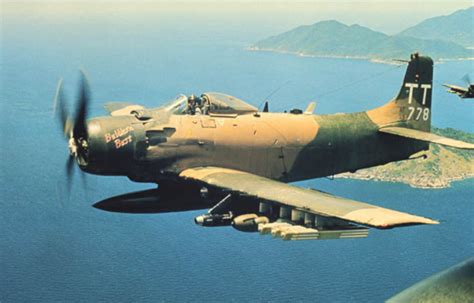
The aircraft ultimately became one of the final major American combat aircraft powered by a piston engine. Its service history mirrored the DC-7’s broader historical role: the last and most refined expression of a technology that jets would soon replace completely.
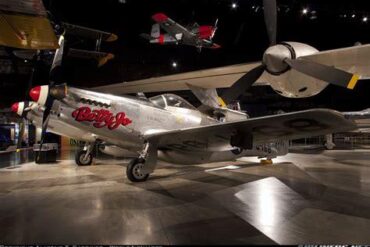
Interestingly, piston-engine combat aircraft even survived into the era of jet warfare. In 1969, the so-called “Football War” between Honduras and El Salvador produced one of history’s final piston-engine fighter dogfights involving aircraft such as the F4U Corsair and P-51 Mustang — an astonishing historical footnote during an age already dominated by supersonic aviation.
Why the DC-7 Still Fascinates Aviation Enthusiasts Today
The Douglas DC-7 endures because it represents more than transportation history. It symbolizes the climax of a technological age driven by mechanical ambition, engineering courage, and relentless experimentation.
Modern airliners prioritize automation, efficiency, and operational simplicity. The DC-7 belonged to a different philosophy entirely. It demanded skill from pilots, precision from mechanics, and endurance from engineers who constantly battled the limitations of piston technology.
Every flight carried an element of mechanical drama.
Passengers heard the engines pulse through the cabin. Pilots monitored complex engine systems continuously. Ground crews swarmed the aircraft after landing to inspect oil lines, cylinders, and cooling systems. Flying still felt deeply connected to machinery rather than software.
The DC-7 also marked the emotional transition between two aviation eras. It was the final moment before jet aircraft transformed flying into the high-speed global network recognized today. In many respects, the DC-7 stood proudly at the edge of obsolescence, roaring defiantly even as the future arrived around it.
That is why museum visitors continue gathering around surviving DC-7s decades after their retirement. The aircraft preserves a sensory experience modern aviation can no longer replicate: the smell of oil, the vibration of radial engines, the metallic growl of giant propellers biting into the air.
The skies today belong to jets, but the spirit of the propeller age survives through aircraft like the Douglas DC-7. It remains America’s last great piston-engine airliner — a machine that pushed aviation technology to its absolute limit before history accelerated into the Jet Age forever.