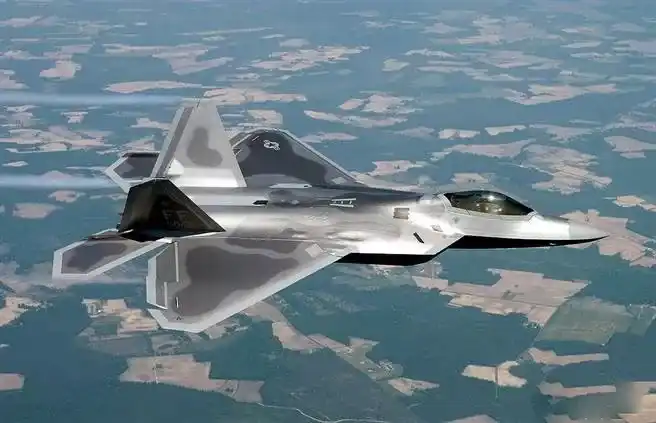
The F-22 Raptor, developed by Lockheed Martin, remains one of the most advanced and highly coveted fighter jets in the world. Its stealth capabilities, supercruise, and cutting-edge avionics set it apart from most of its competitors. Despite this, its presence in Europe, particularly in the United Kingdom, has been limited and shaped by various political and military considerations. This article delves into the early deployments of the F-22 in the UK, the US-UK collaboration on defense matters, and how the UK’s military capabilities have evolved in light of the restrictions on acquiring the F-22.
Early Deployment and Joint Training with the UK
The first notable deployment of the F-22 to the UK occurred in October 2017, when the United States Air Force (USAF) stationed six F-22 Raptors and approximately 150 personnel at RAF Lakenheath, a prominent base located in Suffolk, England. This deployment was part of a broader strategy aimed at strengthening the defense commitments of the United States to its European allies, particularly in the face of rising tensions in Eastern Europe and the Russian threat.
The F-22 deployment was not only about enhancing the defensive capabilities of NATO but also about conducting joint training exercises with the Royal Air Force (RAF) and other NATO partners. The training sought to improve interoperability and coordination in potential joint combat scenarios, showcasing the synergy between US and UK military forces. The deployment was symbolic of the special relationship between the United States and the United Kingdom, highlighting the shared commitment to European security.
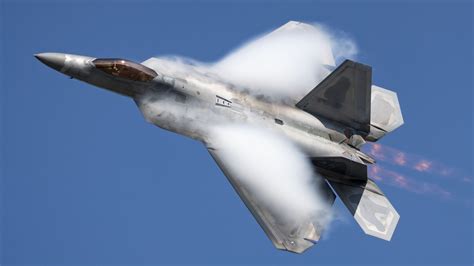
The F-22’s arrival in the UK also underscored the growing role of the United States in the European defense landscape, particularly as tensions with Russia escalated. This deployment marked a significant shift in the US’s approach to NATO defense, with the F-22 serving as a cutting-edge air superiority asset that bolstered the overall deterrent capabilities of the alliance. The aircraft’s arrival at RAF Lakenheath was part of a larger $1 billion plan to strengthen European defense under NATO’s collective security framework, with F-22s eventually moving to other Eastern European nations such as Germany and Poland.
Symbolic Contact and Technological Collaboration
In 2021, the UK’s military engagement with the F-22 took a more symbolic turn when two British pilots were given the rare opportunity to interact with the F-22 and pose for photos next to the fighter jet. This event, which took place in July 2021, was seen as a symbol of the strong military ties between the United States and the United Kingdom. The exchange, however, was more of a gesture than a substantive shift in military cooperation.
Due to US export restrictions, the UK has not been able to purchase the F-22 Raptor, as the aircraft’s sale abroad is prohibited by American law. This means that while British pilots were able to get a closer look at the aircraft, they could not train or operate the F-22 in any significant capacity. This restriction limits the UK’s ability to develop its own air superiority capabilities akin to the F-22, leaving it to depend on alternative technologies.
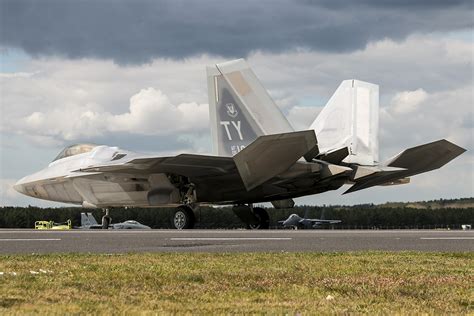
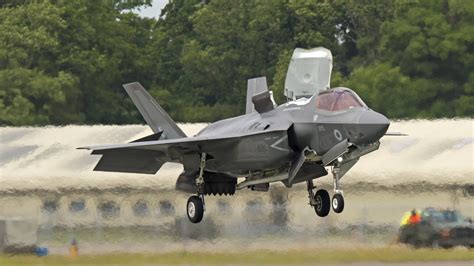
Despite this limitation, the US-UK relationship remains robust. The UK continues to rely heavily on American-made fighter jets, particularly the F-35B Lightning II. The UK’s purchase of the F-35B for use on the HMS Queen Elizabeth, one of the UK’s new aircraft carriers, reflects a pragmatic approach to modernizing its air combat capabilities. However, the F-35, while advanced, does not match the F-22 in terms of air dominance and stealth performance, leading to a continued gap in the UK’s ability to achieve air superiority on par with the capabilities of the F-22.
The Technological Edge of the F-22 and Its Impact on UK Defense Strategy
The F-22 Raptor is a fifth-generation fighter jet that boasts several revolutionary features, setting it apart from older and contemporary European fighters, such as the Eurofighter Typhoon. Among the F-22’s primary advantages are its stealth capabilities, which drastically reduce its radar signature, making it nearly undetectable to enemy radar systems. With a radar cross-section (RCS) of just 0.0001 square meters, the F-22 is designed to dominate the skies in contested environments, even against advanced adversaries.
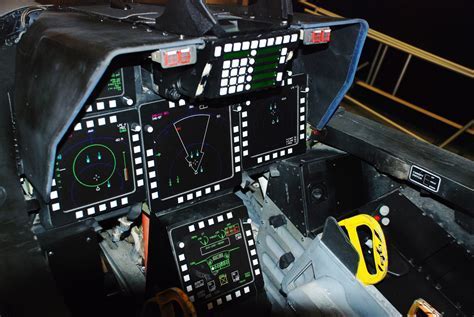
In comparison, European jets like the Eurofighter Typhoon and Dassault Rafale struggle to match the F-22’s stealth and supercruise capabilities. These aircraft, while highly capable in their own right, lack the same level of sensor fusion and advanced avionics that make the F-22 such a formidable asset. The F-22’s radar and sensor suite, including its Active Electronically Scanned Array (AESA) radar, provide a distinct advantage over older systems, allowing it to detect and engage adversaries at long ranges while maintaining complete situational awareness.
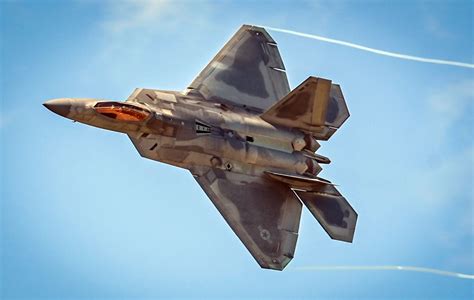
For the UK, this technological edge is significant. As a leading NATO partner, the UK’s military planners must account for the F-22’s capabilities in shaping their own defense strategies. While the UK has remained a core member of the F-35 program, the F-22’s inaccessibility highlights the limits to its strategic autonomy. The inability to obtain the F-22 places the UK at a technological disadvantage when it comes to air superiority in potential conflict scenarios, especially against peer competitors like Russia and China, who are rapidly advancing their own stealth capabilities.
UK’s Shift Toward the F-35 and NATO Integration
Given the F-22’s export restrictions, the UK has pursued alternative avenues for maintaining its air combat capabilities. This shift has led to the UK becoming a major partner in the F-35 Lightning II program, acquiring F-35B variants for deployment on its new aircraft carriers. These aircraft provide the UK with fifth-generation stealth capabilities, though their performance in air-to-air combat remains inferior to the F-22’s, particularly in range, speed, and agility.
The UK’s reliance on the F-35 also underscores its continued dependence on US military technology. This arrangement reflects broader trends within NATO, where US dominance in high-tech defense capabilities is reinforced by its role as the alliance’s military leader. In this context, the F-35 serves as a compromise, offering the UK a modern fighter with advanced stealth and sensor fusion capabilities, even if it cannot match the F-22’s supremacy in the air.
Future Prospects: F-22 Upgrades and Potential NATO Collaboration
Looking ahead, the F-22 is set to undergo a modernization program aimed at extending its operational life well into the 2040s. Key upgrades to the F-22 include new sensors, such as the infrared defensive system (IRDS), increased stealth with auxiliary fuel tanks, and the Scorpion helmet-mounted display system (HMD). These upgrades are designed to maintain the aircraft’s edge over its competitors, ensuring it remains the gold standard for air superiority in NATO.
While the UK cannot directly acquire the F-22, it may benefit indirectly from these upgrades through NATO exercises and joint operations. As the F-22 evolves, the UK’s military might be able to integrate some of these new capabilities into its own air force, either through collaborative training or technology-sharing arrangements within the NATO framework. However, direct access to the F-22’s technology remains unlikely due to US export controls.
Conclusion
In summary, the F-22 Raptor’s involvement in the UK’s defense landscape has been limited to short-term deployments and symbolic gestures of cooperation. The aircraft’s advanced technology, particularly its stealth and air superiority capabilities, enhances the US’s position within NATO and underscores the limitations facing the UK in its quest for strategic autonomy in defense. With export restrictions preventing the UK from acquiring the F-22, the UK has turned to the F-35 to fulfill its air combat needs, but the gap in capabilities between the two aircraft remains apparent.
Looking forward, the F-22’s upgrades may provide the UK and its NATO allies with enhanced cooperative defense capabilities, though the prospect of direct collaboration with the F-22 will remain constrained by US policy. The future of the F-22 in European defense will continue to reflect the broader dynamics of NATO defense integration and the technological leadership of the United States.
FAQ
What is the significance of the F-22 Raptor in NATO defense?
The F-22 provides NATO with a unique air superiority advantage due to its advanced stealth and sensor fusion technologies. Its ability to dominate the skies in contested environments strengthens NATO’s deterrence capabilities against potential adversaries, such as Russia and China.
Why can the UK not acquire the F-22?
The F-22 Raptor is subject to US export restrictions that prohibit its sale to foreign countries. This is due to the sensitive nature of its stealth and sensor technologies, which the US seeks to protect from proliferation.
How does the F-35 compare to the F-22 in terms of air combat?
While the F-35 is a highly advanced fighter jet with stealth and sensor fusion capabilities, it does not match the F-22 in air-to-air combat performance. The F-22’s superior speed, maneuverability, and long-range capabilities make it a better asset for air superiority missions, whereas the F-35 excels in multi-role combat and close air support.