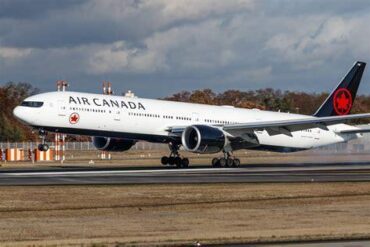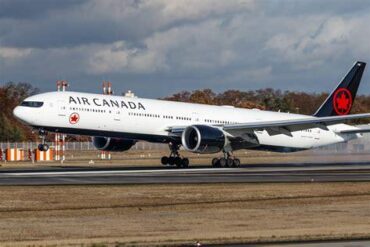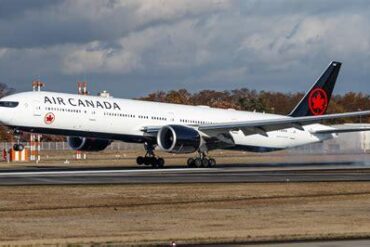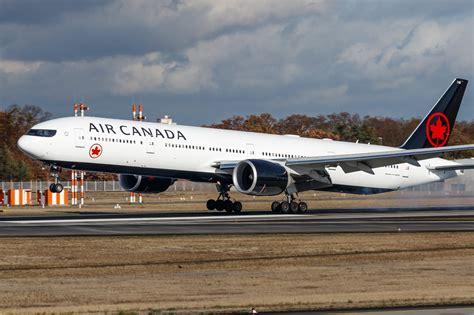
Air Canada is quietly redefining long-haul capacity economics with its newly reconfigured 440-seat Boeing 777-300ER fleet, a move that blends operational efficiency with strategic route deployment. While the reduction from 450 to 440 seats may appear incremental, the implications ripple across fuel efficiency, passenger comfort, and network optimization—especially during the critical summer travel peak.
Operating within a widebody fleet of 85 aircraft, including Airbus A330s and Boeing 787 Dreamliners, Air Canada’s Boeing 777s remain its most powerful capacity tools. Among its 25 Triple Seven aircraft, seven have now transitioned into this high-density 440-seat configuration, marking a subtle yet calculated shift in how the airline balances yield and volume.
Why Air Canada Reduced Capacity—But Still Leads in Density
At first glance, removing ten seats may seem counterintuitive in a high-demand environment. However, this adjustment reflects a deeper understanding of revenue optimization. By eliminating row 29, Air Canada slightly reduces total capacity while improving seat pitch in select economy rows—an upgrade that can command higher fares without significantly sacrificing volume.
The result is a carefully calibrated cabin layout:
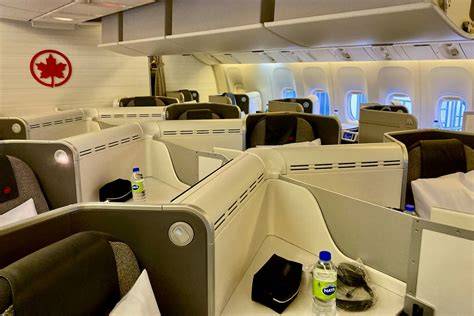
- 28 lie-flat business class seats in a 1-2-1 configuration
- 24 premium economy recliners with 37-inch pitch
- 388 economy seats in a dense 3-4-3 layout
This configuration keeps the aircraft among the highest-capacity Boeing 777s in North America, even surpassing some global competitors in total seat count. The marginal increase in business class proportion—just over 6%—signals a targeted approach: maximize economy-heavy demand while preserving premium revenue streams where viable.
Montreal Emerges as the Strategic Epicenter
A defining feature of this deployment strategy is its heavy reliance on Montreal as a hub. Unlike pre-pandemic patterns, where only about 30% of such high-capacity operations originated from Montreal, the Q3 2026 schedule shows near-total concentration there.
This shift underscores Montreal’s evolving role as a transatlantic gateway, particularly for leisure and visiting friends and relatives (VFR) traffic. These segments typically generate lower yields but deliver high passenger volumes—making them ideal for aircraft with large seat counts and lower seat-mile costs.
Full Route Breakdown: Where the 440-Seat Giants Fly
During the peak July–September period, Air Canada plans the equivalent of seven daily departures each way using these aircraft. The routes are carefully selected to align with demand patterns that justify such capacity.
The core network includes:
- Montreal to Paris Charles de Gaulle: two daily flights, fully operated by 440-seat aircraft
- Montreal to Athens: daily service with approximately 75% utilization of this configuration
- Montreal to Brussels: daily, entirely operated by the high-density 777
- Montreal to Rome Fiumicino: daily with around 71% coverage
- Montreal to Tokyo Narita: daily, fully utilizing the configuration
- Montreal to Vancouver: daily, but only 15% of flights use this aircraft
Additionally, two limited-use routes—Montreal to Toronto and Toronto to Paris—will see one-off deployments on September 30, contributing minimally to overall utilization.
The Economics Behind High-Capacity Deployment
These routes are not random; they reflect a deliberate focus on high-volume, price-sensitive markets. Leisure destinations like Athens and Rome, along with major diaspora corridors such as Montreal–Paris, generate substantial passenger numbers but often lack the premium demand needed to justify lower-density cabins.
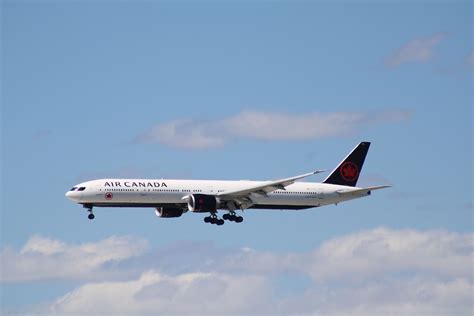
By deploying 440-seat aircraft, Air Canada reduces its cost per available seat mile (CASM), allowing it to remain competitive on fares while maintaining profitability. The slight reduction in fuel burn due to lower weight further enhances operational efficiency—an advantage that compounds over long-haul sectors.
Montreal–Paris: A Case Study in Scale and Demand
Few routes illustrate this strategy better than Montreal to Paris. In 2025, approximately 710,000 round-trip passengers traveled between the two cities, making it one of the busiest transatlantic routes in Canada.
This corridor alone accounted for roughly one in every 14 passengers flying between Canada and Europe, highlighting its strategic importance. With up to nine daily nonstop flights operated by multiple carriers, the market is both competitive and capacity-intensive.
Air Canada’s decision to deploy its largest aircraft here—twice daily—demonstrates confidence in sustained demand. It also reflects the route’s unique blend of leisure, business, and cultural travel, driven by strong linguistic and historical ties.
A Subtle Shift With Major Competitive Implications
While the global aviation industry often focuses on ultra-long-haul innovation or premium cabin upgrades, Air Canada’s move is a reminder that capacity strategy remains a powerful lever. By fine-tuning seat counts and aligning aircraft deployment with demand realities, the airline strengthens its position in key markets without overextending resources.
Interestingly, even some major international carriers operate Boeing 777-300ERs with fewer seats, emphasizing premium-heavy configurations. Air Canada’s approach diverges by prioritizing volume-driven profitability, particularly in markets where price sensitivity dominates.
The Future of High-Density Long-Haul Flying
As airlines navigate fluctuating demand, rising costs, and evolving passenger expectations, the success of Air Canada’s 440-seat Boeing 777s could influence broader industry trends. High-density configurations—once seen as purely cost-driven—are now being refined to balance comfort, efficiency, and revenue potential.
For Air Canada, the message is clear: bigger can still be better, as long as every seat is part of a smarter strategy.