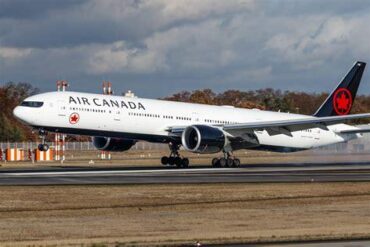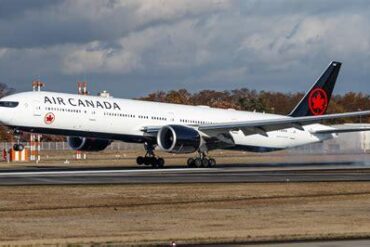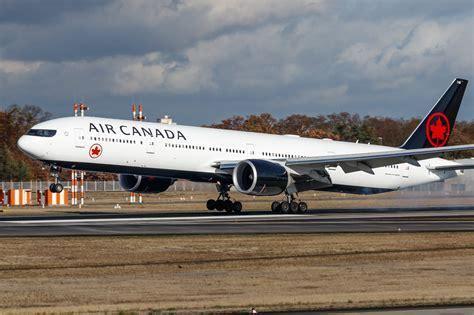
Air Canada’s 440-seat Boeing 777-300ER has become one of the highest-capacity widebody aircraft operated by any North American airline. Designed to carry an enormous number of passengers while maintaining a three-class cabin, these aircraft are strategically deployed on routes where demand is exceptionally strong, particularly during the busy summer travel season. Rather than focusing on premium-heavy business markets, Air Canada uses these aircraft to maximize capacity on leisure destinations, family travel markets, and routes with significant visiting-friends-and-relatives (VFR) traffic.
The airline currently operates one of the largest widebody fleets in Canada, with 85 long-haul aircraft. That fleet includes 32 Boeing 787-9 Dreamliners, 20 Airbus A330-300s, 19 Boeing 777-300ERs, eight Boeing 787-8s, and six Boeing 777-200LRs. Looking ahead, Air Canada has already committed to introducing the Airbus A350-1000 and the Boeing 787-10, ensuring continued modernization of its international fleet while its retired Boeing 767 passenger aircraft now operate exclusively as freighters.
Among its nineteen Boeing 777-300ERs, seven aircraft feature the unique 440-seat layout. Earlier in 2026 these aircraft were slightly denser, accommodating 450 passengers, but Air Canada removed an entire row of seating, reducing capacity by ten seats. Although the reduction appears modest, lowering aircraft weight helps decrease fuel consumption, reduces air navigation charges, and slightly improves operational efficiency across long-haul sectors without significantly affecting revenue potential.
Why Air Canada Reduced Its Boeing 777 Capacity From 450 to 440 Seats
Removing one row of economy seating may seem insignificant on such a large aircraft, but airlines frequently make small adjustments that deliver measurable operational savings over thousands of annual flights. Every kilogram removed from an aircraft contributes to lower fuel burn, while a lighter aircraft may also reduce airport landing fees and overflight charges that are partially based on aircraft weight.
Despite the slight reduction, Air Canada’s Boeing 777-300ER remains extraordinarily dense by North American standards. Each aircraft now accommodates:
- 28 Business Class seats
- 24 Premium Economy seats
- 388 Economy Class seats
- Total: 440 passengers
The layout clearly prioritizes passenger volume while still preserving premium cabins for higher-yield travelers. This balance makes the aircraft particularly effective on routes where economy demand dramatically exceeds premium demand during peak travel periods.
The Eight Routes Served by Air Canada’s 440-Seat Boeing 777
During the third quarter of the year, traditionally the strongest period for international travel, Air Canada schedules these high-capacity aircraft on just eight routes.
The complete network includes:
| Route | Frequency |
|---|---|
| Montréal (YUL) – Paris (CDG) | Two daily |
| Montréal (YUL) – Athens (ATH) | Daily |
| Montréal (YUL) – Brussels (BRU) | Daily |
| Montréal (YUL) – Rome (FCO) | Daily |
| Montréal (YUL) – Tokyo Narita (NRT) | Daily |
| Montréal (YUL) – Vancouver (YVR) | Daily |
| Montréal (YUL) – Toronto (YYZ) | One flight (September 30) |
| Toronto (YYZ) – Barcelona (BCN) | One flight (September 30) |
Nearly every scheduled destination originates from Montréal–Trudeau International Airport, highlighting the airport’s growing importance within Air Canada’s international strategy.
Why Montréal Has Become the Center of the 440-Seat Network
While Toronto Pearson International Airport remains Air Canada’s largest hub, Montréal has become the ideal location for deploying its highest-capacity Boeing 777s.
The explanation lies largely in passenger demographics. Montréal supports exceptionally strong leisure travel to Europe, extensive VFR demand from large immigrant communities, and seasonal tourism flows that emphasize passenger numbers over premium cabin sales.
Toronto, meanwhile, generates more corporate travel and premium business traffic. Flights departing Toronto often benefit from aircraft configured with more Business Class and Premium Economy seating, making lower-density widebodies financially more attractive than the 440-seat configuration.
As a result, Montréal has evolved into the airline’s principal hub for operating maximum-capacity Boeing 777 services.
Montréal–Vancouver Is One of Canada’s Busiest Domestic Markets
One particularly interesting deployment is the daily service between Montréal and Vancouver. Although domestic, this route supports enormous passenger demand extending well beyond local travelers.
Over the twelve months leading to April 2026, approximately 490,000 passengers traveled between Montréal and Vancouver as local origin-and-destination travelers. Around 60,000 additional passengers connected through other Canadian hubs, particularly Toronto and Calgary.
Demand continues to rise. During the third quarter of 2026, airlines collectively plan approximately 836 departures between the two cities, representing an increase of roughly 8% compared with the same period one year earlier.
Air Canada overwhelmingly dominates this market, operating nearly 78% of all departures, while Flair Airlines and Porter Airlines each account for around 11%.
Interestingly, the airline deploys an impressive variety of aircraft throughout the day. On certain dates, passengers may choose flights operated by the Airbus A220-300, Airbus A321ceo, Airbus A330-300, Boeing 787-9 Dreamliner, or the enormous 440-seat Boeing 777-300ER, allowing Air Canada to precisely match capacity with departure times and customer demand.
How Vancouver Strengthens Air Canada’s Global Network
The Montréal–Vancouver service functions as much more than a domestic flight. Vancouver serves as Air Canada’s primary Pacific gateway, allowing passengers arriving from Eastern Canada to continue seamlessly to destinations across Asia and Oceania.
Approximately 390,000 passengers traveled solely between Montréal and Vancouver during the past year, but another 230,000 travelers connected onward through Vancouver.
The strongest connecting markets include:
- Shanghai
- Manila
- Victoria
- Hong Kong
- Sydney
- Kelowna
- Beijing
- Seoul
- Brisbane
Mainland China alone represents nearly one-quarter of these onward journeys, demonstrating Vancouver’s continued importance despite Air Canada’s suspension of nonstop Montréal–Shanghai service several years ago.
Traffic also flows in the opposite direction. Roughly 210,000 passengers originated in Vancouver before connecting through Montréal to destinations including São Paulo, Halifax, Quebec City, Barcelona, Paris, Delhi, Lisbon, Boston, Rome, and Athens. A smaller but notable group of travelers even connects twice, using both Vancouver and Montréal as transfer points on a single itinerary.
A High-Capacity Strategy Focused on Efficiency
Air Canada’s deployment of its 440-seat Boeing 777-300ER fleet reflects a carefully calculated network strategy rather than simply operating the airline’s largest aircraft wherever possible. These jets are reserved for routes where sustained passenger demand consistently fills hundreds of seats while premium cabin demand remains relatively balanced.
Concentrating the aircraft in Montréal enables Air Canada to efficiently serve Europe, Asia, and Canada’s west coast with maximum seat capacity during the busiest travel months. Combined with future fleet additions such as the Airbus A350-1000 and Boeing 787-10, this approach positions the airline to continue expanding while improving efficiency across its long-haul network.
For travelers, these aircraft offer substantially more seat availability on some of Air Canada’s busiest routes. For the airline, they represent an effective way to balance operating costs, maximize seasonal demand, and maintain a competitive advantage across both domestic and international markets.