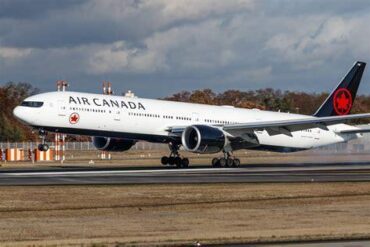
Air Canada’s long-haul strategy has entered a phase where scale, efficiency, and network precision matter more than ever. At the center of this approach sits one of the most unusual widebody configurations flying today: the 450-seat Boeing 777-300ER. These aircraft are not deployed randomly. Instead, they are carefully assigned to routes where demand volume, yield structure, and seasonal flows align perfectly with a high-density layout that prioritizes seat-mile economics over premium-heavy cabins.
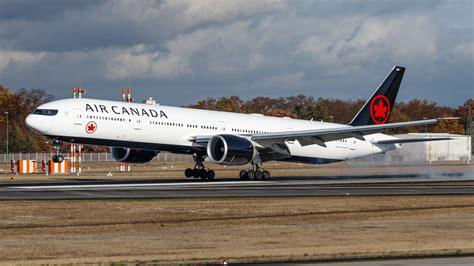
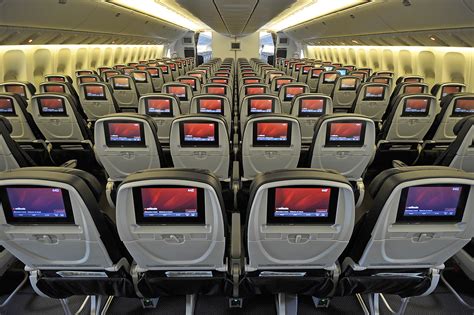
The Canadian flag carrier currently operates seven Boeing 777-300ERs configured with this exceptionally high capacity. With only 28 lie-flat business class seats, 24 premium economy seats, and a staggering 398 economy seats, the aircraft represents a deliberate departure from the premium-focused layouts favored by many global network airlines. Just 6% of total capacity is allocated to business class, underscoring Air Canada’s clear intention: maximize throughput on routes driven by leisure and visiting friends and relatives traffic.
Air Canada’s overall widebody fleet consists of 85 twin-aisle aircraft, including Boeing 787s, Airbus A330s, and multiple variants of the 777. Within this fleet, the 450-seat 777-300ER plays a specialized role. These aircraft are deployed where high load factors are predictable, fares are comparatively lower, and frequency alone cannot absorb demand efficiently.
Montreal Emerges as the Primary Hub for the 450-Seat 777s
Between January and June 2026, operational data reveals that 93% of all international departures operated by Air Canada’s 450-seat 777s originate from Montreal, with just 7% departing from Toronto. This represents a notable shift in network emphasis, with Montreal’s share rising by ten percentage points compared to the same period in 2024. When viewed across all aircraft types, this deployment strategy contributes to Montreal generating more long-haul seats per flight than any other Air Canada hub.
In total, the airline plans 867 international departures using the 450-seat configuration during the first half of 2026. This figure marks a 2% year-over-year increase, even as the average stage length grows by 6%, indicating confidence in the aircraft’s ability to deliver cost efficiency over longer distances.
Leisure and VFR Markets Define the International Network
The international routes selected for these aircraft follow a consistent pattern. They are overwhelmingly focused on leisure-heavy destinations and markets dominated by visiting friends and relatives (VFR) traffic. These segments typically generate lower yields but deliver strong, predictable volume, making them ideal for ultra-dense widebody deployment.
Among the most heavily served routes is Montreal–Paris Charles de Gaulle, which alone accounts for 276 departures in the six-month period. On this route, the 450-seat 777 operates 94% of Air Canada’s flights, effectively becoming the backbone of capacity between Quebec and France. The cultural and linguistic ties between Montreal and Paris translate into sustained demand that justifies such a large aircraft on a near-exclusive basis.
Other major international routes include Montreal–Tokyo Narita, where the 450-seater operates 100% of flights, as well as Montreal–Rome, Montreal–Brussels, and Montreal–Athens, each seeing the aircraft on roughly 60% or more of Air Canada’s services. Seasonal leisure destinations such as Cancun also feature prominently, reinforcing the aircraft’s role as a volume-driven workhorse rather than a premium showcase.
Paris as the Flagship Route for the 450-Seat Strategy
The Montreal–Paris market deserves particular attention. In the twelve months leading up to October 2025, approximately 610,000 round-trip local passengers traveled between the two cities. This makes it the busiest Canada–Europe airport pair, even if it trails Toronto–London at the city level.
Given this demand profile, Air Canada relies almost entirely on the 450-seat 777-300ER to sustain capacity. Only a limited number of flights in January and March are operated by the smaller Airbus A330-300, primarily for schedule balancing. Looking ahead to the northern winter season, the airline plans to evolve the mix further, introducing a daily Boeing 787-8 alongside the daily 450-seat 777, allowing for both capacity and product differentiation.
Selective Domestic Deployment Anchors the Aircraft Utilization
While international routes dominate, Air Canada also deploys the 450-seat 777 on a small number of domestic sectors. Nearly 90% of domestic operations with this aircraft are concentrated on the Montreal–Vancouver route. This transcontinental service sees daily operation, with select dates featuring twice-daily flights to accommodate peak holiday demand around Christmas and New Year.
The operational pattern is tightly choreographed. Evening departures from Montreal allow the aircraft to overnight on the West Coast, returning the following morning. This maximizes utilization while aligning with passenger preference for evening westbound and morning eastbound travel.
Limited appearances on Montreal–Toronto, Toronto–Vancouver, and a single Montreal–Calgary rotation underline how exceptional these domestic deployments are. The upcoming introduction of Airbus A321XLRs on Montreal–Vancouver will further refine this strategy, reserving the 777 primarily for periods of extreme demand.
A Purpose-Built Aircraft for a Specific Mission
The 450-seat Boeing 777-300ER is not designed to impress with luxury. Instead, it reflects Air Canada’s willingness to optimize aggressively for cost efficiency where the market supports it. High-density seating, minimal premium allocation, and carefully chosen routes allow the airline to move vast numbers of passengers while maintaining competitive economics.
In an era where fleet flexibility and network precision increasingly determine profitability, Air Canada’s deployment of its ultra-high-capacity 777s offers a clear lesson: when demand is deep, consistent, and price-sensitive, size still matters.