The Panjandrum was one of World War II’s strangest experimental weapons, combining a huge explosive charge, wooden wheels, and dozens of rockets into a machine that looked more like an enormous firework than a battlefield weapon. Developed by Britain for the planned invasion of Nazi-occupied Europe, it was intended to smash through coastal defenses and open passages for Allied forces.
The weapon emerged from a serious problem facing the Allies before D-Day: how to overcome the heavily fortified Atlantic Wall. Concrete bunkers, obstacles, mines, barbed wire, and other defenses threatened landing forces, so British engineers explored unconventional ways to create breaches quickly. The Panjandrum represented one particularly ambitious answer.
Unlike conventional demolition equipment, the Panjandrum was designed to carry its own explosive payload directly toward the target. Its basic principle was deceptively simple: propel a giant wheel across the beach using rockets, crash it into a defensive structure, and detonate the charge. On paper, it offered a dramatic combination of mobility and destructive power.
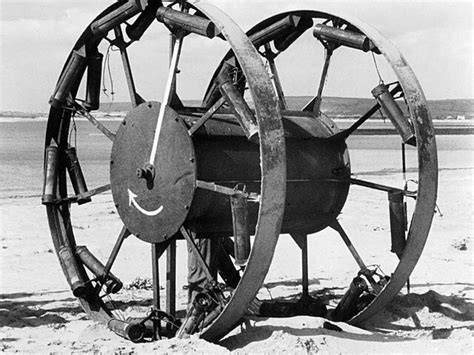
The Panjandrum’s Rocket-Powered Design
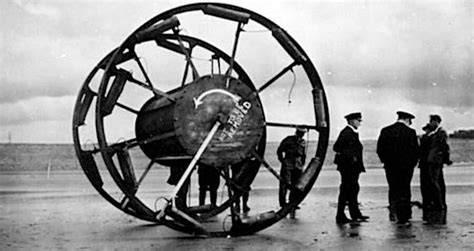
The Panjandrum resembled an enormous Catherine wheel, a type of spinning firework. Two large wheels were connected by a central structure that carried an explosive charge weighing roughly one ton. Rockets were mounted around the wheels and angled to generate forward motion when ignited.
The finished machine stood around 10 feet tall, making it an imposing object even before its rockets were fired. Engineers hoped the propulsion system could eventually drive the weapon at speeds approaching 60 mph, allowing it to cross the beach rapidly before defenders could react.
Its intended mission was straightforward. A landing craft would bring the Panjandrum toward shore, where it would be released into the surf. Once on land, its rockets would propel it toward the Atlantic Wall. The explosive charge would then be detonated against the fortification, creating a gap wide enough for tanks and other vehicles to pass through.
Why Britain Abandoned the Rocket Wheel
The problem was that the Panjandrum’s theoretical simplicity disappeared almost immediately during testing. Keeping a large collection of rockets synchronized while a giant wheel crossed uneven sand proved extraordinarily difficult. The machine could become unstable, lose propulsion, or suddenly change direction when components failed.
Its final trials demonstrated exactly why such a weapon was too unpredictable for an actual invasion. Clamps failed and rockets broke loose, sending burning projectiles in different directions. When the Panjandrum encountered small craters placed in the sand to simulate battlefield conditions, it veered dramatically from its intended course.
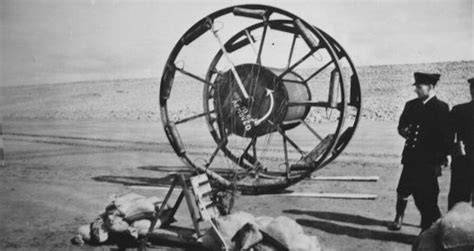
During one notorious test, the runaway machine headed toward members of the observing group, including photographers and senior military personnel. People scattered for safety as the rocket-driven wheel continued its chaotic journey. Rather than smashing into a simulated section of the Atlantic Wall, the Panjandrum eventually turned away and headed back toward the sea.
The experiment demonstrated a crucial weakness: a weapon carrying a huge explosive charge could not be trusted if its propulsion system was incapable of maintaining a predictable path.
A Strange Footnote to D-Day
The Panjandrum was ultimately abandoned, while more practical solutions such as Bangalore torpedoes remained useful for clearing obstacles. Its failure did not mean Allied engineers lacked imagination. Instead, it illustrated how experimental military technology can look convincing in a design office yet become dangerously uncontrollable when exposed to real terrain.
The rocket-powered wheel never breached the Atlantic Wall, but its bizarre appearance and spectacularly unsuccessful trials secured its place among World War II’s strangest weapons. It remains a remarkable example of wartime experimentation: technically ambitious, potentially destructive, and ultimately defeated by the basic problem of making a giant rocket-powered wheel go exactly where humans wanted it to go.