The U.S. Army is actively testing a new modular mobility concept that could fundamentally change how unmanned ground vehicles are designed, deployed, and sustained on future battlefields. Instead of relying on traditional chassis-based platforms with fixed drivetrains, the Army is examining an electrically driven wheel system that can convert almost any structure into a robotic unmanned ground vehicle, dramatically reducing development timelines and logistical complexity. This approach aligns with broader U.S. military efforts to field adaptable, low-cost robotic systems capable of operating in dispersed, expeditionary, and high-risk environments.
At the center of this effort is a wheel-as-a-vehicle concept developed by U.S.-focused defense innovator AZAK. The idea is deceptively simple yet technically ambitious: embed propulsion, power storage, and control electronics directly into each wheel, eliminating the need for axles, transmissions, and centralized powertrains. In this architecture, mobility itself becomes the core building block, while the “vehicle” is defined by whatever structure or payload is attached above the wheels.
This design philosophy represents a sharp departure from decades of ground vehicle engineering, where mobility systems were inseparable from a purpose-built chassis. For the U.S. Army, which increasingly prioritizes speed of adaptation, logistics efficiency, and autonomous capability, the appeal of a modular mobility layer is obvious. Rather than procuring multiple specialized robotic platforms, units could assemble mission-specific UGVs on demand using standardized powered wheels.
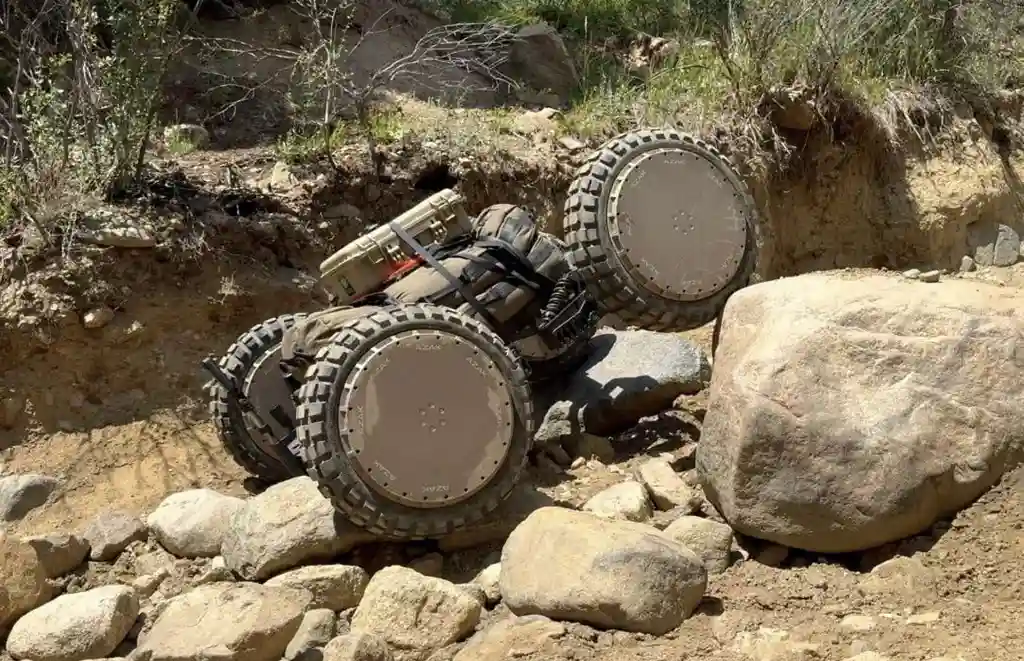
The technical foundation of AZAK’s system is the S26 wheel module, engineered as a fully self-contained propulsion and control node. Each wheel integrates an electric motor, motor controller, gearbox, proprietary control electronics, battery management system, and the battery itself into a single sealed unit. This integration eliminates many of the mechanical vulnerabilities that traditionally limit small UGV reliability, particularly in dusty, muddy, or debris-filled environments.
A critical design choice is the placement of most internal mass below the wheel’s center point. This configuration ensures a consistently low center of gravity regardless of what payload or structure is mounted above the wheels. In operational terms, this translates into improved stability on slopes, better traction over uneven terrain, and more predictable handling when carrying heavy or awkward loads. For robotic platforms operating without a human driver to compensate for instability, these characteristics are particularly important.
According to published specifications, the S26 Gen 1 wheel measures roughly 26 inches in height and 8 inches in width, with a weight of approximately 86 pounds. Each wheel is rated to deliver around 147 pound-feet of continuous torque, with sprint speeds reaching about 12 miles per hour depending on configuration and load. While these figures do not rival those of large tactical vehicles, they are well suited to logistics support, casualty evacuation, reconnaissance, and autonomous resupply missions where reliability and torque matter more than top speed.
The system’s electrical architecture is equally tailored for military use. Each wheel contains roughly 1.27 kWh of battery capacity, with typical mission ranges cited between 20 and 50 miles depending on terrain, payload, and driving profile. Recharge times are on the order of 1.5 hours, and the wheels are sealed to IP67 standards, allowing operation in rain, mud, and shallow water without additional protection. Control options include tethered operation, wireless remote control, and integration with autonomous navigation systems.
One of the most disruptive aspects of the concept is its installation and replacement speed. AZAK emphasizes that a wheel can be attached or swapped in seconds using a quick-connect interface. From a military logistics perspective, this changes the sustainment equation. Instead of diagnosing and repairing complex drivetrains in the field, soldiers could restore mobility by replacing a single damaged wheel. This modularity also supports a form of distributed survivability: disabling one wheel does not necessarily immobilize the entire platform.
Operationally, the implications are significant. With propulsion, braking, steering logic, and energy storage all contained within the wheels, the structure above them becomes almost secondary. A simple welded frame can become a cargo carrier. A stretcher frame can become a robotic casualty evacuation platform. Sensor masts, electronic warfare payloads, or even light weapon mounts can be rapidly transformed into mobile systems without extensive mechanical integration. This aligns closely with the Army’s interest in task-organized robotic assets rather than fixed-role vehicles.
Mobility performance has been a central focus of Army evaluations. Wheel-centric designs deliver torque directly at the contact patch, avoiding losses associated with driveshafts and gear trains. Combined with the low-mounted mass, this allows platforms to climb obstacles that would challenge many conventional small UGVs. AZAK has highlighted the ability to negotiate steep gradients, rubble, and broken ground while carrying substantial loads, addressing a persistent weakness of many lightweight robotic vehicles used for logistics and support roles.
The development path of the technology has been deliberate rather than rushed. AZAK reports that it has been self-funding in-wheel propulsion research since the mid-2010s, refining the concept through multiple prototype iterations. U.S. government innovation programs have shown increasing interest, particularly as the Army focuses on contested logistics and the need to move supplies without exposing soldiers to direct fire. Silent electric operation, low thermal signature, and reduced mechanical complexity make the system attractive for operations in denied or surveilled environments.
From a doctrinal perspective, the Army’s interest reflects a broader reassessment of ground vehicle design. Traditional platforms are optimized for specific roles and environments, but modern conflicts demand flexibility. A standardized powered wheel could enable entire families of robotic systems built around a common mobility core, reducing acquisition costs and simplifying training. Maintenance personnel would need to master one propulsion module rather than dozens of unique vehicle designs.
However, the architecture also introduces challenges that the Army will scrutinize closely during testing. Concentrating batteries and electronics inside sealed wheels raises questions about thermal management during sustained operations. Distributed power systems must also be hardened against electromagnetic interference and cyber intrusion, especially when operating autonomously. Additionally, while low-mounted mass improves stability, it changes suspension dynamics in extreme terrain, an area that requires extensive validation under military load conditions.
Despite these considerations, the concept’s potential impact is hard to ignore. If proven reliable at scale, modular powered wheels could enable rapid fielding of robotic platforms tailored to specific missions and theaters, without the long lead times associated with traditional vehicle programs. For an Army preparing for highly distributed operations across complex terrain, the ability to turn almost any structure into a capable robotic UGV may prove to be less an experiment and more a glimpse of the future of ground mobility.