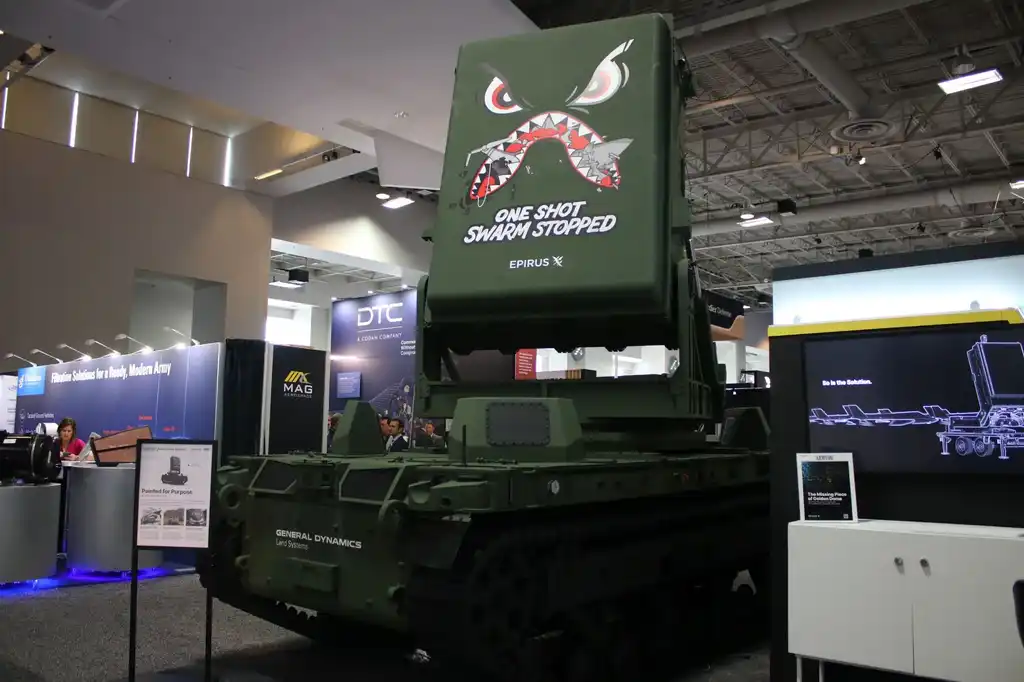
At the Association of the United States Army (AUSA) 2025 Annual Meeting in Washington, D.C., the defense technology world witnessed a groundbreaking debut — the Epirus Leonidas Autonomous Robotic (AR) system. This new entrant merges the Leonidas high-power microwave effector from Epirus with the TRX tracked robotic vehicle developed by General Dynamics Land Systems (GDLS), delivering a vision of fully autonomous, non-kinetic counter-drone warfare that may redefine the future of battlefield defense.
A Fusion of Microwave Power and Robotic Mobility
The Leonidas AR is more than a simple platform integration — it represents a fusion of directed energy weaponry and autonomous ground mobility. Designed to operate remotely or autonomously, the platform offers maneuver units a magazine-deep, software-defined counter-UAS capability, preserving precious kinetic interceptors for high-value aerial threats.
Epirus’ Leonidas high-power microwave module forms the lethal heart of the system. It emits focused bursts of microwave energy capable of disabling or destroying the electronic components of small uncrewed aerial systems (sUAS) and related command nodes. Unlike laser systems, which engage one target at a time, Leonidas offers a “one-to-many” kill capability, capable of neutralizing entire drone swarms with a single pulse under the right conditions.
In live-fire testing at Camp Atterbury, Epirus demonstrated 61 successful neutralizations from 61 engagements, including an event in which a swarm of 49 drones was eliminated simultaneously. These trials underscore the enormous potential of directed microwave energy in addressing the growing global drone threat, though operational validation will still determine the true combat performance.
The Software-Defined Weapon System
Central to Leonidas’ appeal is its software-defined architecture. Unlike traditional hardware-bound weapons, the Leonidas system enables real-time waveform manipulation, frequency band exclusion, and digital geofencing. Operators can tailor electromagnetic effects to specific mission requirements — for instance, shielding friendly frequencies, minimizing collateral disruptions, and maintaining electromagnetic safety around civilian or allied systems.
This software-driven flexibility turns the Leonidas AR into a digital defense platform, not just a weapon. As threats evolve, emission parameters can be updated remotely through software patches rather than hardware retrofits. This capability aligns perfectly with modern military doctrines emphasizing rapid adaptation, modularity, and spectrum agility.
The integration also reflects lessons learned from congested battlefields where radio communications, GPS, and drone control frequencies overlap. By defining safe zones and restricting emission footprints, Leonidas minimizes the risk of electromagnetic fratricide — a persistent concern in the age of unmanned and interconnected warfare.
The TRX Robotic Chassis: A Foundation for Autonomy
General Dynamics Land Systems’ TRX robotic platform provides the mobility backbone of Leonidas AR. The TRX, part of the U.S. Army’s Robotic Combat Vehicle (RCV) family, is a hybrid-electric tracked vehicle built for autonomy, endurance, and modular payloads. With a top speed of 45 mph and a range exceeding 300 miles, TRX offers a balance of agility and persistence for long-duration missions.
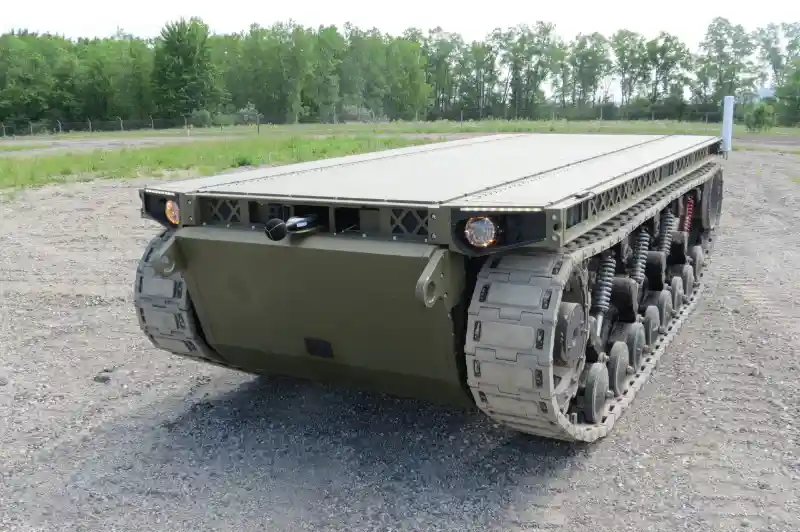
TRX’s 360-degree sensing suite, onboard compute core, and energy-efficient drive system make it an ideal carrier for directed energy payloads. Its low acoustic and thermal signature, combined with teleoperation and autonomy kits, ensures that human operators can stay safely behind cover while the vehicle operates within the threat envelope.
The platform’s energy storage and distribution system is optimized for power-hungry payloads such as the Leonidas microwave emitter. As directed energy weapons typically require stable, high-density electrical output, TRX’s hybrid propulsion serves as both mobility engine and energy reservoir — a vital characteristic for sustained counter-swarm operations.
Operational Role and Tactical Concept
The Leonidas AR is engineered to fill a critical niche between fixed-site defenses and kinetic short-range interceptors. Its design philosophy emphasizes mobility, persistence, and scalability. Unlike stationary high-power microwave systems, the robotic chassis allows Leonidas to maneuver with frontline brigades, providing on-the-move area denial against drone incursions.
In tactical terms, this means Leonidas AR can cover command posts, logistics hubs, and flanking elements, providing an electromagnetic shield over assets that would otherwise rely on limited missile inventories. If field results mirror its demonstration performance, commanders could employ the system to rewrite drone swarm engagement doctrine — using one-to-many electronic effects to conserve interceptors and exhaust enemy drone inventories.
Furthermore, the software geofencing capability allows battlefield planners to deploy multiple Leonidas units in overlapping grids without interference, creating layered directed energy defense zones. These zones can dynamically adapt to shifting front lines or evolving electromagnetic threats, introducing an unprecedented level of electronic maneuverability.
Advancing U.S. Army Directed Energy Strategy
Leonidas AR’s unveiling at AUSA 2025 aligns with broader U.S. Army modernization efforts under the Indirect Fire Protection Capability (IFPC) program. In July 2025, Epirus received a $43.5 million contract from the Army Rapid Capabilities and Critical Technologies Office (RCCTO) for Generation II high-power microwave systems, signaling official momentum toward operational deployment.
According to Epirus, the Generation II iteration doubles the effective range, increases power output by approximately 30%, and introduces wider pulse widths with high-duty burst modes — enhancements that significantly accelerate multi-target engagement rates. These attributes directly support the maneuver protection mission envisioned for Leonidas AR and pave the way for integration within the Army’s multi-layered counter-UAS architecture.
The convergence of Epirus’ directed energy expertise and GDLS’ autonomous vehicle design reflects the Pentagon’s broader interest in modular, upgradable systems that can evolve with mission demands. By coupling a software-defined transmitter with a scalable robotic carrier, the Leonidas AR demonstrates the kind of digital-mechanical integration that future battle networks will rely upon.
Directed Energy vs. Kinetic Interceptors: Strategic Implications
Traditional kinetic counter-UAS solutions rely on missiles, guns, or proximity fuses, which are effective but limited by cost and ammunition capacity. In contrast, directed energy weapons like Leonidas offer a virtually unlimited magazine, constrained only by available electrical power. This “magazine depth” transforms the economics of air defense.
For military planners, the implications are profound. Drone swarms, once a nightmare scenario requiring dozens of interceptors, can now be countered with a fraction of the logistical footprint. By combining directed microwave and kinetic layers, future brigades may achieve persistent air denial over maneuver zones at a lower cost per engagement.
Furthermore, the non-lethal nature of microwave disruption means the system can be used in gray-zone operations — disabling surveillance or logistics drones without overt escalation. This versatility gives commanders graduated response options, from deterrence to destruction, across diverse operational theaters.
Industry Collaboration and Future Prospects
At AUSA 2025, Epirus and General Dynamics framed their partnership as a meeting of domains: directed energy meets autonomous mobility. The collaboration is designed around future scalability, with the TRX platform supporting payload growth and modular swaps, and the Leonidas system evolving through software-driven capability increments.
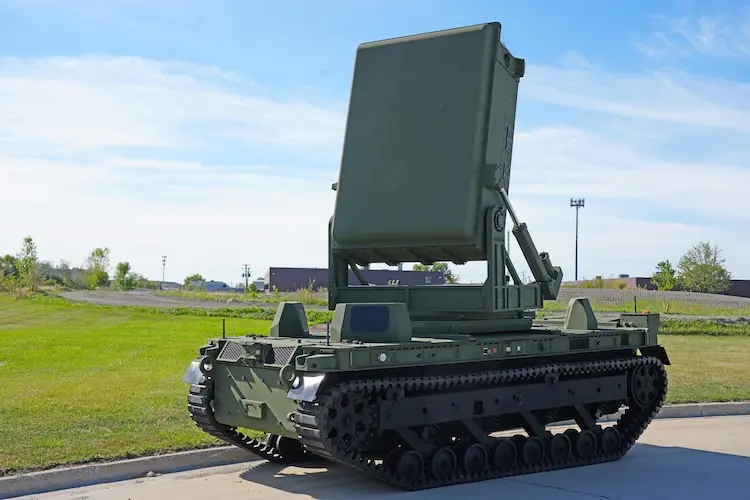
Company representatives emphasized that the Leonidas AR package could serve as a mobile node within broader short-range air defense (SHORAD) ecosystems, complementing radar sensors, laser effectors, and missile interceptors. As warfare becomes more networked and automated, the ability to plug and play such nodes will be key to adaptive force design.
Epirus also hinted at potential wheeled variants under development, designed to support different mobility profiles and expeditionary forces. This reflects a growing demand for modular, platform-agnostic directed energy payloads capable of integrating with uncrewed or optionally manned vehicles.
The Road Ahead: From Prototype to Battlefield Integration
While the Leonidas AR dazzled AUSA attendees with its sleek form and compelling demonstrations, the road from prototype to operational fielding will depend on rigorous operational testing, soldier feedback, and doctrinal alignment. Real-world battlefield environments will test the system’s resilience against electromagnetic clutter, countermeasures, and variable atmospheric conditions.
If performance claims hold under combat conditions, Leonidas AR could mark the beginning of a new class of autonomous, energy-based air defense systems. Such systems could operate semi-independently, coordinating with command networks and contributing to a distributed, AI-enhanced electromagnetic defense mesh that safeguards mobile formations against drone saturation attacks.
Ultimately, the Leonidas Autonomous Robotic system is more than a product; it’s a doctrinal experiment in how the U.S. Army envisions defense in an era where drones outnumber soldiers and data moves faster than bullets. Its presence at AUSA 2025 signifies not only a technological milestone but also a strategic shift toward software-defined lethality — where algorithms, not ammunition, determine battlefield supremacy.
As defense forces worldwide race to adapt to the drone age, Epirus and General Dynamics Land Systems may have offered a glimpse into the future of autonomous directed energy warfare — a future where machines guard machines, and the decisive battles are fought not with steel, but with pulses of invisible power.