The U.S. Army’s recent commitment of $43.55 million to Epirus for its Generation II Leonidas high‑power microwave (HPM) systems marks a significant leap forward in low‑altitude air defense. As swarms of small drones proliferate across modern battlefields, the need for an effective “one‑to‑many” defensive mechanism has never been more urgent. This article explores the contract details, system capabilities, strategic drivers, product variants, technical enhancements, testing roadmap, market prospects, production footprint, operational tactics, and the broader conceptual framework undergirding the Leonidas program.
Contract Award & Schedule
Epirus secured a $43,551,060 contract from the Army’s Rapid Capabilities and Critical Technologies Office (RCCTO) to deliver two advanced Generation II Integrated Fires Protection Capability High‑Power Microwave (IFPC‑HPM) systems, complete with associated equipment and spares. Options for additional tests, components, and support extend the potential value. According to Epirus CEO Andy Lowery, the first system will roll off the production line in Torrance, California by the end of July, the second by the end of August, and a third unit—exercising optional follow‑on support—by late September. This accelerated timeline underscores the Army’s urgency to field a proven directed‑energy defense against unmanned aerial and surface threats.
IFPC‑HPM Role & Capability
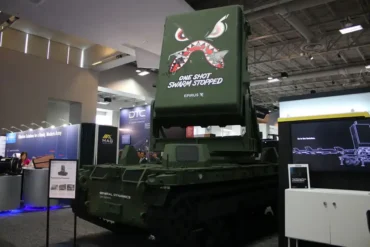
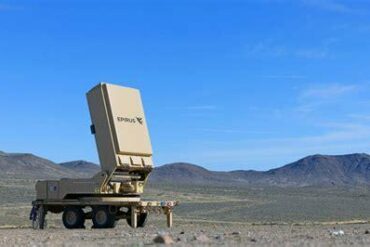
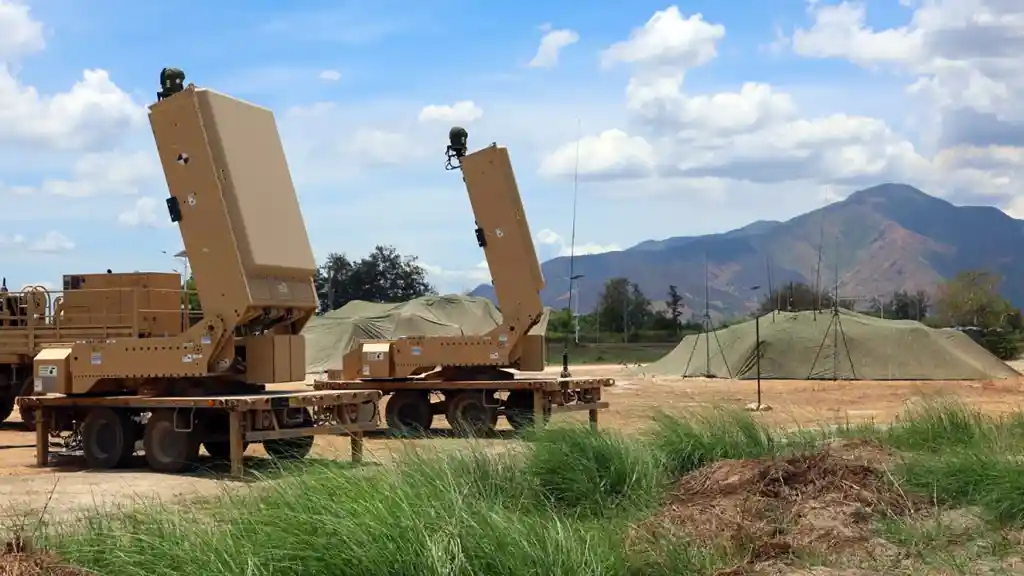
Leonidas, officially designated IFPC‑HPM by the Army, operates in the critical low‑altitude air defense (LAAD) domain. Its primary mission is to counter unmanned aircraft swarms, loitering munitions, low‑flying cruise missiles, and robotic threats on land or sea. Unlike traditional kinetic interceptors, Leonidas deploys long‑pulse microwave energy across multiple frequency bands to overload and disrupt the electronics of any airborne platform entering its electromagnetic interference field (EIF). This “one‑to‑many” effect allows a single transmitter to neutralize dozens—or even hundreds—of drones in rapid succession, offering a scalable, cost‑efficient alternative to missile-based systems.
The core of IFPC‑HPM’s functionality lies in its phased‑array antenna and high‑power transmitter modules, known as Line Replaceable Amplifier Modules (LRAMs). By adjusting the number of active LRAMs, operators can tailor output power and effective range to specific mission requirements, from short‑range base defense to extended perimeter protection. The system’s modular architecture ensures that even if individual LRAMs fail, the array continues to operate at reduced capacity, enabling sustained mission availability without redundant backup systems.
Strategic Context
Recent swarm attacks—dubbed “Trojan Horse” strikes—inside Russia by Ukrainian forces and inside Iran by Israeli units have demonstrated the asymmetric impact of cheap, coordinated drones on high‑value targets. These incidents have catalyzed Pentagon interest in directed‑energy solutions that can rapidly neutralize pop‑up threats before they overwhelm defenses. U.S. installations, sensor networks, maritime vessels, ports, and critical infrastructure remain vulnerable to similar attacks, necessitating defensive systems that can be deployed on short notice, operate autonomously, and impose minimal collateral damage.
Epirus positions Leonidas as a key enabler of pop‑up defense; its rapid deployment capability means that units can be disembarked, powered up, and firing within 15–20 minutes, providing a vital inner layer of protection—termed the “Final Protective Fires” zone—spanning approximately one kilometer around a defensive position.
Product Line Variants
Epirus has expanded the Leonidas family beyond the stationary IFPC‑HPM configuration to address diverse operational environments:
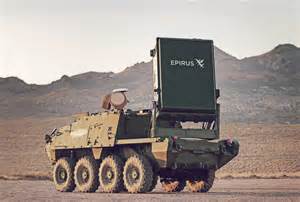
- Leonidas Mobile: Mounts the HPM array on a Stryker armored vehicle for maneuverable LAAD support.
- Leonidas H₂O: A marinized variant optimized for counter‑unmanned surface vessel operations and maritime counter‑swarm defense.
- Leonidas Pod: A UAS‑borne electronic attack payload capable of delivering HPM pulses from an airborne platform.
- Expeditionary Directed Energy Counter‑Swarm (ExDECS): A compact, rapid‑deploy system tailored for Marine Corps expeditionary forces.
These variants ensure that Leonidas capabilities can be integrated across the joint force, from armored brigades and naval task groups to carrier strike teams and forward‑deployed Marine units.
Gen II Enhancements
Building on feedback from the four Generation I prototypes deployed to the Middle East in 2024 and the Indo‑Pacific in Spring 2025, Gen II Leonidas systems deliver substantial performance upgrades. Peak output power has increased by over 30%, and the system can sustain continuous ionization for up to a millisecond per pulse—orders of magnitude longer than traditional HPM bursts. Full signal polarization across all cardinal axes boosts penetration through dielectric or partially shielded targets. The redesigned power infrastructure, anchored by 800 lb of lithium‑polymer batteries, supports up to 30 minutes of untethered firing, enabling protracted engagements without reliance on external generators.
Perhaps most notable is the cooperative‑fires capability: two Gen II units can be networked to synchronize pulses, effectively doubling the radiated power and extending the tactical envelope. This cooperative mode will be a focal point during October’s engineering trials at Naval Air Weapons Station China Lake, where the Army will assess metrics such as pulse coherence, field uniformity, and system reliability under realistic combat scenarios.
Upcoming Tests & Acquisition
The October China Lake test series represents a defining milestone for Epirus and the Army. Two Gen II IFPC‑HPM systems will undergo rigorous evaluation, including cooperative‑fires demonstrations, environmental stress testing, and assessments of operator ergonomics and maintenance workflows. Success in these trials is expected to trigger a formal program of record, paving the way for broader production, fielding, and doctrinal integration across Army formations.
Epirus leadership has characterized the trials as a “make‑or‑break” moment; favorable results could accelerate funding for additional units, doctrine development, and perimeter defense architectures that weave HPM systems into a multi‑layered LAAD umbrella alongside kinetic interceptors and electronic warfare assets.
Market Opportunities
The Leonidas Gen II rollout aligns with multiple defense market drivers:
- Overseas LAAD Missions: In the wake of the Tower 22 attack in January 2024, where drone strikes in Rukban, Jordan, inflicted U.S. casualties, the Army seeks systems to safeguard CENTCOM Patriot batteries and expeditionary outposts.
- Homeland Defense: Initiatives like the Golden Dome layered air defense concept envision HPM nodes protecting major event venues (e.g., the 2026 FIFA World Cup matches) and critical border areas against drone incursions.
- Foreign Military Sales: Partners in Ukraine and the Middle East are evaluating Leonidas for counter‑swarm operations. Under AUKUS Pillar II, Australia’s Project LAND 156 aims to field non‑kinetic small‑UAS defenses, for which Epirus is a leading contender.
- Service‑Specific Acquisitions: Lt. Gen. Adrian Spain of the USAF has signaled interest in leasing IFPC‑HPM units for base defense in 2026, with the Navy and Marine Corps considering demonstrations of mobile and UAS‑borne variants.
These overlapping markets present a robust demand pipeline that could see Leonidas systems proliferate across U.S. and allied forces within the next five years.
Production & Sustainment
Epirus’ Torrance facility is configured to produce 20–30 IFPC‑HPM II units annually with ease. The system’s modular LRAM architecture—typically comprising 150 amplifiers—scales linearly: halving the module count halves the range, doubling it doubles the range. Each LRAM represents roughly 65% of unit cost, with the remaining 35% invested in the antenna structure, trailer, positioner, and support equipment. Field maintenance focuses on LRAM replacement; failed modules can be swapped in under an hour, preserving mission availability without redundant system spares. Epirus estimates a per‑unit price of $10–20 million, a fraction of comparable directed‑energy solutions, thanks to commercial off‑the‑shelf components and a pragmatic design ethos that eschews “exquisite parts and gold‑plated apertures.”
Operational Considerations
Leonidas Gen II is optimized for the inner LAAD ring known as Final Protective Fires—roughly a 1 km zone around defended assets. However, its high electromagnetic signature when transmitting—described by Lowery as “bright as the sun”—renders it vulnerable to detection and targeting. To mitigate risk, Army planners are developing “shoot‑and‑scoot” tactics: firing a brief, intense burst to neutralize an incoming swarm, then rapidly relocating the system to avoid counter‑attack. Integration on mobile platforms, including Strykers and maritime vessels, will enhance survivability by enabling continuous movement and dispersed firing angles. Cold‑start-to‑firing capability in less than 20 minutes ensures rapid response to emerging threats.
Conceptual Framework: The Sixth Domain
Epirus frames Leonidas not merely as a directed‑energy weapon but as “weaponized electromagnetic interference” for the nascent sixth domain of physical‑cyber warfare. In this domain, autonomy, robotics, and advanced processing chips—Qualcomm Snapdragons and Nvidia accelerators—drive a new era of “guerrilla robot” tactics. While adversaries like Ukraine, Israel, and Russia have already stood up dedicated drone warfare branches, the U.S. military lags behind. The fielding of IFPC‑HPM and complementary systems could catalyze the creation of a dedicated robotic‑warfare service arm, ensuring that America maintains technological and doctrinal edge in the electromagnetic battlespace.
As unmanned systems continue to proliferate, Leonidas offers a scalable, cost‑effective bulwark against the deluge of emerging threats. With the Army’s $43 million investment and upcoming milestone tests, Epirus is poised to transform LAAD paradigms and usher in a resilient, layered defense posture that safeguards U.S. forces and allies alike in the 21st‑century theater of electromagnetic conflict.