The U.S. Army has awarded a $5.2 million contract to Perennial Autonomy for the delivery of the Bumblebee V2 collision-based drone interceptor, marking a decisive move to strengthen frontline defenses against the rapidly evolving small unmanned aircraft systems (sUAS) threat. The agreement, issued by the Army’s Joint Interagency Task Force 401 (JIATF-401) on February 6, 2026, underscores a strategic push to field a soldier-operated, low-collateral solution capable of immediate deployment in complex operational environments.
Deliveries of the Bumblebee V2 are scheduled to begin in March 2026, with the system slated for operational assessment by the Army’s Global Response Force. That timeline reflects urgency. The proliferation of low-cost drones—used for reconnaissance, targeting, and even explosive delivery—has altered the tactical calculus of modern warfare. The Army is not merely experimenting; it is accelerating fieldable solutions that place counter-drone capability directly into soldiers’ hands.
A Collision-Based Counter-Drone Concept Built for Modern Battlefields
At the heart of the Bumblebee V2 is a deceptively simple but strategically significant design philosophy: controlled kinetic interception through direct collision. Rather than deploying explosive warheads or fragmentation-based munitions, the system neutralizes hostile drones by physically colliding with them, rendering both aircraft inoperable.
This approach addresses one of the most persistent challenges in counter-UAS operations—collateral risk. Explosive interceptors may be effective, but they introduce secondary hazards, especially in dense environments where friendly forces, civilian infrastructure, or sensitive facilities are nearby. A missed shot, unexploded ordnance, or fragmentation debris can create consequences that outweigh the initial threat. The Bumblebee V2’s collision-based method reduces that footprint dramatically.
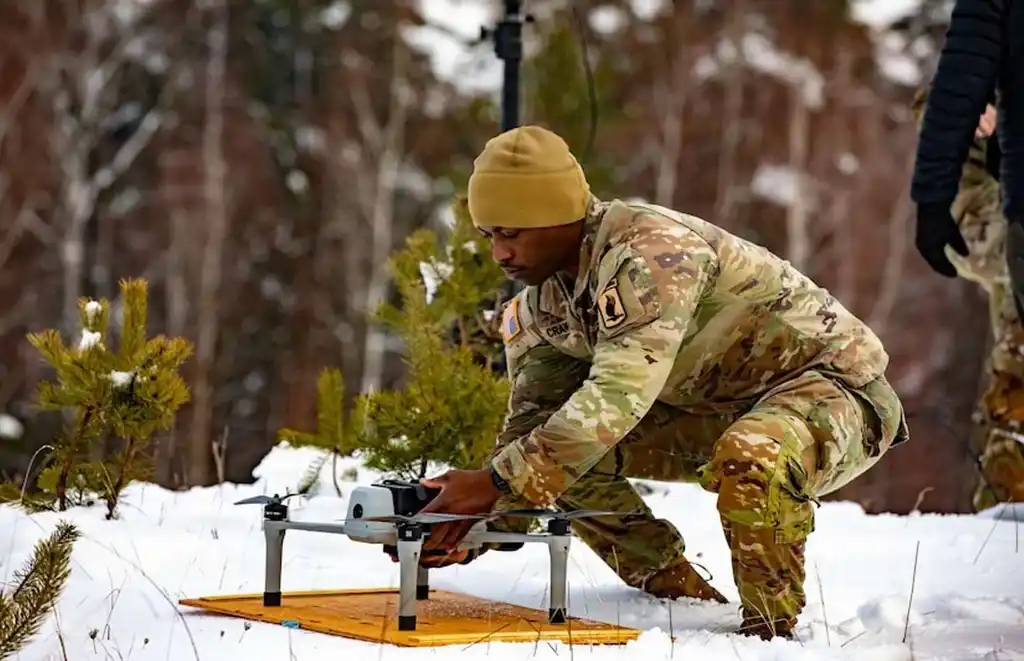
Described officially as a next-generation first-person-view (FPV) multirotor, the interceptor is soldier-operated and optimized for close-range engagements in contested airspace. Its mission profile centers on point defense, engaging hostile drones within the final engagement envelope where other tools—such as electronic warfare or small arms—may be unreliable or operationally risky.
Onboard Recognition and Autonomous Intercept Logic
The most consequential capability embedded within the Bumblebee V2 lies in its onboard identification, tracking, and collision software. While the Army has not released detailed performance specifications such as top speed, endurance, or engagement range, the functional description reveals a system equipped with an integrated perception and guidance stack capable of real-time target acquisition and terminal maneuvering.
To intercept a small drone, particularly one maneuvering unpredictably, the interceptor must accomplish several tasks in rapid sequence:
- Detect a small, low-signature aerial object against background clutter
- Maintain a stable track despite evasive movement
- Calculate a high-closure intercept trajectory
- Execute terminal guidance with minimal operator correction
This implies the presence of advanced onboard processing capable of blending computer vision, sensor fusion, and flight stabilization. The operator’s role, framed within the FPV architecture, allows for aggressive steering and rapid decision-making, while automated stabilization algorithms refine the final intercept geometry.
In practical terms, this reduces operator workload during the critical final seconds of engagement. Instead of demanding perfect manual precision under stress, the system augments the human pilot with digital assistance, increasing the probability of a successful collision while maintaining responsiveness.
Low-Collateral Defense in Layered Counter-UAS Architecture
The Bumblebee V2 is not designed to operate in isolation. The Army’s integration strategy positions it within a layered counter-UAS architecture, where multiple detection and defeat mechanisms work in concert.
Electronic warfare systems remain essential tools for disrupting drone communications and GPS signals. However, adversaries increasingly deploy autonomous flight modes, hardened communication links, and expendable platforms that can resist or bypass jamming. In such cases, kinetic defeat remains necessary.
Within this layered construct, the Bumblebee V2 functions as a close-in effector. Sensors and observers provide early warning, cueing the interceptor once a hostile drone penetrates a protected footprint. Engagement occurs within the final hundreds of meters, where precision and minimal collateral risk are paramount.
The Army’s imagery from Grafenwoehr training exercises shows familiarization flights and instructor certification, reinforcing that this capability is intended for unit-level use. The system is designed for rapid deployment, intuitive handling, and scalable fielding rather than niche specialization.
Strategic Context: JIATF-401 and the Replicator 2 Initiative
The contract aligns directly with broader Pentagon reforms that established JIATF-401 as a centralized authority to coordinate counter-UAS efforts. A formal directive creating the task force emphasized that the small UAS threat is expanding at an exponential rate and that prior counter-drone initiatives had become fragmented across services and agencies.
JIATF-401 now drives Replicator 2, an initiative focused on rapidly fielding counter-UAS capabilities by leveraging commercial innovation. Rather than developing bespoke systems from the ground up, the Department of Defense is accelerating adoption of adaptable technologies already advancing within the private sector.
The Bumblebee V2 complements earlier Replicator 2 procurements such as Fortem’s DroneHunter F700 net-capture interceptor, which emphasizes controlled capture and forensic recovery in domestic contexts. Together, these acquisitions illustrate a portfolio approach: explosive-free interception methods tailored to specific operational environments.
The establishment of the Lt. Gen. James M. Gavin Joint Innovation Outpost (JIOP) at Fort Bragg further reinforces this adaptive model. The JIOP’s mission is to bridge tactical requirements with industry solutions through rapid testing and iterative refinement. Collision-based interceptors, with software-driven performance characteristics, are particularly well-suited to iterative upgrades as battlefield lessons emerge.
Sustainment, Cost Dynamics, and Tactical Implications
The sacrifice nature of a collision-based interceptor introduces unique sustainment considerations. Each engagement consumes an interceptor, reshaping logistics planning. Unlike reusable net systems or missile interceptors with higher unit costs, the Bumblebee V2 model favors scalable production and simplified training pipelines.
This cost dynamic reflects battlefield realities observed in recent conflicts, where adversaries deploy inexpensive drones in swarms or frequent waves. Countermeasures must achieve economic parity. Deploying a high-cost missile against a low-cost quadcopter is strategically unsustainable. A consumable but relatively low-cost interceptor offers a more balanced exchange ratio.
Additionally, the soldier-operated design enables decentralized employment. Units do not need to wait for higher-echelon air defense assets. Immediate response reduces vulnerability windows, particularly for expeditionary forces or rapidly deployed elements within the Global Response Force framework.
Global Momentum in Drone-on-Drone Defense
Although no foreign military adoption of the specific Perennial Autonomy system has been publicly confirmed, the broader concept of drone-on-drone interception is gaining international traction. The operational environment in Ukraine has demonstrated the tactical value of low-cost interceptors engaging hostile UAVs directly rather than relying solely on traditional air defense systems.
European nations have also accelerated procurement of interceptor UAVs. Latvia, Estonia, and Belgium have begun receiving systems such as Origin Robotics’ Blaze interceptor, with Belgium publicly citing repeated drone incursions around critical infrastructure as justification for urgent acquisition. The common thread is clear: airspace once considered secure is now permeable to inexpensive aerial threats.
The United States’ investment in the Bumblebee V2 reflects not experimentation but adaptation. Small drones have compressed the engagement timeline, blurred distinctions between battlefield and homeland security, and forced militaries to rethink sovereignty in low-altitude airspace.
Restoring Tactical Control in the Age of Small UAS Proliferation
The awarding of the $5.2 million contract for the Bumblebee V2 signals more than procurement; it reflects doctrinal evolution. The Army is embracing low-collateral, soldier-operated interception systems as essential components of modern force protection. By combining onboard recognition software, collision-based neutralization, and rapid deployment capability, the system addresses both operational urgency and collateral risk.
As deliveries commence in March 2026 and operational assessments proceed within the Global Response Force, the Bumblebee V2 will serve as a litmus test for scalable, consumable counter-UAS defense. Its success will not be measured solely by interception statistics, but by how effectively it integrates into layered defense networks and adapts to evolving drone tactics.
In a battlespace increasingly defined by inexpensive airborne threats, the Army’s investment positions the Bumblebee V2 as a tangible step toward reclaiming control of contested airspace—one controlled collision at a time.