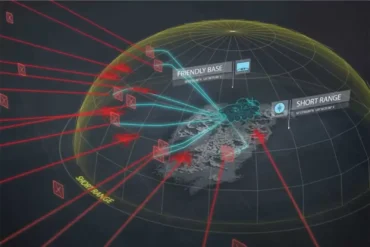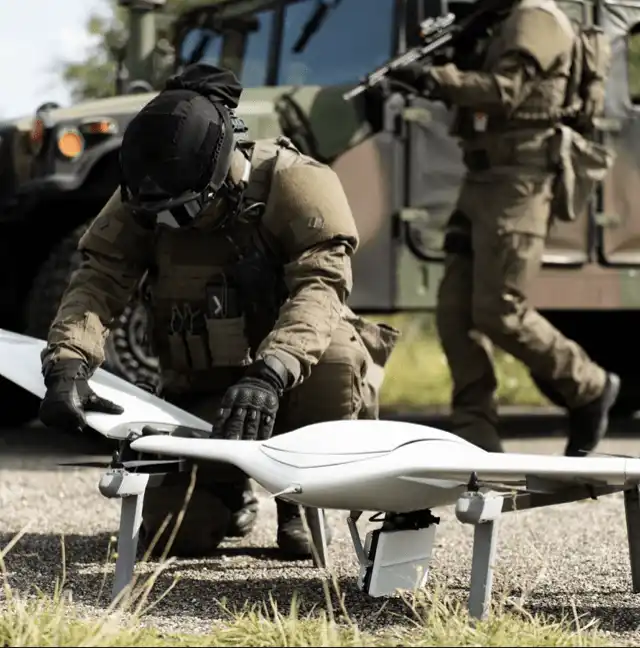
In a dramatic leap forward in aerial defense technology, Alpine Eagle, a German defense tech innovator based in Brühl, has introduced the world’s first drone-based counter-UAS swarm system, marking a pivotal transformation in how military forces can detect and neutralize airborne threats. Known as the Sentinel system, this sophisticated network of autonomous drones combines cutting-edge radar capabilities with real-time threat elimination to offer a mobile, resilient, and highly scalable counter-drone solution.
The Limitations of Ground-Based Radar and the Need for Mobility
Traditional counter-UAS systems rely heavily on ground-based radar installations. While effective in open terrain, these systems suffer significant drawbacks when faced with natural obstructions such as hills, forests, or urban landscapes. Moreover, ground radar installations are stationary and vulnerable to detection and attack, making them a liability in rapidly evolving conflict zones.
Benji Pauly, Alpine Eagle’s Business Development Manager, emphasized this issue at the Xponential 2025 conference in Houston: “If you have a hill or trees in the way, you’re no longer going to get any radar detections.” He further underscored that fixed radar positions are easily triangulated by adversaries, making them potential targets. This recognition spurred Alpine Eagle’s approach to replace static systems with airborne, agile radar units.
Sentinel OS: The Intelligent Core of the System
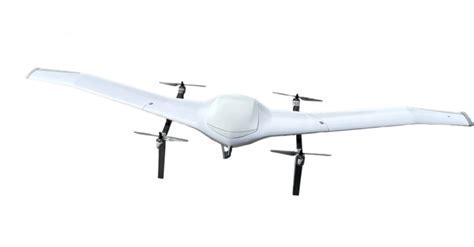
At the heart of the Sentinel system is Sentinel OS, a hardware-agnostic, intelligent software platform that unifies the various drone components into a cohesive, autonomous defense network. Developed entirely in-house, Sentinel OS enables seamless communication between swarm units, facilitating dynamic formation shifts and synchronized mission execution.
This OS interprets data from radar sensors mounted on drones and feeds it into NVIDIA Jetson onboard computers, which process the information locally before sending concise situational updates to human operators. This decentralization not only improves latency and reaction time but also ensures robust functionality in contested electronic environments where centralized communication might be disrupted.
Technological Synergy: Radar, Drones, and Real-Time Threat Elimination
The Sentinel system utilizes radar technology from Echodyne, a U.S.-based provider renowned for its high-resolution radar arrays. Instead of relying on radio frequency signatures or thermal imaging, Alpine Eagle’s drones use active radar scanning to detect aerial threats, enabling superior detection of low-profile and stealth drones.
Alpine Eagle’s fleet includes fixed-wing drones from the Netherlands and multi-rotor drones from the UK, all modified with the company’s proprietary software. The combination of mobility, radar agility, and software intelligence allows Sentinel drones to detect:
- Small consumer drones (like DJI Mini) at ~1 km
- Large ISR-capable drones at distances up to 4 km
- Helicopters, fixed-wing aircraft, and even ground vehicles
This wide-spectrum detection ability gives Sentinel a significant edge in battlefield versatility.
Swarm Intelligence: Expanding Coverage and Autonomy
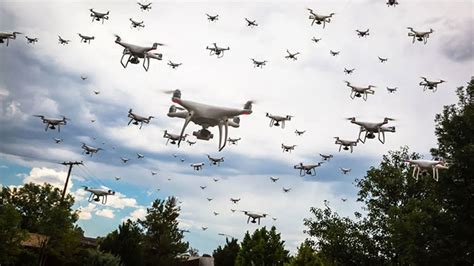
While a single radar drone offers an angular field of view of 120 degrees horizontally and 80 degrees vertically, the true innovation lies in the system’s swarm capabilities. Swarm formations are autonomously determined based on mission parameters:
- For base defense: drones orbit installations in protective loops
- For convoy security: swarms move in tandem with ground vehicles
- For border patrol: drones align in linear or elliptical scanning formations
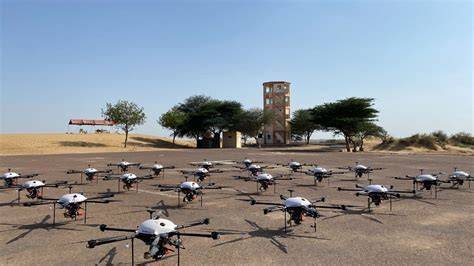
Operators deploy a lead drone to define the mission area, and subsequent units autonomously self-organize into a coverage-optimized formation. The drones share real-time radar data, processed on the fly, with geo-location coordinates pinpointing incoming threats.
Armed and Operational: The Interceptor Drone Capability
Beyond passive surveillance, Sentinel includes active threat neutralization via Interceptor drones. These units, equipped with precision-guided mini-missiles carrying approximately 300 grams of high-explosive payload, can target and destroy enemy UAVs in flight.
The kill-chain is fully integrated:
- Radar drone detects and tracks the threat
- Interceptor drone receives continuous positional updates
- AI-driven camera locks onto the target
- Explosive payload is launched for direct intercept
In scenarios requiring extended range, Interceptors can be mounted on fixed-wing aircraft, increasing effective radius from 5 kilometers to 270 kilometers—an unmatched operational envelope for tactical UAV-based defense.
Field Deployment: Flexibility, Portability, and Speed
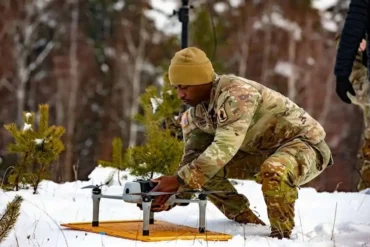
Designed with frontline deployment in mind, Sentinel drones are highly portable and tool-free. Soldiers can assemble and launch the drones in less than 20 minutes, requiring only a 2-square-meter launch pad. The vertical take-off and landing (VTOL) capability makes them suitable for dense urban environments and rugged terrains.
Each drone offers up to 72 hours of operational battery life, with smart auto-return functions. When a drone’s battery depletes, it autonomously returns for a battery swap and then rejoins the swarm without human intervention, redistributing itself within the formation for seamless continuity.
Integration with NATO Forces and Real-World Testing
The Sentinel system is currently undergoing trials with the Bundeswehr, and has attracted interest from the U.S. and U.K. militaries. Testing is also underway with Ukrainian defense units, evaluating Sentinel’s capabilities in real-time conflict scenarios against Russian drone incursions.
During one German Army trial, Alpine Eagle personnel demonstrated the system’s ability to detect a military vehicle carrying a general well before visual confirmation. The radar signature provided enough time for the operator to confirm the incoming vehicle’s identity—proof of Sentinel’s potential for battlefield reconnaissance and threat identification.
Beyond Defense: Sentinel’s Civilian Potential
While currently tailored for military applications, Alpine Eagle envisions broader utility in civilian airspace protection. Large-scale venues like sports stadiums, government buildings, and airports face growing threats from consumer drones. Sentinel swarms could provide temporary aerial radar coverage during high-risk events without the need for fixed infrastructure.
However, deploying active radar systems in civilian areas introduces regulatory hurdles, especially surrounding radio frequencies. As Pauly noted, “You do need a radio license for that. Of course, the military has a lot of easier ways to get around that.” Still, Alpine Eagle is actively exploring dual-use compliance pathways that could allow limited civilian usage under strict controls.
The Strategic Implications of a Mobile Counter-UAS Swarm System
The introduction of a drone-based, radar-integrated, and self-organizing counter-UAS swarm significantly alters the landscape of aerial defense. In regions where electronic warfare and drone threats have become ubiquitous, such as Eastern Europe and the Middle East, systems like Sentinel offer the speed, precision, and resilience against signal jamming that legacy platforms cannot.
Moreover, the modular and off-the-shelf nature of the components—sourced from allied nations and integrated via Alpine Eagle’s proprietary software—makes Sentinel cost-effective and easy to scale. Unlike traditional air defense networks, Sentinel swarms can be rapidly deployed in forward-operating environments without months of construction or calibration.
Conclusion: A New Frontier in Aerial Defense
Alpine Eagle’s Sentinel platform redefines the counter-UAS paradigm, moving from stationary detection to autonomous, mobile, swarm-based interdiction. It harnesses the convergence of drone mobility, AI, radar, and tactical strike capability to create a layered aerial defense system that’s both proactive and adaptable.
As drone warfare escalates in modern battlefields and civilian airspaces alike, Alpine Eagle’s innovation could soon become the standard blueprint for counter-UAS systems worldwide—an agile eye in the sky, watching, calculating, and neutralizing threats before they strike.