The emergence of unmanned aerial systems (UAS) has revolutionized the battlefield, providing militaries and non-state actors with new capabilities ranging from reconnaissance to precision strikes. Among these developments, drone swarms pose one of the most pressing threats to national defense and critical infrastructure. Unlike single-drone incursions, swarms consist of multiple autonomous or semi-autonomous drones working in coordination to overwhelm traditional defense systems. Their agility, cost-effectiveness, and ability to confuse radar and electronic warfare systems make them exceptionally difficult to counter with conventional air defense technologies.
Recognizing this, defense manufacturers and military organizations worldwide have intensified efforts to develop counter-drone systems that are not only effective against individual drones but also scalable to neutralize entire swarms. Honeywell Aerospace Technologies, a division of Honeywell (NASDAQ: HON), has positioned itself at the forefront of this mission, unveiling a new solution designed specifically to address this challenge.
Honeywell’s Demonstration: A Turning Point in Counter-UAS Technology
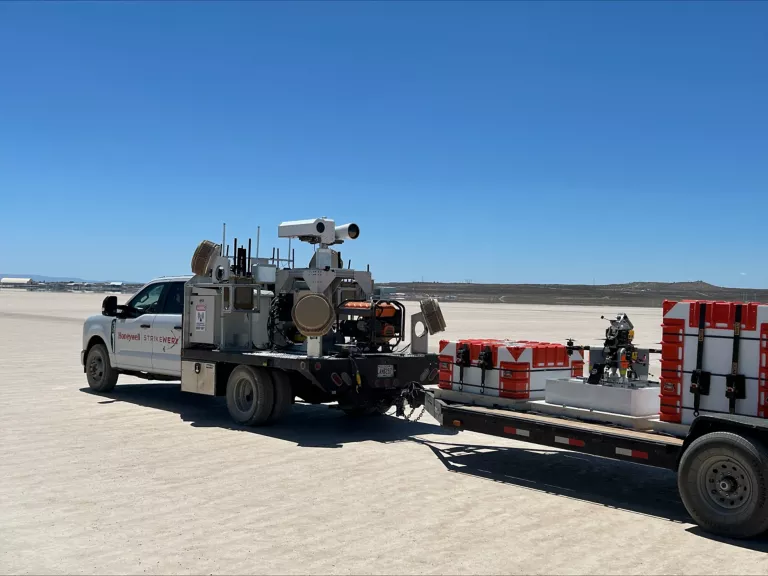
In a series of recent demonstrations for U.S. military operators, Honeywell successfully showcased its Stationary and Mobile UAS Reveal and Intercept system. The tests highlighted the platform’s ability to detect, track, and neutralize multiple drones in coordinated swarm attacks. What makes this demonstration significant is the operational flexibility: the system was deployed both from a ground vehicle and from an aerostat positioned more than 1,000 feet above ground level, proving adaptability in both mobile and stationary roles.
According to Matt Milas, President of Defense and Space at Honeywell Aerospace Technologies, swarm drones represent an escalating danger to high-value military assets. He emphasized that Honeywell’s demonstration not only validated the system’s reliability, scalability, and battlefield readiness but also confirmed its seamless integration with existing military defense architectures. This interoperability ensures that armed forces can enhance current security investments rather than completely overhaul infrastructure.
Core Capabilities of the Stationary and Mobile UAS Reveal and Intercept System
Honeywell’s new system is built upon a Model-Based Systems Engineering (MBSE) approach, enabling a turnkey solution that integrates detectors and effectors tailored to customer requirements. MBSE allows military clients to configure systems to specific operational needs while ensuring compliance with Modular Open Systems Approach (MOSA) standards. This means the system remains flexible, upgradeable, and future-proof in the face of evolving drone technologies.
Among its standout features are:
- Multi-Layer Detection: The system employs advanced radio frequency (RF) detection and optical sensors capable of identifying, tracking, and classifying aerial threats, including swarms.
- Interception and Neutralization: Honeywell’s offensive capabilities include the deployment of counter-drone UAVs and other active effectors that can disable or destroy hostile drones mid-flight.
- Rapid Integration: Operators can quickly incorporate new detectors or effectors into the system, minimizing downtime and adapting to emerging threats.
- Ease of Operation: Designed for use by security forces and tower operators, the platform is user-friendly and requires minimal training for deployment.
- Sustainability: Honeywell provides a single point of contact for system updates, ensuring that all components evolve as threat landscapes shift.
Collaboration with Leading Defense Manufacturers
The strength of Honeywell’s system lies not only in its engineering but also in the integration of advanced components from a wide range of defense partners. Among the key contributors are:
- BlueHalo – Specializing in counter-UAS directed energy and RF systems.
- Leonardo DRS – Known for its advanced sensing and electronic warfare solutions.
- Pierce Aerospace – Focused on UAS identification and integration capabilities.
- Silent Sentinel – Providing long-range electro-optical detection.
- Walaris – Delivering drone surveillance and tracking software.
- Rocky Research – Supplying energy systems to support mobile defense platforms.
- Versatol – Contributing tailored hardware for kinetic and non-kinetic intercepts.
By integrating such diverse technologies into a modular ecosystem, Honeywell ensures military operators gain comprehensive protection against the multi-faceted threat of drone swarms.
Strategic Military Implications
The successful demonstration of Honeywell’s system carries profound implications for U.S. defense strategy and allied forces worldwide. Swarm drones are being increasingly deployed in conflict zones, from the Middle East to Eastern Europe, where they have proven capable of overwhelming traditional short-range air defense systems. Adversaries leveraging low-cost, commercially modified drones can pose a disproportionate risk to high-value targets such as airfields, radar installations, and command centers.
With the Honeywell system, the U.S. military gains a scalable and mobile countermeasure that not only defends critical infrastructure but also protects forces on the move. The ability to mount the system on a ground vehicle or tether it to an aerostat offers unmatched operational flexibility, enabling defensive coverage across wide areas and rugged terrain.
Furthermore, Honeywell’s MOSA compliance ensures that allied militaries can integrate the system into existing command-and-control networks, facilitating interoperability during joint operations. This is crucial for NATO and coalition forces seeking standardized, adaptable defense platforms capable of rapid deployment.
Commercial and International Opportunities
While the demonstration was conducted for U.S. military operators, Honeywell has signaled its readiness to provide the system for international defense partners and commercial operators. This opens significant opportunities for countries seeking to defend against drone threats without relying on large-scale missile defense systems. Critical infrastructure operators, including airports, energy facilities, and government installations, could also benefit from a scaled-down version of Honeywell’s counter-UAS technology.
The growing demand for cost-effective and reliable counter-drone solutions is expected to expand the global market significantly over the next decade. Honeywell’s demonstration positions the company as a leader in this field, offering a product that is not only field-proven but also adaptable to diverse operational environments.
Looking Ahead: The Evolution of Drone Defense
As drone technologies advance, so too must countermeasures evolve to keep pace. Swarm drones may soon incorporate artificial intelligence (AI) for autonomous decision-making, making them even more difficult to counter. Honeywell’s emphasis on scalability and rapid integration of new detectors and effectors ensures that its system can adapt as these challenges arise.
Moreover, the development of directed energy weapons, such as high-powered lasers and microwave systems, may become a core element of future iterations. Honeywell’s modular design philosophy ensures compatibility with such technologies, preserving the relevance and effectiveness of its system well into the future.
The company’s proactive engagement with military operators also signals a commitment to iterative development, ensuring feedback from real-world exercises informs system improvements. This cycle of continuous evolution will be critical as adversaries seek to exploit weaknesses in existing defenses.
Conclusion: Honeywell’s Counter-Swarm Breakthrough
Honeywell’s successful demonstration of its Stationary and Mobile UAS Reveal and Intercept system marks a significant milestone in the defense industry’s ongoing battle against drone swarms. By proving the system’s capability in both stationary and mobile environments, Honeywell has delivered a solution that is battlefield-ready, modular, and scalable.
With contributions from leading defense technology partners and an emphasis on MOSA compliance, the system offers militaries worldwide a future-proof solution capable of evolving alongside the rapidly changing drone threat landscape. Beyond its military applications, the technology holds promise for safeguarding critical infrastructure and supporting international security efforts.
As the threat of swarm drones continues to grow, Honeywell’s innovation represents a decisive step forward in ensuring airspace dominance and operational security. This achievement not only strengthens U.S. defense capabilities but also sets a benchmark for counter-drone technologies across the global security landscape.