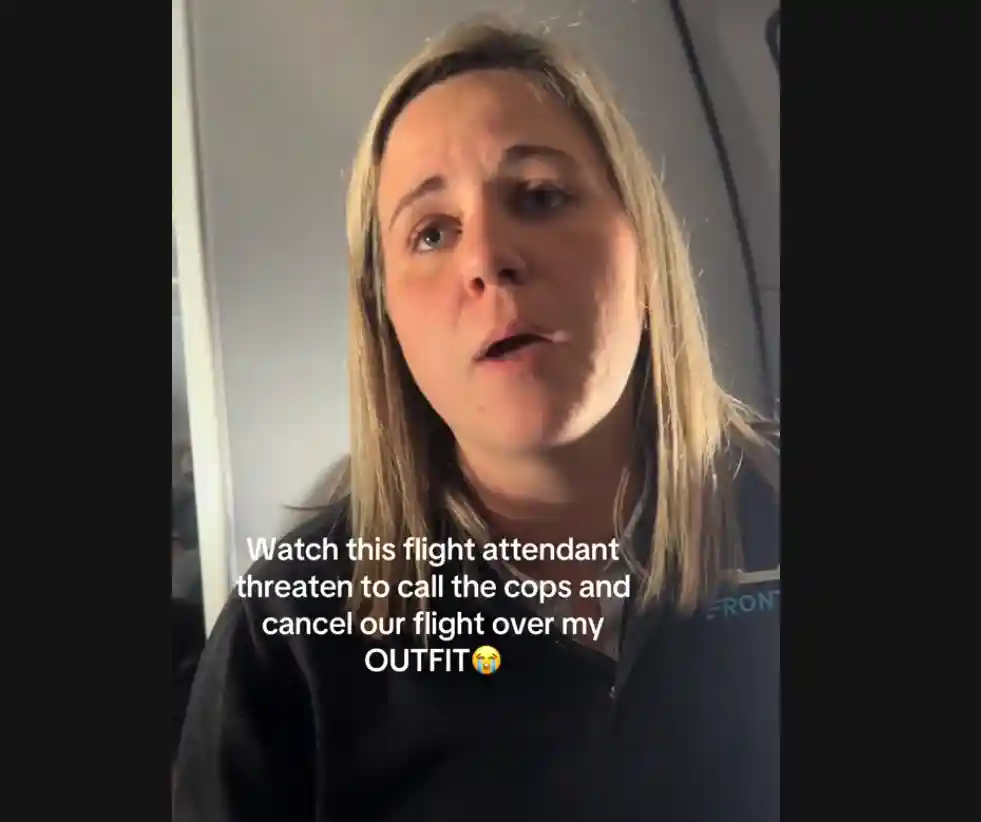
A heated confrontation aboard a Frontier Airlines flight has sparked viral outrage after a passenger was told to change her shorts mid-flight or risk being met by law enforcement upon landing. The incident, caught on camera and widely shared across TikTok, features a passenger, who goes by the handle @90sbabygirl (Nereidaa), disputing the flight crew’s claim that her shorts were inappropriate under airline policy.
The situation escalated aboard a flight departing Atlanta Hartsfield-Jackson International Airport, when a flight attendant named Katie informed the passenger that her outfit was unacceptable due to its alleged “see-through” nature. What followed was a confrontation that lasted several minutes, recorded and later posted online by Nereidaa, drawing more than three million views and igniting a debate on dress codes, racial profiling, and in-flight authority.
The Confrontation Captured in Viral TikToks
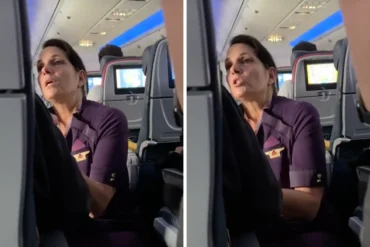
The viral footage begins mid-exchange. Katie, the flight attendant, is seen declaring, “I’m not even gonna tolerate that because I don’t racially profile at all.” This statement immediately fueled speculation among viewers that racial profiling might have played an unspoken role in the interaction. In her retort, Nereidaa questions why she was being singled out among several other female passengers also wearing short shorts.
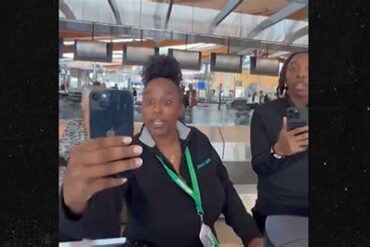
Nereidaa pans the camera down to reveal her outfit—light-colored shorts—and insists that they are not see-through, arguing, “You can’t see my skin through these.” The flight attendant rebuts with a firm, “Your pants are see-through.”
The encounter intensifies when Katie, clearly agitated, contacts another crew member over the phone, stating she is being “extremely harassed.” Her voice quivers as she says, “Her camera is less than a foot from my face,” and later explains that she gave the passenger a chance to change after takeoff to avoid the flight being canceled.
Passenger’s Side: A Practical Clothing Choice, Not a Statement
In a detailed post accompanying the videos, Nereidaa explains that the shorts in question were not her first clothing choice but simply the only clean and dry item she had after a rainy trip to Atlanta. She rushed to the airport and, at the gate, was initially approached by the same flight attendant who told her to change before boarding. Hoping to avoid a confrontation, she agreed—only to later observe numerous other women wearing similar outfits.
“I explained to management that my only alternative was wet clothing, and I pointed out others dressed the same,” Nereidaa wrote. After reviewing her case, the gate agents determined that her attire was acceptable, and she boarded the plane without incident. No one, including multiple attendants, flagged her outfit as a concern—until mid-flight.
Shortly after using the restroom in the air, she says she was again confronted by Katie, who insisted she change her shorts on the plane. As the debate unfolded, Nereidaa received a formal federal warning, a printed notice stating that interfering with a crewmember or engaging in illegal behavior could lead to criminal charges.
Airline Dress Code vs Passenger Expectations
Many online were quick to point out that Frontier Airlines’ passenger dress code is not readily available on their official website. The closest mention is found within the contract of carriage, which grants the airline discretion to refuse service to passengers not fully clothed or wearing outfits deemed lewd, obscene, threatening, intimidating, or objectionable to reasonable persons.
This vagueness leaves substantial room for subjective judgment, which critics argue can lead to discriminatory enforcement. Numerous commenters on Nereidaa’s videos expressed disbelief, noting that her attire appeared no more revealing than that of others aboard the flight. “I watched all the parts & this is absurd,” one user wrote. Another noted, “Not her call for help saying SHE is the one being harassed.”
The Aftermath and Official Response
While the incident could have easily escalated into law enforcement involvement, it concluded with a practical compromise: Nereidaa slipped on a pair of damp black shorts she had stowed in her bag over the original ones. She reported that although she was told law enforcement would be waiting at the arrival gate, she was not detained or approached upon landing.
After the flight, she contacted Frontier’s customer service and received a response acknowledging the incident. The airline stated that an internal investigation had been launched and apologized for her experience. Screenshots of the correspondence were later posted by Nereidaa.
Was the Flight Attendant Slurring Her Words?
Another dimension of public concern centered on the behavior of the flight attendant herself. Viewers analyzing the video noted that Katie appeared to be slurring her words, leading to speculation that she may have been under the influence of alcohol during the shift.
Though no direct evidence has emerged to support that theory, the perception among viewers was widespread. “Is it just me or is she drunk?” one commenter asked. The issue raises important questions about crew accountability and passenger trust in those responsible for their safety.
Public Outcry Over Discretion and Fairness
Beyond the issue of wardrobe policing, the incident highlights a larger debate about inconsistency in airline policy enforcement and the discretionary power wielded by crew. With no clear, accessible public dress code policy and wide latitude given to flight attendants, passengers often don’t know what’s allowed until they’re being threatened mid-flight.
Many commenters accused Frontier of enabling what they viewed as overreach and called for the company to provide clearer policies, both for passengers and employees. Some questioned whether this event would have unfolded similarly if the passenger were white or male, underscoring the ever-present concerns about implicit bias in enforcement decisions.
Airline Authority vs Passenger Rights
Airline employees, especially flight attendants, are granted broad authority during flights under federal law. Interfering with or refusing to obey a crewmember’s lawful instructions can carry significant penalties. This authority is rooted in ensuring safety aboard the aircraft, particularly during turbulence, emergencies, or security threats.
However, this authority can also be misused or misinterpreted, as many commenters feel it was in this case. Nereidaa’s calm, composed demeanor and her willingness to comply—albeit under duress—earned her praise, while the flight attendant’s conduct faced significant scrutiny.
Critics argue that this case illustrates the gray area between safety enforcement and personal discretion, and underscores the need for airlines to train staff more thoroughly on bias and customer relations.
Frontier’s Culture and Controversy History
This is not the first time Frontier Airlines has found itself at the center of a viral controversy. The low-cost carrier, known for its no-frills service model, has previously faced backlash over its customer service policies, surprise fees, and rigid rule enforcement. However, this incident adds a unique twist—raising concerns about employee conduct, gender norms, and body autonomy.
As one viewer aptly summarized, “If her shorts were a true safety issue, why was she allowed to board?” The question remains whether this was an isolated incident involving a rogue employee or a symptom of a deeper cultural issue within the airline.
Conclusion: A Flashpoint for Change or Just Another Viral Moment?
As TikTok continues to play a powerful role in amplifying passenger experiences, incidents like this force airlines to address their internal inconsistencies and public-facing policies. For Frontier, the pressure is now on to show that it takes such concerns seriously and is willing to make changes.
In the meantime, passengers like Nereidaa are leveraging social media to hold airlines accountable, raising awareness of not just what happened, but why it matters.
The implications of this mid-air confrontation stretch far beyond a pair of shorts. At the heart of the controversy lies a conversation about personal freedom, subjective judgment, and the boundaries of authority at 30,000 feet. Whether Frontier takes meaningful action or lets the storm pass remains to be seen.