Mid-flight disruptions are rarely heartwarming, yet one recent Delta Air Lines flight turned into a poignant showcase of humanity at 30,000 feet. A video that has now gone viral with over 5 million views on TikTok captured a Delta flight attendant gently assisting a passenger who suffered a sudden panic attack. The scene unfolded on a domestic route either departing from or arriving in Atlanta (ATL), offering a moving contrast to the often mechanical routines of air travel. What might have passed unnoticed in a quieter era has become a powerful symbol of compassion, professionalism, and the critical emotional labor performed by flight crews daily.
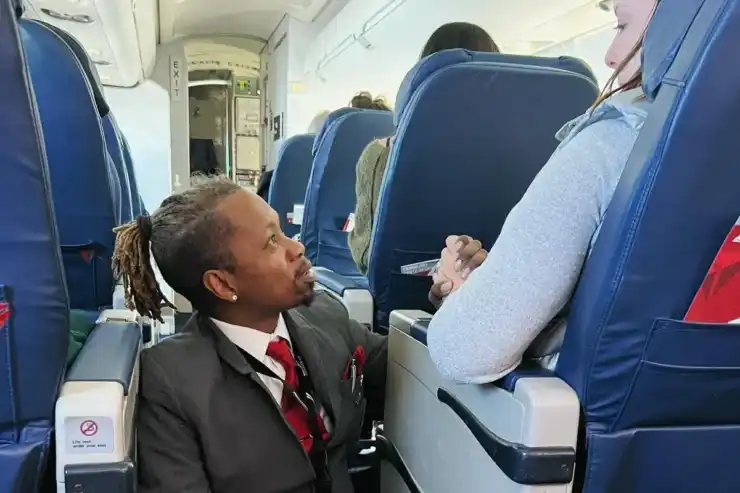
As aircraft cruised above the clouds, a visibly distressed man seated near the front of the cabin was overwhelmed by anxiety. Amid the soft hum of the engines and the occasional clink of service carts, his escalating panic caught the attention of both passengers and crew. Rather than merely offering verbal reassurances or calling for medical intervention, the Delta flight attendant made an extraordinary choice—she sat down beside him, face-to-face, and personally guided him through a calming breathing exercise.
The moment, captured by a fellow traveler seated just behind the man, shows the crew member placing all her focus on the passenger. She never once appeared rushed or distracted, despite being mid-shift in a highly regulated environment. Her hands moved slowly, guiding the man through inhales and exhales, a gesture that speaks volumes more than the typical inflight script.
Viral Video Ignites Wave of Admiration
The video’s caption—**“The guy in front of me was having an anxiety attack, and she sat with him and talked him through it, absolutely amazing”—**sets the tone for what many are now calling one of the most touching inflight moments seen online in years. Comments began pouring in almost immediately. One stood out: “That’s my mom! She’s always been someone who genuinely cares about people… proud to see the world recognize that!” The commenter, believed to be the attendant’s son, gave the narrative an even more emotional resonance, humanizing the heroine behind the uniform.
Another commenter, identifying as a fellow Delta crew member, pledged to notify company leadership, ensuring that the attendant receives formal recognition for her act. While Delta has yet to release an official statement, the airline’s brand reputation has already benefitted from this unscripted display of empathy.
A Culture Rooted in Human-Centric Service
This act wasn’t a one-off. Delta Air Lines has previously been recognized for its crew members’ sensitivity toward passengers undergoing emotional distress. In 2023, a similar story circulated online: a Delta flight attendant was photographed sitting cross-legged on the cabin floor, holding the hand of a woman struggling with fear during takeoff. These moments, though rare in official reports, form part of a growing archive of compassion within Delta’s inflight culture.
What sets these interactions apart is the degree of emotional intelligence demonstrated. Beyond safety checks, beverage service, and standard protocol, flight attendants are often the first responders to emotional emergencies in the skies. With enclosed spaces, limited exits, and no access to ground-based psychological help, they become the calming presence passengers desperately need when panic sets in.
This ethos may not be part of a formal job description, but Delta’s team members appear to embody it naturally. The airline’s internal training is believed to place emphasis not only on customer service but also on situational empathy—the ability to assess and respond appropriately to a variety of human conditions mid-flight.
Inside the Fear: Understanding Aviophobia
A key part of this story revolves around the condition itself: aviophobia, or the fear of flying. Often dismissed as irrational, aviophobia is a deeply rooted psychological condition affecting nearly 40% of Americans, according to some surveys. For 5% of the population, the fear is so severe that they avoid flying entirely, even when it means missing out on family events, job opportunities, or personal growth.
The causes are multifaceted. Some sufferers trace their fear back to turbulent flights in childhood, while others point to more recent triggers such as high-profile aviation incidents. Media coverage of accidents—such as the June 12 crash of an Air India Boeing 787 or the earlier loss of American Airlines Flight AA5342 over the Potomac River—tends to reinforce anxiety, regardless of the viewer’s own travel history.
Moreover, anxiety disorders unrelated to flying can be magnified inside an aircraft. The enclosed cabin, restricted movement, and lack of control can all feed into a sensation of helplessness. Unfortunately, the United States has lagged behind other countries in offering structured support for such travelers. While British Airways and EasyJet run successful “fear of flying” courses—with reported success rates as high as 95%—no major U.S. airline has rolled out a comparable national program.
TikTok as a Medium of Empathy and Visibility
In an era dominated by short-form content, TikTok has evolved beyond dance challenges and viral pranks to become a platform for real, human stories. The Delta incident gained traction not simply because of its emotional gravity but also because of the raw authenticity captured in under a minute of footage. There was no editing, no framing, no narration—just a snapshot of real kindness in motion.
This has led many to reflect on the unseen emotional labor of airline staff, whose workdays include not just safety demonstrations but genuine, unscripted human support. Social media’s power in this case lies not in distortion but in exposure—offering a rare window into moments typically hidden behind cabin doors and corporate silence.
Industry Implications: A New Benchmark for Customer Care
Airlines often emphasize their investments in fleet modernization, entertainment systems, or inflight Wi-Fi. While these features contribute to customer satisfaction, they are ultimately interchangeable. What cannot be replicated by hardware or algorithms is the warmth of human connection—an element that forms the bedrock of loyalty in the airline industry.
This Delta crew member’s action has become more than just a momentary viral sensation; it’s now a benchmark for inflight emotional care. Travelers are increasingly voicing a desire for airline experiences that prioritize mental well-being as much as physical safety. If one attendant can help calm a panic attack mid-flight, what could a formal program—comparable to the UK’s fear-of-flying initiatives—achieve across U.S. airlines?
There are indications that empathy-based training may become a competitive edge in the service industry. Forward-thinking airlines could leverage such stories as inspiration for future crew protocols, helping redefine what it means to deliver five-star service—not through luxury, but through genuine connection.
Passenger Testimonials Add Emotional Weight
Since the video surfaced, others who’ve experienced panic attacks while flying have chimed in with their own stories. One woman commented, “I once had an anxiety attack on a flight to Chicago, and no one noticed—not even the crew. Watching this video felt like a balm to that memory.” Another added, “This video helped me decide to book my next flight. If more attendants were like her, I’d fly again.”
These testimonials underline an essential truth: when people feel seen and supported, barriers dissolve. For some, the gesture of a flight attendant taking the time to guide someone through deep breaths may mark the beginning of a new relationship with air travel—one not defined by fear but by hope.
A Moment Etched in Memory—And Policy?
While Delta Air Lines has not yet announced formal recognition or procedural changes in response to the event, industry analysts speculate that such viral compassion stories may inform future customer service training modules. Recognition of this type reminds crews that the smallest gestures can carry the largest weight, both in the moment and long after landing.
This episode also reinforces a broader truth for aviation professionals: beyond technical skill and regulatory compliance, emotional intelligence is increasingly one of the most valuable tools in an airline’s service arsenal. It’s not about grand heroic acts—it’s about being present, being kind, and above all, being human.
In a world often overwhelmed by digital noise and efficiency-driven metrics, the viral Delta flight attendant’s response shows that sometimes, the best service isn’t scripted—it’s simply felt. And that is something no seatback screen or first-class meal can replicate.