U.S. Central Command has officially transitioned Task Force Scorpion Strike into operational status, fielding the first dedicated unit equipped with the Low-cost Unmanned Combat Attack System (LUCAS) for potential employment in the Middle East. The move marks a decisive institutional shift toward scalable, expendable strike systems designed to impose cost, saturate air defenses, and expand what military planners describe as “magazine depth” in a possible contingency involving Iran.
Rather than adding a marginal capability, the activation of this unit signals a structural adjustment in how the United States prepares for high-intensity regional conflict. LUCAS is not intended to rival cruise missiles in sophistication or survivability. Its purpose is different: to be fielded in volume, launched from dispersed locations, and employed in coordinated waves that stretch adversary defensive inventories beyond sustainable limits.
The decision comes amid heightened tensions across the Red Sea and the Persian Gulf, where maritime security concerns and Iranian missile capabilities continue to shape U.S. force posture. By formalizing a one-way attack drone squadron under Central Command, the Pentagon is institutionalizing a capability that until recently existed primarily as an experimental or irregular warfare concept.
The Emergence of Task Force Scorpion Strike
Task Force Scorpion originated as an experimental formation focused on rapidly integrating expendable unmanned strike platforms. Its evolution into an operationally ready unit in less than three months underscores a procurement tempo that diverges sharply from traditional acquisition cycles. Public acknowledgment of the squadron occurred in early December 2025; by late February 2026, Central Command confirmed the unit’s readiness for potential deployment.
This compressed timeline reflects a wartime acquisition mindset shaped by recent conflicts. Rather than refining a platform over years of incremental development, the Pentagon prioritized fielding a functional system capable of immediate integration into existing strike architectures. The emphasis is less on technological perfection and more on operational utility at scale.
Officials have characterized the activation as a readiness milestone rather than a symbolic gesture. The unit is structured to deploy rapidly, coordinate with joint force assets, and sustain replenishment cycles consistent with high-volume attrition operations.
LUCAS: Design Philosophy and Operational Role
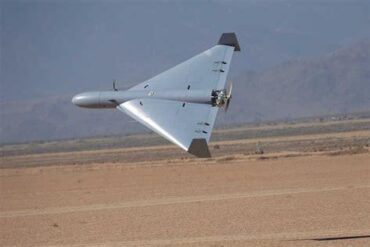
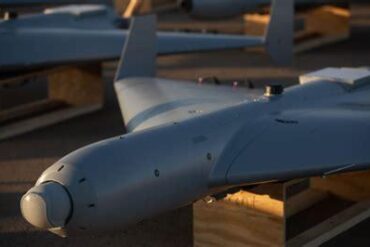
At the core of the squadron is LUCAS, produced by Arizona-based SpektreWorks and priced at approximately $35,000 per unit. The drone carries a payload in the 40-pound class and is optimized for extended-range, one-way strike missions against soft and semi-hardened targets.
Its design philosophy prioritizes affordability, autonomy, and launch flexibility. LUCAS can be deployed via ground-based catapults, rocket-assisted takeoff systems, or mobile vehicle platforms. The absence of runway dependence enables dispersed basing, complicating adversary targeting and reducing vulnerability to preemptive strikes.
The system is widely described as having lineage linked to the Iranian Shahed-136 family of one-way attack drones. That lineage is significant not as a replication effort but as a case study in cost-effective aerial attrition. The Shahed design—characterized by a delta-wing airframe, pusher propeller propulsion, and pre-programmed navigation—demonstrated in Ukraine how relatively modest payloads could generate strategic effect when deployed in large numbers.
LUCAS adopts that central logic: volume over exquisite survivability, distributed launch over centralized basing, and repetition over singular overmatch.
Performance Parameters and Capability Envelope
Open-source specifications associated with SpektreWorks’ FLM 136 threat-emulation platform, which mirrors Shahed-class characteristics, provide insight into likely performance metrics. The platform lists a range of approximately 444 nautical miles, endurance of up to six hours, cruise speeds near 74 knots, and dash speeds approaching 105 knots, with a maximum payload capacity around 40 pounds.
While official U.S. operational configurations may differ, the performance envelope indicates coverage extending deep into southern and western Iran from Gulf-based positions. Such range permits targeting of coastal missile batteries, logistics hubs, radar installations, and naval infrastructure without requiring forward airfields inside highly contested zones.
The payload class limits effectiveness against deeply hardened underground facilities. However, it is sufficient for degrading radar arrays, mobile launchers, ammunition storage sites, and production facilities when employed in coordinated waves.
Maritime Launch and Distributed Basing Concepts
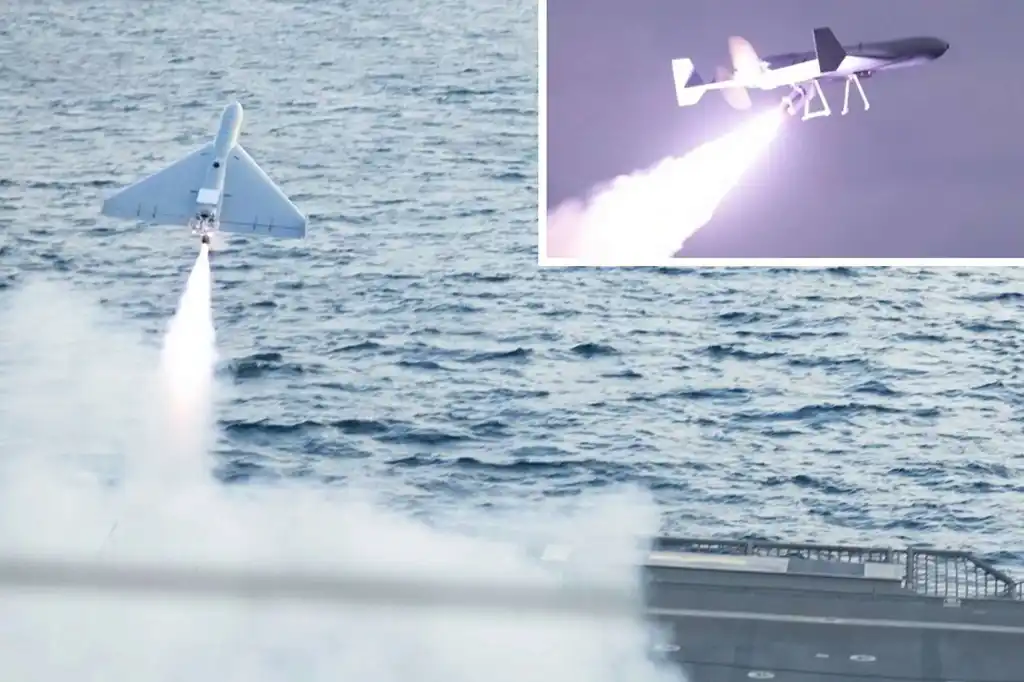
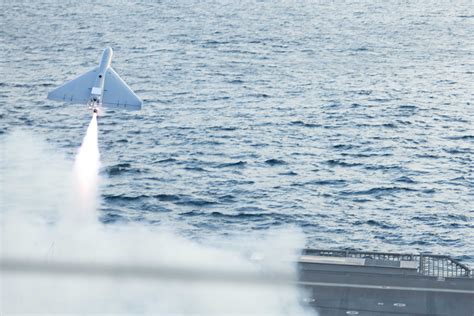
A key milestone occurred when LUCAS was successfully launched from the flight deck of an Independence-class littoral combat ship operating in the Arabian Gulf. The demonstration validated shipboard expeditionary launch concepts for one-way attack drones and expanded potential axes of approach in a regional conflict.
Ship-based deployment offers strategic elasticity. Strike capacity can be repositioned without constructing new land infrastructure, and drones can originate from unpredictable azimuths relative to Iranian defensive coverage. This complicates planning for fixed radar arcs and surface-to-air missile engagement envelopes.
In a theater defined by narrow maritime corridors such as the Strait of Hormuz, unpredictability of launch origin has outsized tactical value. Even modest-range systems gain leverage when adversaries must defend 360 degrees rather than a limited number of expected approach vectors.
Cost Imposition and Air Defense Saturation
The most significant aspect of LUCAS lies in economic asymmetry. Modern surface-to-air missile interceptors often cost hundreds of thousands—or millions—of dollars per shot. A drone priced near $35,000 alters the exchange ratio dramatically. When dozens are launched simultaneously, defenders face an unenviable decision: expend expensive interceptors or risk penetration.
This dynamic has been observed in Ukraine, where Shahed-class drones forced defenders into sustained inventory contests. Success in such contests is not measured by the survival of each drone but by cumulative disruption. Even partial penetration can degrade infrastructure, disrupt logistics, and compel constant defensive expenditure.
By integrating LUCAS into a formal squadron structure, the United States is signaling that attritable systems are no longer peripheral tools. They are becoming an operational layer designed to thin defenses ahead of higher-end strikes, absorb attrition, and shape the battlespace for manned aircraft and long-range precision weapons.
Integration into Joint Doctrine and Airspace Management
The operationalization of Task Force Scorpion Strike introduces doctrinal and logistical implications beyond the drone itself. Coordinating large numbers of autonomous strike platforms within crowded Middle Eastern airspace requires robust deconfliction procedures. Manned aircraft, surveillance assets, and cruise missiles must operate in concert with expendable systems without mutual interference.
Command-and-control integration is central to effectiveness. Multi-intelligence targeting, real-time ISR cueing, and digital mission planning enable distributed drone launches to converge on dispersed objectives. The unit’s creation suggests that the Pentagon has advanced beyond ad hoc experimentation toward structured sustainment planning, training pipelines, and industrial supply chains.
The emphasis on replenishment cycles reflects recognition that high-volume unmanned warfare depends as much on manufacturing throughput as on battlefield tactics.
Strategic Implications for a Potential Iran Contingency
In a potential Iran scenario, geography defines both opportunity and constraint. A 400-plus nautical mile range permits engagement of coastal and near-interior targets from Gulf waters and regional bases. Coordinated salvos could target air defense radars, mobile missile launchers, logistics depots, and naval concentrations supporting anti-ship and ballistic missile operations.
The drones are not substitutes for bunker-busting munitions against deeply buried facilities. Instead, they function as preparatory and complementary tools. By saturating defenses and revealing radar positions, they can create corridors for follow-on strikes by higher-value assets.
Simultaneous, geographically separated attacks generate operational friction. Air defense operators must track, prioritize, and engage multiple inbound threats arriving from diverse vectors. Even if many drones are intercepted, the cumulative strain can degrade readiness and expose vulnerabilities.
Institutional Shift Toward Mass as Capability
The activation of the first operational LUCAS squadron under Central Command reflects an institutional acknowledgment that mass itself constitutes combat power. In recent conflicts, the decisive variable has often been the ability to sustain volume over time rather than to field isolated technological marvels.
The Pentagon’s rapid fielding approach suggests a recalibration of acquisition philosophy. Attritable systems are being treated not as disposable experiments but as scalable instruments of strategy. Industrial capacity, rapid integration, and doctrinal adaptation are becoming as central as platform specifications.
If Task Force Scorpion Strike demonstrates sustained deployment, effective coordination, and reliable replenishment, it will validate a model of warfare shaped by distributed autonomy and cost-imposing dynamics. The operational debut of LUCAS therefore represents more than a new drone entering inventory. It marks a transition toward a layered strike ecosystem in which low-cost systems expand depth, multiply options, and reshape the calculus of regional deterrence in the Middle East.